[Reprint] How Dobbs Increased Support for Abortion Rights

Public opinion on abortion has shifted 4 years after Dobbs decision overturned Roe v. Wade

Several people stand in front of a federal building with columns.
People gather in front of the Supreme Court building following the Dobbs v. Jackson Women’s Health Organization ruling on June 24, 2022, in Washington, D.C.
Nathan Howard/Getty Images

Laurel Elder, Hartwick College; Mary-Kate Lizotte, Augusta University, and Steven Greene, North Carolina State University

It’s been four years since the Supreme Court’s decision in Dobbs v. Jackson Women’s Health Organization overturned Roe v. Wade, ending the federal constitutional right to abortion.

In the immediate aftermath of the decision, national attention centered on implementation of state bans and a rapidly shifting legal landscape.

But four years later, one of the most impactful developments has been less visible: a significant, sustained and politically consequential shift in public opinion. In the wake of Dobbs, the debate over abortion rights did not simply return to the states. It fundamentally altered how many Americans think about the issue and how they vote.

In our recently published book, “Not Going Back: Public Opinion on Abortion in Post-Dobbs America,” we examined how and why these changes have occurred, and what they mean for U.S. politics. We believe the shift could have real consequences for the November 2026 midterms.

Post-Roe stability

Drawing on several nationally representative surveys conducted before and after Dobbs, we examined how Americans’ abortion attitudes, political priorities and voting behavior have changed in response to the most significant shift in abortion policy in half a century.

For nearly 50 years after Roe, public opinion on abortion was remarkably stable. In 1975, Gallup found support for legal abortion in certain circumstances at 54% and support for a ban in all circumstances at 22%. In 2021 – the year before the Dobbs decision – these figures were virtually the same: 48% and 19%, respectively.

Despite heated political rhetoric, most Americans held nuanced views. They were neither fully anti-abortion nor fully pro-abortion. Instead, they supported legal abortion in some circumstances and not in others.

That underlying stability shaped both policy and politics for decades. Republicans were able to rally a committed core of supporters around opposition to Roe, while the underlying constitutional right to access abortion remained unchanged.

As states moved quickly after the Dobbs decision to enact abortion bans and strict gestational limits, public opinion moved in the opposite direction.

Today, more Americans identify as pro-choice than they did before Dobbs. And, as we document in our book, more Americans are now taking absolutist positions. They support legal access to abortion in all or most cases and oppose government regulation altogether.

How Dobbs shattered the equilibrium

One of the most striking changes in the post-Dobbs era concerns who cares most about abortion. For decades, abortion was a higher priority for Republicans and those identifying as pro-life.

That dynamic has now flipped. In both 2022 and 2024, Democrats and pro-choice Americans were more likely than Republicans to say abortion was a top political issue shaping their vote. In our book, we document how in both 2022 and 2024, pro-choice Democrats were especially motivated to vote and remained highly loyal to Democratic candidates.

At the same time, the considerable minority of Republicans who support legal abortion found themselves politically cross-pressured, meaning they experienced conflicting political influences.

Drawing on multiple nationally representative data sets, our book reveals that roughly one-third of Republicans hold views on abortion that do not align with the official pro-life position embraced by their party. They either identify as pro-choice or support legal abortion in at least some cases.

It was one thing to identify as a pro-choice Republican when Roe guaranteed a constitutional right to abortion. After Dobbs, however, Republican electoral victories could directly result in abortion bans and other restrictions. That makes partisan choices far more consequential.

We found that cross-pressured Republicans had lower turnout rates and were more willing to cross party lines, reflecting the growing tension between their abortion views and their party’s position. Given the size of this group, that presents a serious challenge for GOP candidates.

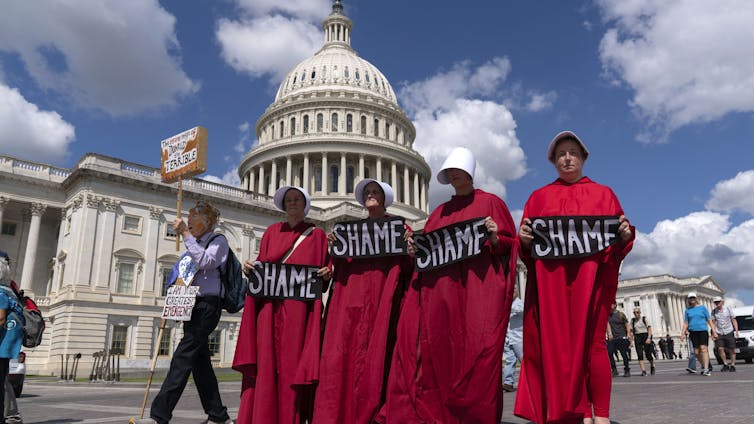
Several people gather in front of a federal building with columns.
A group of abortion-rights supporters gather in front of the Supreme Court on June 28, 2022, in Washington, D.C.
Nathan Howard/Getty Images
Reshaping US politics

At the same time, efforts to find a middle ground on abortion have proven difficult. Republican legislators in North Carolina and Virginia, for example, have sought to position policies such as 12- or 15-week bans as a reasonable compromise.

That might have worked in 1990. But public opinion has shifted in ways that make this strategy increasingly untenable. Our research shows that most Americans, including Republicans, do not see these “moderate” policies as meaningfully different from more restrictive bans.

One reason may be that, in the wake of Dobbs, abortion restrictions have become concrete rather than abstract. Extensive media coverage of women denied care during miscarriages, severe pregnancy complications and other medical emergencies has highlighted the consequences of gestational limits. This leads many Americans to judge these policies by their practical effects rather than the specific week at which abortion is prohibited.

In addition, our original survey data reveals that many Americans have only a limited understanding of how pregnancy is dated. That makes distinctions between six-, 12- and 15-week bans less meaningful than policymakers often assume.

Another major change is the emergence of a gender gap in abortion attitudes. For decades, men and women held remarkably similar views on abortion. That is no longer the case.

Since Dobbs, women have become significantly more supportive of abortion rights than men. For example, 56% of women say abortion should be legal in all or most circumstances, compared to 41% of men.

This new gender gap reflects both women’s experiences with pregnancy and abortion and the changed policy environment following Dobbs. After the ruling, the consequences of abortion restrictions became far more immediate and tangible.

Rather than accepting these new restrictions, many women reacted against them. As abortion policy moved sharply to the right in many states, women’s attitudes moved in the opposite direction. This has resulted in substantially greater support for abortion rights.

Our survey research further finds that a better understanding of human reproduction, including how pregnancies are dated, is associated with greater support for legal access to abortion.

Taken together, these changes have reshaped American politics in ways that advantage Democrats. Abortion rights played a key role in the 2022 midterms, contributing to stronger-than-expected Democratic performance nationwide.

And it continues to shape voter motivation and turnout patterns heading into future elections.

‘Not going back’

That said, abortion is not the only issue that matters in modern U.S. politics. In the 2026 midterm elections, the economy and partisanship – especially in an era dominated by President Donald Trump – will remain central to electoral outcomes.

Abortion alone is unlikely to determine any single race. But it has altered the political landscape in ways that will matter this November and beyond.

The phrase that gives our book its title – “Not Going Back” – captures this moment. The changes we document are not temporary reactions to a single Supreme Court decision.

The stability that defined abortion politics for half a century is gone. The new normal is a political landscape in which abortion rights have become both more widely supported and more politically consequential. They are motivating Democratic voters while creating new tensions within the Republican coalition.

Perhaps most importantly, Dobbs transformed abortion from a constitutional question into an electoral one. As abortion laws became substantially more restrictive, public opinion moved toward greater support for abortion access. The 2026 elections will offer another test of how the U.S. responds when public policy and public preferences move in opposite directions.

This story was produced in collaboration with Rewire News Group, an independent nonprofit media outlet that covers reproductive health.The Conversation

Laurel Elder, Professor of Political Science, Hartwick College; Mary-Kate Lizotte, Professor of Political Science, Augusta University, and Steven Greene, Professor of Political Science, North Carolina State University

This article is republished from The Conversation under a Creative Commons license. Read the original article.

Continue reading “[Reprint] How Dobbs Increased Support for Abortion Rights”

Reprint: Abortion Rights vs Authoritarianism

Banning abortion is a hallmark of authoritarian regimes

Abortion rights protesters march against Trump’s deployment of federal troops to Washington, D.C., on Sept. 2, 2025.
Jose Luis Magana/AP

Seda Saluk, University of Michigan

Pregnant women crossing borders to get an abortion. People who miscarry facing jail time or dying from infection. Doctors who won’t perform lifesaving procedures on a pregnant patient for fear of prosecution.

For years, this was the kind of thing that happened in Poland, Nicaragua or El Salvador. Now, it’s headline news in the United States.

As a scholar who studies the relationship between reproductive rights and political regimes, I see the U.S. mirroring a pattern that has happened in authoritarian regimes around the world. When a government erects barriers to comprehensive reproductive care, it doesn’t just cause more death and suffering for women and their families. Such policies are often a first step in the gradual decline of democracies.

Yet, the U.S. is different in a meaningful way. Here, abortion has historically been framed as a personal right to privacy. In many other countries I’ve studied, abortion is viewed more as a collective right that is inextricably tied to broader social and economic issues.

The American individualist perspective on abortion can make it harder for people in the U.S. to understand why banning abortion can serve as a back door for the erosion of civil liberties – and of democracy itself.

Autocrats target abortion first

Restricting reproductive rights is a hallmark of authoritarian regimes.

From Benito Mussolini’s Italy in 1926 and Josef Stalin’s Soviet Union in 1936 to Francisco Franco’s Spain in 1941 and Nicolae Ceaușescu’s Romania in 1966, the first move most 20th-century dictators made after seizing power was to criminalize abortion and contraception.

Initially, for some of those autocratic leaders, limiting access to abortion and contraception was a strategy to gain the approval of the nation’s religious leaders. The Catholic Church held great power in Italy and Spain, as did the Orthodox Church in Romania. At the time, these faiths opposed artificial birth control and still believe life begins at conception.

Restrictions on reproductive rights also aimed to increase birth rates following two world wars that had stamped out some of the population, particularly in the Soviet Union and Italy. Many political leaders saw procreation as a national duty. They designated women – white, heterosexual women, that is – specific roles, primarily as mothers, to produce babies as well as future soldiers and workers for their regimes.

In the past two decades, countries in Europe and the Americas have been following this recognizable pattern. Nicaragua and Poland have both banned abortion. Hungary, Turkey and Russia have all clamped down on access to it.

Restricting reproductive freedoms has helped Hungary’s Viktor Orbán, Russia’s Vladimir Putin and Turkey’s Recep Tayyip Erdoğan stoke lasting political divisions within society that help them consolidate their own power.

These leaders invoke a threat of moral and demographic decline, claiming that child-free women, queer people and immigrants pose a danger to national survival. In doing so, they portray themselves as defenders of their respective nations. It’s a way to regain and retain popular support even as their policies deepen poverty, erode civil liberties and increase corruption.

These politicians have also taken power away from a significant portion of the population by reinstating earlier, fascist-era restrictions on bodily autonomy. As feminist scholars have pointed out, strong reproductive rights are central to functioning democracies.

Restrictions on reproductive freedoms often necessitate other kinds of restrictions to enforce and maintain them. These might include free speech limits that prohibit providers from discussing people’s reproductive options. Criminalizing political dissent enables the arrest of people who protest restrictions on reproductive freedoms. Travel bans threaten prison time for individuals who help young people get abortion care out of state.

When these civil liberties weaken, it becomes harder to defend other rights. Without the right to speak, dissent or move freely, people cannot engage in conversations, organize or voice collective grievances.

Putting the US in a global context

In 2022, the U.S. joined the likes of Poland and Hungary when the Supreme Court overturned Roe v. Wade, ending 50 years of federal abortion protections.

President Donald Trump was not in power when this happened. Yet the Supreme Court’s conservative majority was shaped during his first term.

Since then, both the second Trump administration and many states have enacted their own regulations or bans on abortion. This has created a divided country where in some states abortion is as restricted as it is under some of the world’s most autocratic regimes.

Yet, there’s a key difference.

In the U.S., abortion is viewed by the law and the public as a matter of individual rights. The debate often boils down to whether a person should be allowed to terminate their pregnancy.

In many other contexts, reproductive rights are understood as a collective good that benefits all society – or, conversely, harms all society when revoked.

This perspective can be a powerful driver of change. It’s how, for example, women’s and feminist groups in places such as Argentina, Colombia and Mexico have successfully pressured their governments to decriminalize abortion in recent years.

Since 2018, the movement known as Latin America’s Green Wave, or “Marea Verde” for their green protest bandannas, has deliberately and strategically reframed abortion as a human right and used that assertion to expand reproductive rights.

The Latin American feminist activists have also documented how restricting abortion intensifies authoritarianism and worsens both individual and collective rights.

In a region where many citizens remember life under military dictatorship, highlighting the relationship between abortion and authoritarianism may be particularly galvanizing.

Limits of framing abortion as an individual right

Roe v. Wade in 1973 recognized abortion as a private medical decision between “the woman and her responsible physician” up to the point of fetal viability − roughly around 24 to 26 weeks − and that framing has stuck.

This was basically what the mainstream pro-choice movement advocated for at the time. White feminists saw abortion rights as a personal liberty. This framing has real limitations.

As Black and brown reproductive justice advocates have long pointed out, Roe never served women of color or poor people particularly well because of underlying unequal access to health care. Their work has, for decades, illustrated the strong connection between racial, economic and reproductive justice, yet abortion is still largely regarded as solely an individual issue.

When debates about reproductive freedoms are framed as fights over individual rights, it can engender a legal quagmire. Other entities with rights emerge – the fetus, for example, or a potential grandparent – and are pitted against the pregnant person.

Recently, for instance, a pregnant woman declared brain dead in Georgia was kept alive for several months until her fetus became viable, apparently to comply with the state’s strict anti-abortion law. As her mother told the press, her family had no say in the matter.

Narrowly focusing on abortion as an individual right can also obscure why banning it has societal impacts.

Research worldwide shows that restricting reproductive freedoms does not lead to fewer abortions. Abortion bans only make abortion dangerous as people turn to unregulated “back alley” procedures. Maternal and infant mortality rates rise, especially in marginalized communities.

Simply stated: More women and babies die when abortion and contraception laws become more restrictive.

Other kinds of suffering increase, too. Women and their families tend to become poorer when contraception and abortion are hard to get.

Abortion bans also lead to discriminatory practices in health care beyond reproductive health services, such as oncology, neurology and cardiology. Physicians who fear criminalization are forced to withhold or alter gold-standard treatments for pregnant patients, for example, or they may prescribe less effective drugs out of concern about legal consequences should patients later become pregnant.

Lifesaving procedures in the emergency room must await a negative pregnancy test.

As a result, abortion bans decrease the quality and effectiveness of medical care for many patients, not just those who are pregnant.

Defending reproductive freedoms for healthy democracies

These findings demonstrate why reproductive rights are really a collective good. When viewed this way, it illuminates why they are an essential element of democracy.

Already, the rollback of reproductive freedoms in the U.S. has been followed by efforts to limit other key areas of freedoms, including LGBTQ rights, freedom of speech and the right to travel.

Access to safe abortion for pregnant people, gender-affirming care for trans youth, and international travel for noncitizens are intertwined rights – not isolated issues.

When the government starts stripping away any of these rights, I believe it signals serious trouble for democracy.

This story is published in collaboration with Rewire News Group, a nonprofit newsroom dedicated to covering reproductive and sexual health.The Conversation

Seda Saluk, Assistant Professor of Women’s and Gender Studies, University of Michigan

This article is republished from The Conversation under a Creative Commons license. Read the original article.

Continue reading “Reprint: Abortion Rights vs Authoritarianism”

Roe, Russ, and The Baby on the Fire Escape

I have never been pregnant. I have no children. I do not regret either of these things, but both of them are things that could have happened.

They didn’t happen because I came of age not only when birth control pills were available, but also at the time when it became easier for single women to get prescriptions for the pill or other forms of contraception.

Since I’ve never been pregnant, I’ve never had an abortion. However, I know that I would not have hesitated to have an abortion if I had become pregnant at many times in my life.

I can imagine more possible regrets to having a child than I can to having an abortion. Is that shocking? Perhaps it is. But I have watched the struggle of single mothers.

On the basic biological level, the purpose of our existence may well be to reproduce, but despite the many failures of human beings, I do think our current purpose is far beyond the biological. People have dreams and goals, things they want to accomplish in their short period of time on Earth. I object to people sacrificing what matters to them for their children or their partner or their parents or even the good of the world.

I was in law school when Roe v. Wade made abortion legal in the United States. It was certainly something to celebrate.

I think the biggest mistake we made back then was to be queasy about supporting abortion. These days we say it is health care, but in the past all too often people said it should be “rare.”

We tiptoed around it. We should have claimed abortion a long time ago.

No one should be forced to carry a pregnancy to term. Period. (No one should be forced to end one, either, but that’s part of the point.)

That brings me to two books. Continue reading Roe, Russ, and The Baby on the Fire Escape

What Condition Our Condition Is In

“I just dropped in to see what condition my condition was in.”

— Mickey Newberry

What with fires, hurricanes, other storms, heat waves, the ongoing pandemic, and outrageous laws targeting reproductive and voting rights, our condition is headed for the ICU. And that’s just in the United States.

I could rant about any and all of these things, but there are plenty of other people doing that. Instead, I want to make a point that might be getting overlooked as people deal with our many crises:

The normal that we thought we had doesn’t exist anymore. We can’t go back to the way things were, because that isn’t going to solve any of our problems.

Or as I put it in a senryu this week:

We keep making plans
for the way we wish things were,
not the way they are.

Take the hurricanes. The new levees held in New Orleans, so some flooding was prevented. But there were communities that didn’t have levees yet that were inundated. Plus the investor-owned utility “solutions” for making sure the city would still have electricity didn’t work — power is still out all over the area.

And none of that work stopped the damage in New York City, where people died in basement apartments due to flooding.

We can’t just respond to hurricanes by building a few levees and pretending we’ve addressed a complex problem that is getting much worse due to climate change. We have to look at preserving what’s left of barrier islands, to set up power systems based on micro grids and batteries, to stop building in areas that will flood repeatedly, and generally to approach the whole problem in a multifaceted way.

Otherwise, we’re going to end up with a lot of climate refugees within our own country. Continue reading “What Condition Our Condition Is In”