
Is my brain wired to never see a ghost? A psychologist on three factors that make a paranormal experience more likely
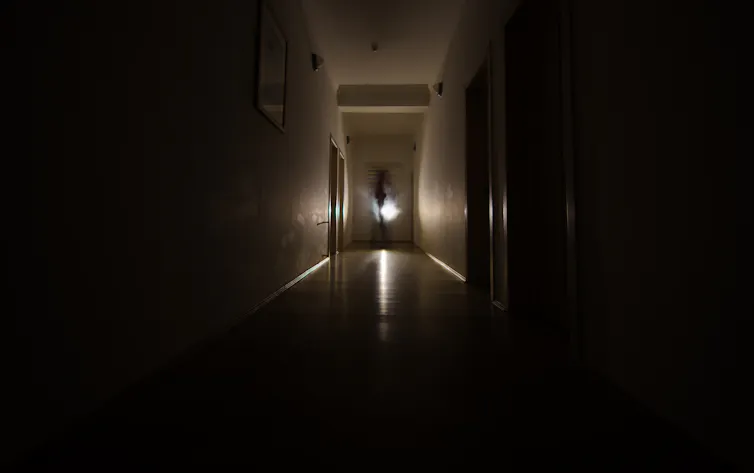
Zeferli/iStock via Getty Images Plus
Melissa Maffeo, Wake Forest University
Around 1 in 5 Americans say they’ve seen a ghost. I’m not one of them, and I probably never will be. I blame my brain.
Let me explain. No one can say definitively that ghosts exist, but many people believe they do. Roughly three-quarters of Americans believe in some form of paranormal activity – not only ghosts, but psychic abilities, precognitive dreams, mediums and anything else that conventional explanations can’t account for.
As a psychology professor, I often think about the subjectivity people use when interpreting experiences. I wonder, then, if there are perfectly ordinary explanations for seemingly extraordinary experiences. Maybe a perfect storm of everyday factors can converge and trigger the sensation of a paranormal experience.
In my new book, “Science of the Supernatural,” I explore the idea that the human brain might be creating an experience of the supernatural by misinterpreting the external world. Here are three factors that might trick your brain into creating a fake ghost:
Haunted factor #1: Environmental stimuli
Anyone who’s ever watched a ghost hunting show has seen the paranormal investigator mutter something like “The EMF’s going crazy” when there’s purported supernatural activity afoot. Electromagnetic fields, or EMFs, are invisible areas of energy created by electrically charged particles.
At present, there is no direct evidence that humans can consciously sense EMF the same way we can touch, see or hear things in our environment. But with a handheld device purchased at a local hardware store, you can measure them anywhere. An EMF detector picks up electrical or magnetic activity, whether human-made or otherworldly. But do EMF fluctuations relate to paranormal activity?
The scientific method might help answer this question. In one study, conducted in the South Street vaults underneath Edinburgh, Scotland, EMFs fluctuated more in areas with a history of ghostly happenings. Another study found greater variability of EMFs in the more “haunted” areas of Hampton Court Palace in England.
People might unknowingly be detecting changes in environmental stimuli, like electromagnetic fields. The question then becomes: Did the ghost cause the EMF, or did the EMF cause the ghost?
To date, only one research group has attempted to experimentally manipulate environmental factors, including complex EMF, and measure subsequent perceptions of the paranormal.
Participants did report many peculiarities, ranging from feeling dizzy to feeling like they were detached from their bodies and even sensing a presence – but these experiences didn’t correspond to how the researchers varied environmental conditions, like EMF intensity. Interestingly, the people who described anomalous experiences were the same people who believed more strongly in the paranormal.
Do environmental factors like EMF lead to perceptions of the paranormal? On the one hand, there is a correlation between reportedly haunted places and EMF variability. And there are some indications that humans can detect magnetism. On the other hand, experimental manipulation of EMF did not relate to weird perceptions in a lab setting.
I think we need to look into other haunted factors.
Haunted factor #2: Neurological mix-ups
By applying a small electrical current to the side of the head, usually to evaluate a patient for a clinical procedure, researchers have observed some strange effects. One case study described a patient who experienced an “illusory shadow figure” that was mimicking, and even interfering, with their movements. Other people have reported out-of-body experiences.

John A Beal/Wikimedia Commons, CC BY

Experimental evidence suggests that this brain area, the temporoparietal junction, is probably crucial for the feeling of embodiment – that you inhabit your own body. Disrupting this brain area seems to trigger a sensation of disembodiment.
Neuroscientists aren’t completely sure how the sense of embodiment is built in the brain. The brain probably integrates bodily senses, like balance and position, with other internal processes, like a sense of self and agency. When this integration is altered, a person will experience very strange sensations.
Sometimes, misinterpretation of sensations from the body can happen during sleep, when your brain shuts out the external world. During rapid eye movement, or REM, sleep, when most vivid dreams occur, the brain sends messages that prevent movement of skeletal muscles. This inhibition causes complete paralysis during REM sleep. It is a neurological safeguard; without it, you would be likely to act out your dreams.

Ralf Nau/The Image Bank via Getty Images
Some people, though, wake up during REM sleep and find that they cannot move. They may simultaneously experience rich hallucinations – the remnants of their dream. This experience passes quickly. But in that moment of sleep paralysis, the neural signals that control skeletal muscle movement are inhibited, resulting in a mismatch of feedback from the body to the brain. Most people respond to the missing sensory information with fear, which makes them more likely to experience the sights and sounds from their dreams as reality.
Haunted factor #3: Personality traits
Living through a paranormal encounter requires that a person label their experience as such. If a believer were exposed to fluctuating EMFs, for example, they might be quick to categorize the strange sensation as paranormal. A skeptic might note they felt weird or off, but probably not point to a paranormal explanation.
There’s a growing body of research that suggests people with certain personality traits are more likely to believe in the paranormal.
For instance, some people are hyperaware of unconscious perceptions and ideas, which then permeate their consciousness. Often, these traits are associated with magical thinking, distorted or unusual thoughts, disorganized behavior and, sometimes, trouble forming close relationships.
Psychologists refer to this set of traits as schizotypy. They’re related to schizophrenia, although being high in schizotypy doesn’t mean you will be diagnosed with the disorder of schizophrenia. People with high levels of schizotypy are more likely to believe in the paranormal. They’re also more likely to experience disembodiment and spontaneous sensory perceptions and have trouble discriminating between self and others.
All of these traits relate to the function of the temporoparietal junction – the brain area that helps you know you’re located within your own body.

urbazon/E+ via Getty Images
When haunted factors add up to a ghost
While I cannot say for sure whether ghosts exist, I can propose a plausible explanation for why some people might be more prone to apparent paranormal experiences than others.
Consider a person who believes in paranormal phenomena who experiences a natural change in electromagnetic fields or an episode of sleep paralysis. Those experiences induce unusual sensations that this person cannot explain. Searching for meaning in ambiguity, this person distorts their distinction between internally and externally generated sensations. They settle on the only explanation that makes sense to them – that this strange feeling they experienced was a ghost.
My guess is that belief in the paranormal is the glue that holds the haunted factors together to create the (mis)perception of a ghost.
One experiment asked participants to walk through a disused theater in Decatur, Illinois. Some were told that the theater was haunted, and some were not. Several participants noted weird sensations that they attributed to paranormal activity – but only those who believed that the theater was haunted reported these sensations.
Belief alone might not create a ghost, but belief combined with at least one haunted factor – environmental stimuli, neurological hiccups or psychological conditions – might be enough to make a ghost real.
This becomes a chicken-or-the-egg riddle – or in this case, the ghost or the EMF. Someone who is more likely to be sensitive to environmental factors or who experiences sleep paralysis might create belief from their experiences. When someone cannot explain these experiences with any “natural” explanation, a supernatural explanation might be the only one that makes sense.
I’ve never noticed EMF. I’ve never experienced sleep paralysis. I’m pretty sure I don’t have personality traits like schizotypy. I don’t believe in the paranormal. And I don’t think I’ll ever see a ghost.
Melissa Maffeo, Teaching Professor of Psychology, Wake Forest University
This article is republished from The Conversation under a Creative Commons license. Read the original article.
Continue reading “Reprint: Is My Brain Wired To Never See a Ghost?”…