I keep forgetting to introduce my books to you! Let me remedy this.
This week, someone (a very generous someone) posted about The Year of the Fruit Cake. They said lovely things about it and about my writing. While I ought to simply share the post, or at least repeat the words, this week I am terribly, terribly Australian. Just saying that someone said nice things is blowing my own trumpet in Oz. Tall poppy syndrome is one of our big cultural babies and so I cannot repeat things without feeling as if I need to be cut down. This is, of course, a really bad way of letting you know about my book.
The Year of the Fruit Cake won me a nice trophy and mentions in many places. I will never understand this, because it’s not that easy to read. It’s at the literary end of SF. I wanted to write about a difficult set of subjects (including perimenopause) and I wanted to do it with science fiction and I used so many of the things women experience at that time of life in Australia to shape the novel. Not just as the subjects dealt with in the novel, but in the storytelling itself.
When I went through perimenopause my body was unreliable, so the narrators are unreliable. Everything is personal.
My memory had blips, so my main character has major memory issues.
So many friendships had to be renegotiated, especially those with men and with younger women, who mostly had not idea of the magnitude of the changes and that hot flushes were not just an excuse to wield a pretty fan. Our society lacks story that explains these changes, so I turned one of my perimenoapusal women into an alien.
Eventually I discovered that one of the issues I and my cohort faced was gentle shifts along gender spectra. OK, not so gentle. Now I’m past it, my body doesn’t want to declare how very female it is one minute and that it’s increasing in testosterone the next. I have settled into being female, but not into being female in the same way I once was. The aliens in the novel with their twelve genders are closer to my physical reality than I like to admit. I gave them at least one shift that was delightful. I wish I could do the same for human women. Perimenopause was a nightmare for me, so I made those physical changes a nightmare for my alien-in-human-body.
Also, I wanted to write about othering. Australia is not good to older women, so I wrote about the process of becoming an older woman and having to find new ways of living in society. I had no idea the same thing (in a more extreme version) would apply to me right now as an Australian Jew. I had no idea that this year I would live in a year of Fruit Cake, with an uncertain future and a society I thought was stable turned chancy.
I entirely thought chocolate would remain important and I was totally correct about that, thankfully.
The novel is a slow read and I will never write one as difficult again… but I got some things far too right. I’m glad that one of them was chocolate.
I’ve been on a road trip helping my partner deal with some family matters, which included carting home boxes of things that families tend to treasure. While I’m almost finished reading a book that I think will resonate with other writers in particular, I am way too wiped out to summon the intellectual process necessary to do it justice.
So I’m sharing some of the senryu I call “Zentao” that I write every morning. Since I’ve been driving through Oregon, I’ll start with this one:
Oh, a volcano!
Ahead. Now behind. Three more!
Must be Oregon.
We drove home down the eastern side of the Cascades, so I think at one point we actually saw five at once.
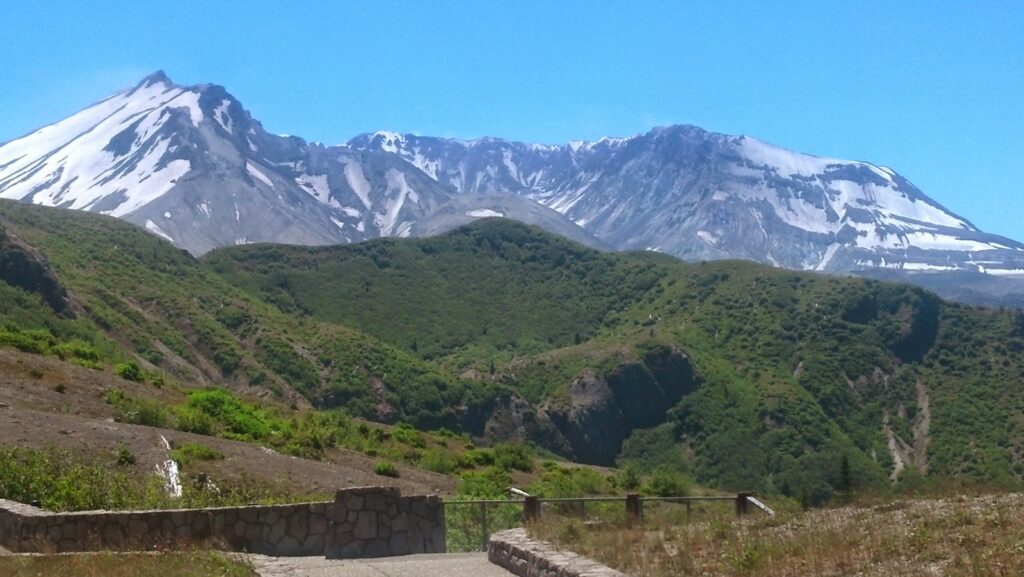
A senryu about volcanos needs a picture of one. I didn’t take many pictures this trip, but here’s a picture of Mt. St. Helen’s I took some years back after we stumbled onto a ranger lecture on the history of its 1980 eruption. (It’s a Washington volcano, but you can see it from Oregon as well.)
My original reason to do a daily senryu was to capture how I was feeling each morning. For obvious reasons, a lot of them have turned out to be political:
Daily things to check:
weather, fires, air quality,
threats to democracy.
Wars. Stupid tech. Grift.
A pretense that it’s all normal.
Not civilized yet.
People came together
to watch them scrape off his name.
Build on that action.
Or about broligarchs:
They think they’re so smart
since they’ve made so much money.
Not civilized yet.
Don’t take any advice
from broligarchs who think that we
are just NPCs.
Those developing tech
should be required to study
Donna Haraway’s work.
Some days I strive for philosophical insight:
Simple feels good,
but it leaves out way too much.
Learn to think in depth.
Play well with others,
but stand up for what’s right, and
ask the hard questions.
“The world not yet lost.”
Maybe nothing’s lost yet,
just being found anew.
And since I’ve just been on a road trip across a couple of states, which reminds me of both how beautiful our country is and how much destruction of both people and places we’ve wrought, a couple on those contradictions:
Traveling the U.S.
So many trucks and chain stores.
So much great beauty.
Ocean, hills (still green), palm trees.
Freeways, cars, so many buildings.
Complex paradise.
And, of course, cats. After giving ourselves a year to mourn the loss of our last elderly cat, we got two young cats. It might have been the best decision of the last several years.
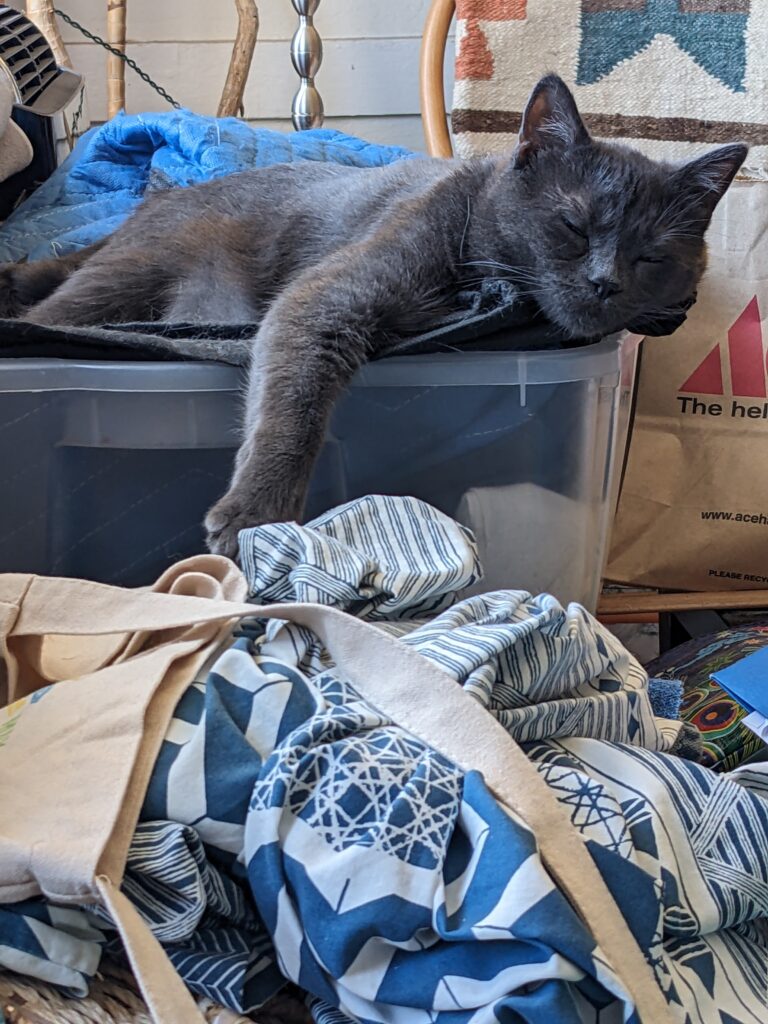
Here’s Shadow:
Cats are wonderful.
Cats create abundant chaos.
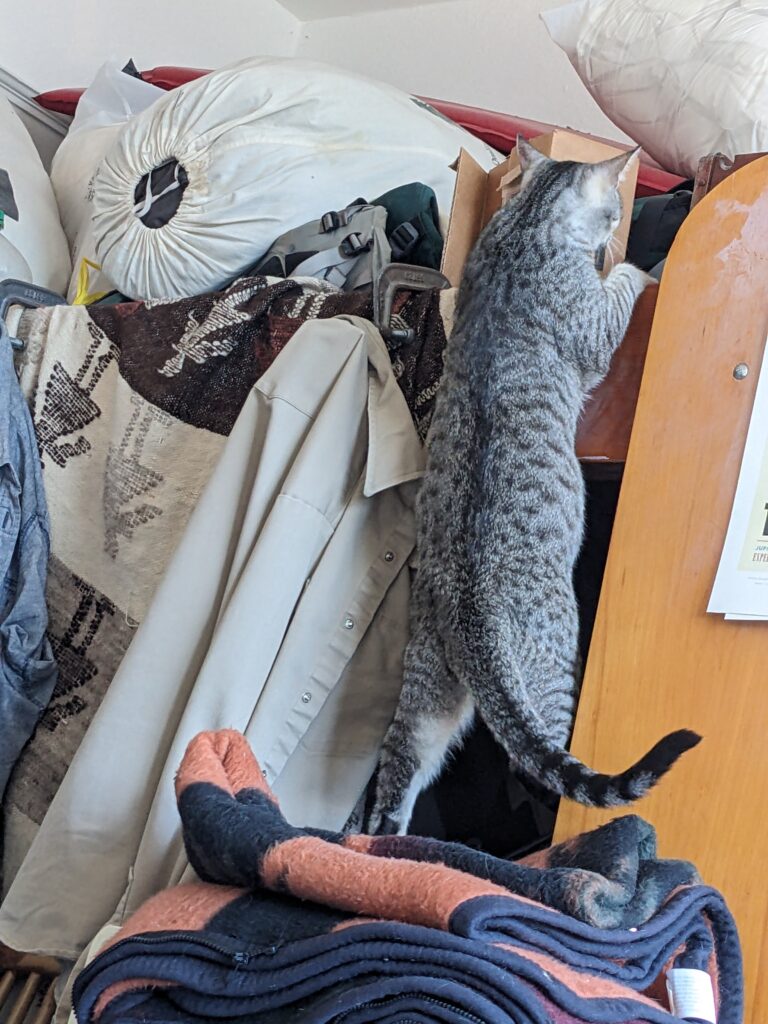
Not contradictory.
And here’s her brother, Piper:
And finally, a bit of self-evaluation:
I contradict myself.
I went to church with the space program.
What would you expect?
I am late! I am late and want to talk about Jewish matters.
The Australian Royal Commission into Antisemitism and Social Cohesion has just released the total number of submissions and it’s a lot higher than anyone expected. I predicted 10,000 submissions and everyone around me said that 5,000 would be a lot and would reflect what was happening in our country a lot more. Even 10,000 was considered an overprediction because of the way most people saw antisemitism in Australia, in other words. So what does 20,000 mean? That things matter. That people have things to say.
What the submissions give us is something amazing, especially given that this is a census year and that we can fit those submissions into a snapshot of Australia in 2026 (the last census was in 2021, and you can see what it shows about jewish Australia here: The-Jewish-Population-of-Australia-Report_2021-Census-1.pdf . There are issues with the way data was collected and how unsafe the collection made Jews, and that Judaism was not listed as a religious or cultural option ie people had to write it in manually, but it still gives some indication of who we are in Jewish Australia. We have a surprising number of old people, for instance, and an unsurprisingly high average level of education.
Put these 20,000 submissions into analysis the way that Mass Obersvation Project has done for the UK, and it becomes an enormous data base for research into one aspect of Australian life: how people see Jewish Australia and how Jewish Australia sees itself. What we are. Who we are. How we deal with hate. This will lead to insights into how Australia sees other cultural and religious groups in the country. It has the capacity to change Australia’s self-knowledge.
What’s really interesting is how silent the far left is about the number of submissions. We don’t yet know if those submissions reflect their views as leading or typical. I strongly suspect that their views are bigoted and hateful, but I’m willing to wait and see how the data presents itself. And I want to know what Australia does with all this information about how we think and feel.
Given that the trigger was the Bondi murders and there is a very strong likelihood that those murders were caused by links to certain terrorist groups, we can’t exclude the outside world. But we can take a close look at ourselves and find out who we are and what we want to be.
Australia is in a strange place politically. Everything’s changing. I suspect those 20,000 submissions are part of that change. Who we are and how safe we are and the paths we take are all up for grabs in this very interesting year.
Let me explain. No one can say definitively that ghosts exist, but many people believe they do. Roughly three-quarters of Americans believe in some form of paranormal activity – not only ghosts, but psychic abilities, precognitive dreams, mediums and anything else that conventional explanations can’t account for.
As a psychology professor, I often think about the subjectivity people use when interpreting experiences. I wonder, then, if there are perfectly ordinary explanations for seemingly extraordinary experiences. Maybe a perfect storm of everyday factors can converge and trigger the sensation of a paranormal experience.
In my new book, “Science of the Supernatural,” I explore the idea that the human brain might be creating an experience of the supernatural by misinterpreting the external world. Here are three factors that might trick your brain into creating a fake ghost:
Haunted factor #1: Environmental stimuli
Anyone who’s ever watched a ghost hunting show has seen the paranormal investigator mutter something like “The EMF’s going crazy” when there’s purported supernatural activity afoot. Electromagnetic fields, or EMFs, are invisible areas of energy created by electrically charged particles.
At present, there is no direct evidence that humans can consciously sense EMF the same way we can touch, see or hear things in our environment. But with a handheld device purchased at a local hardware store, you can measure them anywhere. An EMF detector picks up electrical or magnetic activity, whether human-made or otherworldly. But do EMF fluctuations relate to paranormal activity?
The scientific method might help answer this question. In one study, conducted in the South Street vaults underneath Edinburgh, Scotland, EMFs fluctuated more in areas with a history of ghostly happenings. Another study found greater variability of EMFs in the more “haunted” areas of Hampton Court Palace in England.
People might unknowingly be detecting changes in environmental stimuli, like electromagnetic fields. The question then becomes: Did the ghost cause the EMF, or did the EMF cause the ghost?
Participants did report many peculiarities, ranging from feeling dizzy to feeling like they were detached from their bodies and even sensing a presence – but these experiences didn’t correspond to how the researchers varied environmental conditions, like EMF intensity. Interestingly, the people who described anomalous experiences were the same people who believed more strongly in the paranormal.
Do environmental factors like EMF lead to perceptions of the paranormal? On the one hand, there is a correlation between reportedly haunted places and EMF variability. And there are some indications that humans can detect magnetism. On the other hand, experimental manipulation of EMF did not relate to weird perceptions in a lab setting.
I think we need to look into other haunted factors.
Haunted factor #2: Neurological mix-ups
By applying a small electrical current to the side of the head, usually to evaluate a patient for a clinical procedure, researchers have observed some strange effects. One case study described a patient who experienced an “illusory shadow figure” that was mimicking, and even interfering, with their movements. Other people have reported out-of-body experiences.
The temporoparietal junction is on each side of the brain; this region helps you feel that you are within your own body. John A Beal/Wikimedia Commons, CC BY
Experimental evidence suggests that this brain area, the temporoparietal junction, is probably crucial for the feeling of embodiment – that you inhabit your own body. Disrupting this brain area seems to trigger a sensation of disembodiment.
Neuroscientists aren’t completely sure how the sense of embodiment is built in the brain. The brain probably integrates bodily senses, like balance and position, with other internal processes, like a sense of self and agency. When this integration is altered, a person will experience very strange sensations.
Sometimes, misinterpretation of sensations from the body can happen during sleep, when your brain shuts out the external world. During rapid eye movement, or REM, sleep, when most vivid dreams occur, the brain sends messages that prevent movement of skeletal muscles. This inhibition causes complete paralysis during REM sleep. It is a neurological safeguard; without it, you would be likely to act out your dreams.
Some people, though, wake up during REM sleep and find that they cannot move. They may simultaneously experience rich hallucinations – the remnants of their dream. This experience passes quickly. But in that moment of sleep paralysis, the neural signals that control skeletal muscle movement are inhibited, resulting in a mismatch of feedback from the body to the brain. Most people respond to the missing sensory information with fear, which makes them more likely to experience the sights and sounds from their dreams as reality.
Haunted factor #3: Personality traits
Living through a paranormal encounter requires that a person label their experience as such. If a believer were exposed to fluctuating EMFs, for example, they might be quick to categorize the strange sensation as paranormal. A skeptic might note they felt weird or off, but probably not point to a paranormal explanation.
There’s a growing body of research that suggests people with certain personality traits are more likely to believe in the paranormal.
For instance, some people are hyperaware of unconscious perceptions and ideas, which then permeate their consciousness. Often, these traits are associated with magical thinking, distorted or unusual thoughts, disorganized behavior and, sometimes, trouble forming close relationships.
Psychologists refer to this set of traits as schizotypy. They’re related to schizophrenia, although being high in schizotypy doesn’t mean you will be diagnosed with the disorder of schizophrenia. People with high levels of schizotypy are more likely to believe in the paranormal. They’re also more likely to experience disembodiment and spontaneous sensory perceptions and have trouble discriminating between self and others.
All of these traits relate to the function of the temporoparietal junction – the brain area that helps you know you’re located within your own body.
While I cannot say for sure whether ghosts exist, I can propose a plausible explanation for why some people might be more prone to apparent paranormal experiences than others.
Consider a person who believes in paranormal phenomena who experiences a natural change in electromagnetic fields or an episode of sleep paralysis. Those experiences induce unusual sensations that this person cannot explain. Searching for meaning in ambiguity, this person distorts their distinction between internally and externally generated sensations. They settle on the only explanation that makes sense to them – that this strange feeling they experienced was a ghost.
My guess is that belief in the paranormal is the glue that holds the haunted factors together to create the (mis)perception of a ghost.
One experiment asked participants to walk through a disused theater in Decatur, Illinois. Some were told that the theater was haunted, and some were not. Several participants noted weird sensations that they attributed to paranormal activity – but only those who believed that the theater was haunted reported these sensations.
Belief alone might not create a ghost, but belief combined with at least one haunted factor – environmental stimuli, neurological hiccups or psychological conditions – might be enough to make a ghost real.
This becomes a chicken-or-the-egg riddle – or in this case, the ghost or the EMF. Someone who is more likely to be sensitive to environmental factors or who experiences sleep paralysis might create belief from their experiences. When someone cannot explain these experiences with any “natural” explanation, a supernatural explanation might be the only one that makes sense.
I’ve never noticed EMF. I’ve never experienced sleep paralysis. I’m pretty sure I don’t have personality traits like schizotypy. I don’t believe in the paranormal. And I don’t think I’ll ever see a ghost.
It’s really hard to decide on what I should post about today. I have diversions.
The first is that I’m in the final throes of revising my thesis to meet the examiners’ comments. I thought it would be a much bigger task than it was. I’ve sent my revisions and comments to my supervisors and then I send the final in and, hopefully, by the end of the week it will be done and dusted save for graduation. I submitted the thesis over a year ago – even for Australia this is slow. I don’t know why it was so slow, but career-wise it doesn’t matter to me (this is not my first PhD and I’m in my sixties) so it’s better the admin slowness doesn’t apply to young students than it does apply to me. Also, between submission and graduation, my first PhD took 3 years. It was not my fault, but it cost me my first career. By me a drink and I’ll tell you the story.
It’s rather nice that lateness doesn’t always carry such costs.
The second is that the submission period for the Royal Commission into Antisemitism and Social Cohesion closed yesterday. Many of us are a bit overwhelmed. On 4 June (10 days before submissions closed) there were over 14,000 submissions, which was a record for Royal Commissions. No-one knows the final number yet.
The staff serving the Royal Commissioner is obligated to read every single one of them. And those of us keeping track are wondering what this means. That Jewish Australia matters? That haters have put in many thoughts? We know that haters have oput in some thoughts. We also know that Palestinian Australia put in a 259 page submission. I’ve seen the outline and need to read it because I cannot make sense of it. Or rather, I can make sense of it in and of itself, but not how it helps Australia handle antisemitism. It seems to be arguing that we’re making things up. This is why I have to check. I’ve been told by quite a few people this last week that antisemitism is fictional, but there are so many incidents right now that this is not a claim so much as a misdirection. I need to know why APAN feels the need to spend 259 pages backing that misdirection if that is, indeed what they’re doing.
What I’m supposed to be doing is writing fiction. I lay in bed last night working out things that needed working out, but today have only written a couple of hundred words. We’re in a weather trap and my bones hurt and I keep procrastinating and worrying about Jewish Australia and other groups being confined by wagon trains circling hate.
Let me leave you and go back to my big writing decision for this week: Lincoln or London in the twelfth century for a section of the novel. I want both, but I don’t think both will fit. I also want Cologne and Speyer. Both! Actually, writing this out has made me think: people travelled in the Middle Ages. Why don’t I have someone travelling to Cologne from Speyer? That would give me the words for Lincoln and London. I just need to check concepts and characters and plot and… all the things… except the history. I have most of the research for that at my fingertips because of the non-fiction I was working on recently and that still has no home. All this research pays.
I have emerged (finally) from government documents.
Australia is an interesting place and how Australia handles being in interesting places is through calling for submissions from the public. I’ve written two on matters of antisemitism and hate (one of which being 22 pages long and still too short, and containing far too many typos because I had to do it in a time of physical pain) and one on cultural policy. My cultural policy one was for the government consideration of what Australia’s cultural policy should look like in the future. Last time I wrote on this, I pointed out how impossible our policies are towards writers. They’re still not generous. There is an opera company that gets as much money from the Federal government in a year as all writers and writing organisations and festivals. Or there used to be. I haven’t looked it up this year because, while it’s still a major concern, a bigger one is the direction our Arts are heading. Erasure, hate, purity tests… federal spending that supports hate is unwise. I wrote 1300 words explaining this (a short submission!) and using examples from close to home.
What have I emerged to? I’m so glad you asked.
I’m at Balticon online. And then at Swancon in person. When I return from both… I will have news.
I’m sorry I missed last week. Jewish Australia is a bit… different. There’s a Royal Commission into antisemitism and social cohesion. I’ve submitted 22 pages to it and keep thinking I missed critical things. Last week was the first of the public hearings, and by Monday morning 9,400 submissions had been made. There are so very many that the open period for submissions was extended by two weeks. This is a vast number, for the whole population of Australia and all its territories is significantly less than the population of California. We fit somewhere between the population of Florida and Texas. If you printed the submissions and handed them out to random Jewish Australians (using the Monday morning numbers, weeks before submissions close), one in eleven would receive an interesting document to read.
Antisemitism is pretty bad here, and whatever the Royal Commission decides will determine our future in many ways. In equally many ways, our future rests on how the rest of Australia feels on hearing just how difficult life has been for Australian Jews.
Even checking up on what is said in the first lot of public hearings was exhausting. So many reports had me nodding alongside, think, “Yep, that’s happened, and oh yes, that too.” I am still annoyed by the people who accuse Jews of complaining too much or of clutching pearls or of being perpetual victims, or of being guilty by dint of being Jewish. In a perfect world, they would stop and listen. They would also not tell me, when I quietly let them know some of the worst incidents, “But what about Gaza?” So many are saying, “If every Australian Jew disassociated themselves from Israel, then there would be no antisemitism.” This is oddly funny, because other times and other places when there have been hate we’ve been told the same thing. Convert to Catholicism was the argument in 15th century Spain. And then came the definitions of impure blood and Judaicising. Some of those who had done the denial as asked were burned alive as Christians because their denials weren’t believed.
Canberra has almost winter weather, and we’ve not even reached the traditional time to change to autumnal linen and to turn on the heaters. That traditional day is a public holiday, which this year falls on a long weekend … and happens to be my birthday. I will turn 65. I have dinner with a friend the day before my birthday, and lunch with another friend the long weekend Monday, but that’s it. Most Canberrans will, I suspect, be down the coast, trying desperately to avoid below zero temperatures. The coast has a very mild winter and, by Australian standards, Canberra does not. (We don’t get down to zero Fahrenheit, just to reassure you, but we’ve already been below zero Celsius in April.)
Let me ask you all a question, then.
Since it’s a mug’s game to work on one’s 65th, and since the Dawn Service* (which I would’ve liked to go to) requires me leaving my flat before 3 am when the temperature will be below zero, I’ve decided to stay home and watch a sequence of streamed films on Saturday. Which films should I watch? The Lord of the Rings comes to mind, but… I’m not certain.
I was going to watch When Things were Rotten and Robin Hood, Men in Tights, but they require note-taking, since I’m writing an article about them in a few weeks.
Suggest something. All suggestions will be taken seriously.
* The public holiday is ANZAC Day, which is our equivalent of Memorial Day and is the sole day of the year when it is legal to play Two-Up. Two-Up is one of the most boring forms of gambling possible, but it is very, very Australian.
My sweetheart and I have made two very good decisions in the past few months.
The first was getting cats. I wrote about that here.
The second was signing up for a Road Scholar trip to the Channel Islands, which are just off the coast of Southern California.
I admit I was a bit skeptical of doing a trip as part of a group. I’ve always been a go-it-alone sort. But it turned out to be the best way to see this particular area.
For one thing, we had lectures on the history, geology, and biology of the islands, so we learned a lot – so much, in fact, that on our trip to Santa Cruz Island, many of us found ourselves in deep conversation with a seven-year-old, obsessed as only a child that age can be, about the island fox and other creatures on the island. (We had walked past him on our way back from a hike and he asked questions of everybody.)
For another, Road Scholar attracts the sort of older person who is energetic and interested in things. Our group ranged in age from about mid-60s to mid-80s, and everyone participated fully and clearly did other things like this either as part of this organization or on their own.
And finally, there is a great deal of pleasure in participating in something where all the planning has been done by someone else. I know some people really like to plan trips, but I am not one of them. I like to pick locations, but not hotels, boat charters, and the like.
Road Scholar is very good at the planning part.
We stayed at a hotel in Ventura, California, and went out to the islands themselves twice on boats that regularly take tourists out to them. While there are campgrounds on the islands we visited – Anacapa and Santa Cruz – they are very basic, and for Anacapa you must bring your own water as well as food, as there are no water sources on that island.
I am still willing to camp, but I have to say there is a lot to be said for having a shower and a soft bed after a day of hiking.
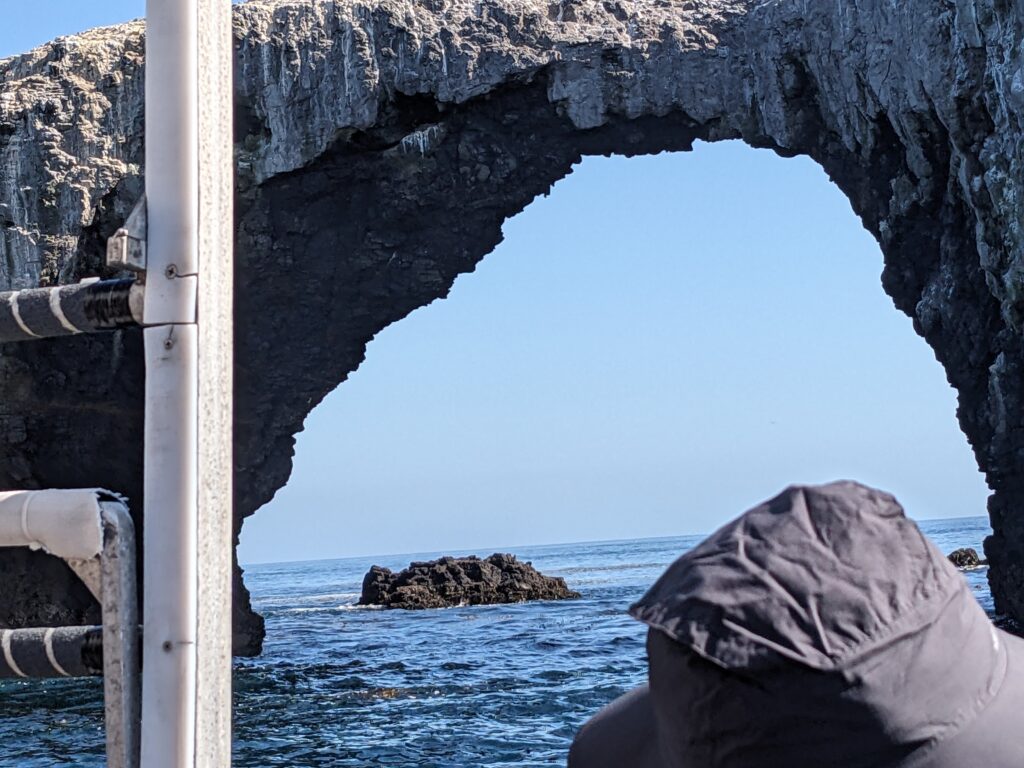
I’m prone to sea-sickness, but I used wrist-bands that press on acupressure points and did okay even on our second trip, when the ocean was pretty rocky. And in fact, coming back on the first trip in particular I found myself in a state of blissful calm, just staring at the ocean and not thinking about anything in particular. (The photo above was taken from the boat on that trip.)
That was on Tuesday, April 7, when much of the world was focused on whether the person currently occupying the U.S. White House was going to commit major war crimes in Iran. I knew that was going on and was, of course, quite worried, but it wasn’t on my mind at all as I watched the waves and kept an eye out for wildlife.
Eight years ago I spent ten days in Amiens. I had great aims and ambitions. I wanted to explore how World War I changed the people and the landscape. I did a lot of research in Australia early on, which was just as well, because my body was beginning to ache at the seams and I could only do half the research. I did that half, and I also did the related research for a novel. That novel is timely now, for all the wrong reasons.
It’s about the Green Children. There are medieval tales of the Green Children of Woolwich, and they are oddly consistent. I wanted to add a pocket universe to the story and turn it into fantasy with a little bit of scientific underlay. The best place to do this wasn’t in England, where the story came from. It was in the Zone Rouge in France.
I wanted to understand how Jewish superheroes would create themselves if they weren’t strangers in a world full of hate, but refugees in a tiny universe where they were the majority. I wanted to see the stupidity that comes with confidence and being the centre of things, and to put a non-Jewish superhero at the heart of the story, showing how she saw the world around her and how she dealt with some really bad cards. In other words, I wanted to reverse some of our assumptions.
Part of this was asking, “What would our world be like with magic?” I’m an historian and for me there is not one simple type of magic, but complex systems that interact and that change over time. In my novel I used some historical systems and some less historical, and added a couple that only belong in that other world. If there are many systems and if they’re not simplified for ease of tale-telling then they leave more chaos in their wake when they’re abused. Also, how would magic be regulated? I used the UK for the regulation of magic, because I could bring important and old families into the story. Also because it means I could play in the wonderful sandpit of alternate history in London. Imagine a history of England where Jews were brought back in the 15th century? I wrote a short story to explain a part of this, and it was a finalist in the Sidewise Awards, which means… it’s Alternate History, even though it has magic. I rather like this. The story is in Other Covenants.
I lived in London and I lived in Paris for a little, many years ago, and, historically, London is a lot more fun for the type of story I wanted to tell. Pop-up history, small churches with pits to hell… I needed to know that terrain. I know the church in question (and its history) and I know the streets in question. This is not just due to having lived there for a little, many years ago. It’s because I used to teach students about medieval London at the Australian National University, and because I spent a whole day walking the whole of Cheapside because the maps of it showing it in the Middle Ages did not fit the modern maps. I took photos that document how and why Cheapside changed and can explain what this means to the wider City of London. I looked at the difference between Old Jewry, the newer Jewry where my family came from, and Golders’ Green. I walked all these places an took pictures, at various times.
A small US imprint published my novel as their first book. I never got to do a slide show of all the places and explain how the Somme and how London and Paris came together and how I used my historian-self to furnish the novel. Before the novel came out, I talked with a writers’ group about the layers of history in landscape and how war changed everything, using the Somme as a case study. Then COVID hit. Most novels published in the first two years of COVID are lesser-known. This doesn’t change the fact that my world-building for The Green Children Help Out was amazing fun.
What book should I introduce next week? Time-travel, magic in Canberra, non-fiction? I’m open to suggestions.