Reprint: The Moral Ambiguity of Xenotransplantation

Putting pig organs in people is OK in the US, but growing human organs in pigs is not – why is that?
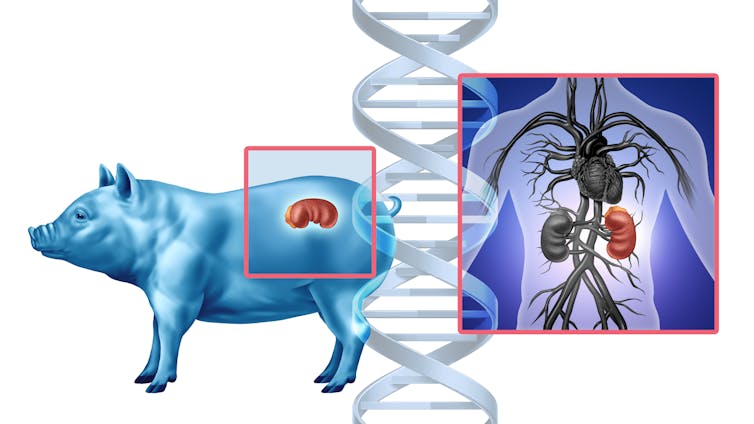
While research on human-pig chimeras is on an indefinite pause, xenotransplantation is moving ahead.
wildpixel/iStock via Getty Images Plus

Monika Piotrowska, University at Albany, State University of New York

In a New York operating room one day in October 2025, doctors made medical history by transplanting a genetically modified pig kidney into a living patient as part of a clinical trial. The kidney had been engineered to mimic human tissue and was grown in a pig, as an alternative to waiting around for a human organ donor who might never come. For decades, this idea lived at the edge of science fiction. Now it’s on the table, literally.

The patient is one of six taking part in the first clinical trial of pig-to-human kidney transplants. The goal: to see whether gene-edited pig kidneys can safely replace failing human ones.

A decade ago, scientists were chasing a different solution. Instead of editing the genes of pigs to make their organs human-friendly, they tried to grow human organs – made entirely of human cells – inside pigs. But in 2015 the National Institutes of Health paused funding for that work to consider its ethical risks. The pause remains today.

As a bioethicist and philosopher who has spent years studying the ethics of using organs grown in animals – including serving on an NIH-funded national working group examining oversight for research on human-animal chimeras – I was perplexed by the decision. The ban assumed the danger was making pigs too human. Yet regulators now seem comfortable making humans a little more pig.

Why is it considered ethical to put pig organs in humans but not to grow human organs in pigs?

Urgent need drives xenotransplantation

It’s easy to overlook the desperation driving these experiments. More than 100,000 Americans are waiting for organ transplants. Demand overwhelms supply, and thousands die each year before one becomes available.

For decades, scientists have looked across species for help – from baboon hearts in the 1960s to genetically altered pigs today. The challenge has always been the immune system. The body treats cells it does not recognize as part of itself as invaders. As a result, it destroys them.

A recent case underscores this fragility. A man in New Hampshire received a gene-edited pig kidney in January 2025. Nine months later, it had to be removed because its function was declining. While this partial success gave scientists hope, it was also a reminder that rejection remains a central problem for transplanting organs across species, also known as xenotransplantation.

Decades of research have led to the first clinical trial of pig kidney transplants.

Researchers are attempting to work around transplant rejection by creating an organ the human body might tolerate, inserting a few human genes and deleting some pig ones. Still, recipients of these gene-edited pig organs need powerful drugs to suppress the immune system both during and long after the transplant procedure, and even this may not prevent rejection. Even human-to-human transplants require lifelong immunosuppressants.

That’s why another approach – growing organs from a patient’s own cells – looked promising. This involved disabling the genes that let pig embryos form a kidney and injecting human stem cells into the embryo to fill the gap where a kidney would be. As a result, the pig embryo would grow a kidney genetically matched to a future patient, theoretically eliminating the risk of rejection.

Although simple in concept, the execution is technically complex because human and pig cells develop at different speeds. Even so, five years prior to the NIH ban, researchers had already done something similar by growing a mouse pancreas inside a rat.

Cross-species organ growth was not a fantasy – it was a working proof of concept.

Ethics of creating organs in other species

The worries motivating the NIH ban in 2015 on inserting human stem cells into animal embryos did not come from concerns about scientific failure but rather from moral confusion.

Policymakers feared that human cells might spread through the animal’s body – even into its brain – and in so doing blur the line between human and animal. The NIH warned of possible “alterations of the animal’s cognitive state.” The Animal Legal Defense Fund, an animal advocacy organization, argued that if such chimeras gained humanlike awareness, they should be treated as human research subjects.

The worry centers on the possibility that an animal’s moral status – that is, the degree to which an entity’s interests matter morally and the level of protection it is owed – might change. Higher moral status requires better treatment because it comes with vulnerability to greater forms of harm.

Think of the harm caused by poking an animal that’s sentient compared to the harm caused by poking an animal that’s self-conscious. A sentient animal – that is, one capable of experiencing sensations such as pain or pleasure – would sense the pain and try to avoid it. In contrast, an animal that’s self-conscious – that is, one capable of reflecting on having those experiences – would not only sense the pain but grasp that it is itself the subject of that pain. The latter kind of harm is deeper, involving not just sensation but awareness.

Thus, the NIH’s concern is that if human cells migrate into an animal’s brain, they might introduce new forms of experience and suffering, thereby elevating its moral status.

Close-up of piglets moving between bars
How human do pigs need to be for them to be considered part of the human species?
AP Photo/Shelby Lum
The flawed logic of the NIH ban

However, the reasoning behind the NIH’s ban is faulty. If certain cognitive capacities, such as self-consciousness, conferred higher moral status, then it follows that regulators would be equally concerned about inserting dolphin or primate cells into pigs as they are about inserting human cells. They are not.

In practice, the moral circle of beings whose interests matter is drawn not around self-consciousness but around species membership. Regulators protect all humans from harmful research because they are human, not because of their specific cognitive capacities such as the ability to feel pain, use language or engage in abstract reasoning. In fact, many people lack such capacities. Moral concern flows from that relationship, not from having a particular form of awareness. No research goal can justify violating the most basic interests of human beings.

If a pig embryo infused with human cells truly became something close enough to count as a member of the human species, then current research regulations would dictate it’s owed human-level regard. But the mere presence of human cells doesn’t make pigs humans.

The pigs engineered for kidney transplants already carry human genes, but they aren’t called half-human beings. When a person donates a kidney, the recipient doesn’t become part of the donor’s family. Yet current research policies treat a pig with a human kidney as if it might.

There may be good reasons to object to using animals as living organ factories, including welfare concerns. But the rationale behind the NIH ban that human cells could make pigs too human rests on a misunderstanding of what gives beings – and human beings in particular – moral standing.

This article was updated to correct the location and date of the first pig kidney transplant clinical trial.The Conversation

Monika Piotrowska, Associate Professor of Philosophy, University at Albany, State University of New York

This article is republished from The Conversation under a Creative Commons license. Read the original article.

Continue reading “Reprint: The Moral Ambiguity of Xenotransplantation”

Journalism and “Brands”

As someone who was all but born on a copy desk – my mother always said she wasn’t the first woman copy editor on the Houston Chronicle, but she was the first pregnant one – I grew up with the myths, the realities, and the ethics of journalism at the core of my being.

I may have picked up much of the same sort of beliefs about the legal profession in law school, but to be completely honest, I’ve always believed in journalism more than I believed in the law. I do know a lot of lawyers who really believe in the law and right now some of the finest of those are using it to fight the abusive regime that’s trying to destroy our democracy.

There are some journalists who believe in true journalism doing that as well.

But then there are the others.

I had never heard of Olivia Nuzzi until the scandal broke about her relationship with the Kennedy scion who is now dismantling our health resources, a relationship that went on while she was supposedly reporting on his presidential campaign. (I’m using the word “relationship” because I don’t know the details and really don’t want to find out what they are, but what went on between them was not a simple matter of reporter and subject of interest.)

She was “cancelled” – lost her job, was criticized heavily in many corners – but now she’s back. It’s been about a year. She’s written a book and The New York Times did an elaborate feature piece on her. Apparently she also has a new job at Vanity Fair.

I have not read her book. As far as I know, I’ve never read anything she’s written and from what I’ve read about her I can’t think of any reason why I would. I have, however, read a few pieces about her, which caused me to reflect  on what journalism is and should be.

In the piece that brought her to my attention, Colby Hall (who I also never heard of before) compared her to Hunter S. Thompson. He was talking about the kind of political coverage Nuzzi did and he meant it as a huge compliment, an assessment that she broke the rules in the same effective way that Thompson did back in the day.

It’s possible she is equally outrageous. Maybe she’s an asshole in a manner similar to Thompson. (I read Thompson religiously during the Nixon and Reagan years, but while I loved his savage reporting, I never wanted to meet him.)

But here’s the thing that makes me question that comparison – and question the judgment of anyone who would make it – Thompson never had anything approaching a friendly relationship with the political people he covered. In fact, he mostly hated them and made no bones about it.

Hunter S. Thompson did not do access journalism. At all. He was the anti-access journalist. Continue reading “Journalism and “Brands””

Reprint: Legal Ethics and the Constitution

Justice Department lawyers work for justice and the Constitution – not the White House

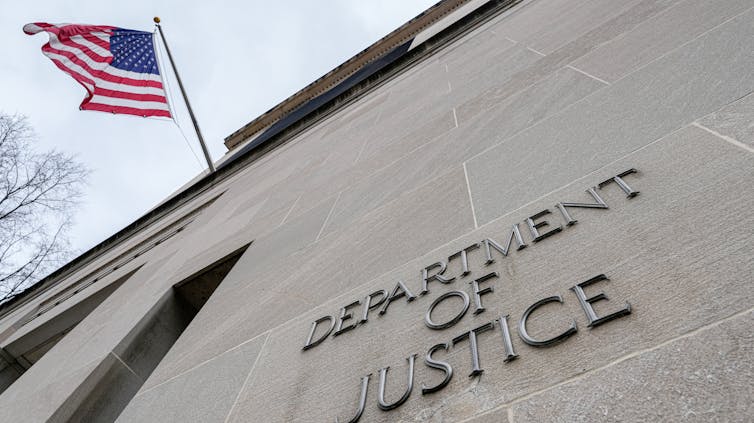
The U.S. flag flies above Department of Justice headquarters on Jan. 20, 2024, in Washington.
J. David Ake/Getty Images

Cassandra Burke Robertson, Case Western Reserve University

In the 1970s, President Richard Nixon tried to fire the Department of Justice prosecutor leading an investigation into the president’s involvement in wiretapping the Democratic National Committee’s headquarters.

Since then, the DOJ has generally been run as an impartial law enforcement agency, separated from the executive office and partisan politics.

Those guardrails are now being severely tested under the Trump administration.

In February 2025, seven DOJ attorneys resigned, rather than follow orders from Attorney General Pam Bondi to dismiss corruption charges against New York Mayor Eric Adams. Adams was indicted in September 2024, during the Biden administration, for alleged bribery and campaign finance violations.

One DOJ prosecutor, Hagan Scotten, wrote in his Feb. 15 resignation letter that while he held no negative views of the Trump administration, he believed the dismissal request violated DOJ’s ethical standards.

Among more than a dozen DOJ attorneys who have recently been terminated, the DOJ fired Erez Reuveni, acting deputy chief of the department’s Office of Immigration Litigation, on April 15. Reuveni lost his job for speaking honestly to the court about the facts of an immigration case, instead of following political directives from Bondi and other superiors.

Reuveni was terminated for acknowledging in court on April 14 that the Department of Homeland Security had made an “administrative error” in deporting Kilmar Abrego Garcia to El Salvador, against court orders. DOJ leadership placed Reuveni on leave the very next day.

Bondi defended the decision, arguing that Reuveni had failed to “vigorously advocate” for the administration’s position.

I’m a legal ethics scholar, and I know that as more DOJ lawyers face choices between following political directives and upholding their profession’s ethical standards, they confront a critical question: To whom do they ultimately owe their loyalty?

An older man with a blue suit speaks into a microphone while a woman with blonde hair looks at him.
President Donald Trump speaks before Pam Bondi is sworn in as attorney general at the White House on Feb. 5, 2025.
Andrew Harnik/Getty Images

Identifying the real client

All attorneys have core ethical obligations, including loyalty to clients, confidentiality and honesty to the courts. DOJ lawyers have additional professional obligations: They have a duty to seek justice, rather than merely win cases, as well as to protect constitutional rights even when inconvenient.

DOJ attorneys typically answer to multiple authorities, including the attorney general. But their highest loyalty belongs to the U.S. Constitution and justice itself.

The Supreme Court established in a 1935 case that DOJ attorneys have a special mission to ensure that “justice shall be done.”

DOJ attorneys reinforce their commitment to this mission by taking an oath to uphold the Constitution when they join the department. They also have training programs, internal guidelines and a long-standing institutional culture that emphasizes their unique responsibility to pursue justice, rather than simply win cases.

This creates a professional identity that goes beyond simply carrying out the wishes of political appointees.

Playing by stricter rules

All lawyers also follow special professional rules in order to receive and maintain a license to practice law. These professional rules are established by state bar associations and supreme courts as part of the state-based licensing system for attorneys.

But the more than 10,000 attorneys at the DOJ face even tougher standards.

The McDade Amendment, passed in 1998, requires federal government lawyers to follow both the ethics rules of the state where they are licensed to practice and federal regulations. This includes rules that prohibit DOJ attorneys from participating in cases where they have personal or political relationships with involved parties, for example.

This law also explicitly subjects federal prosecutors to state bar discipline. Such discipline could range from private reprimands to suspension or even permanent disbarment, effectively ending an attorney’s legal career.

This means DOJ lawyers might have to refuse a supervisor’s orders if those directives would violate professional conduct standards – even at the risk of their jobs.

This is what Assistant U.S. Attorney Danielle Sassoon wrote in a Feb. 12, 2025, letter to Bondi, explaining why she could not drop the charges against Adams. Sassoon instead resigned from her position at the DOJ.

“Because the law does not support a dismissal, and because I am confident that Adams has committed the crimes with which he is charged, I cannot agree to seek a dismissal driven by improper considerations … because I do not see any good-faith basis for the proposed position, I cannot make such arguments consistent with my duty of candor,” Sassoon wrote.

As DOJ’s own guidance states, attorneys “must satisfy themselves that their behavior comports with the applicable rules of professional conduct” regardless of what their bosses say.

Post-Watergate principles under pressure

The president nominates the attorney general, who must be confirmed by the U.S. Senate.

That can create the perception and even the reality that the attorney general is indebted to, and loyal to, the president. To counter that, Attorney General Griffin Bell, in 1978, spelled out three principles established after Watergate to maintain a deliberate separation between the White House and the Justice Department.

First, Bell called for procedures to prevent personal or partisan interests from influencing legal judgments.

Second, Bell said that public confidence in the department’s objectivity is essential to democracy, with DOJ serving as the “acknowledged guardian and keeper of the law.”

Third, these principles ultimately depend on DOJ lawyers committed to good judgment and integrity, even under intense political pressure. These principles apply to all employees throughout the department – including the attorney general.

Recent ethics tests

These principles face a stark test in the current political climate.

The March 2025 firing of Elizabeth Oyer, a career pardon attorney with the Justice Department, raises questions about the boundaries between political directives and professional obligations.

Oyer was fired by Bondi shortly after declining to recommend the restoration of gun rights to actor Mel Gibson, a known Donald Trump supporter. Gibson lost his gun rights after pleading no contest to a misdemeanor domestic battery charge in 2011.

Oyer initially expressed concern to her superiors about restoring Gibson’s gun rights without a sufficient background investigation, particularly given Gibson’s history of domestic violence.

When Oyer later agreed to testify before Congress in a hearing about the White House’s handling of the Justice Department, the administration initially planned to send armed U.S. Marshals officers to deliver a warning letter to her home, saying that she could not disclose records about firearms rights to lawmakers.

Oyer was away from home when she received an urgent alert that the marshals were en route to her home, where her teenage child was alone. Oyer’s attorney described this plan as “both unprecedented and completely inappropriate.”

Officials called off the marshals only after Oyer confirmed receipt of the letter via email.

A woman with dark hair and a purple blazer sits at a table with other people dressed formally seated nearby her.
Elizabeth Oyer, a former U.S. pardon attorney at the Justice Department, speaks at a Senate hearing on April 7, 2025, in Washington.
Kayla Bartkowski/Getty Images

Why independence matters

In my research, I found that lawyers sometimes have lapses in judgment because of the “partisan kinship,” conscious or not, they develop with clients. This partisan kinship can lead attorneys to overlook serious red flags that outsiders would easily spot.

When lawyers become too politically aligned with clients – or their superiors – their judgment suffers. They miss ethical problems and legal flaws that would otherwise be obvious. Professional distance allows attorneys to provide the highest quality legal counsel, even if that means saying “no” to powerful people.

That’s why DOJ attorneys sometimes make decisions that frustrate political objectives. When they refuse to target political opponents, when they won’t let allies off easily, or when they disclose information their superiors wanted hidden, they’re not being insubordinate.

They’re fulfilling their highest ethical duties to the Constitution and rule of law.The Conversation

Cassandra Burke Robertson, Professor of Law and Director of the Center for Professional Ethics, Case Western Reserve University

This article is republished from The Conversation under a Creative Commons license. Read the original article.

Continue reading “Reprint: Legal Ethics and the Constitution”