My neighborhood has a wealth of record stores. There’s one around the corner on 40th, and a half dozen more within walking distance.
They’re not just stores that happen to carry vinyl records in addition to some other music-related items like CDs or instruments. They specialize in records, mostly the LP albums that were the in-thing when I was coming of age. (The previous generation did more with the 45s that had one song on each side.)
I used to have a lot of records, but I got rid of them when I was moving cross country back in early 2008. I’d ditched my record player years earlier. I was fond of them, but they were heavy and took up space and I no longer listened to them.
I probably should have held onto them a little bit longer, though since I wasn’t a purist or a collector, I didn’t take extra care of them. I doubt any of them were especially valuable. And I probably wouldn’t want to set up an old-fashioned Hi-Fi system to listen to them anyway.
But people are back into records these days, enough of them to support a lot of indie record shops.
Typewriters are also making a comeback. The New York Times had a lovely piece a week or so ago on a man who took over a typewriter repair business from a man who started it in Bremerton, Washington, in 1947. The middle-aged guy who took it over – after spending a lot of time with the previous owner learning how to work on typewriters – did it more or less on a gut feeling that it was a good choice for his life.
But there’s a lot of work for people who know how to fix typewriters, both the manual and electric kind. Some people are into typewriters in the digital age.
I learned to type in high school back when there was a course called “typing” that was mostly aimed at people who wanted to do secretarial work. We learned on electric ones with no letters on the keyboard – memorizing the keyboard layout was part of the skill.
My parents had manual typewriters at home, and once I learned to type I wrote all my papers for school on them. I took one with me to college, but they took it back when they started a newspaper.
In those pre-computer days I lusted for an IBM correcting Selectric, but I never could come up with enough money. By the time I was making enough money to pay for something like that, the personal computer was a thing and I got that instead.
Cameras, too. Film cameras, not just digital ones, and not just fancy ones, but ones intended for the kind of snapshot at which the mobile phone camera has become king. At our coffee shop the baristas take Polaroids of patrons’ dogs and post them in the shop. Continue reading “Old School”…
I just posted about one of my novels, Borderlanders, on Facebook. Let me share that post, and let me add to it.
Memories…
This was the book wanted by readers on FB. I noted (on FB, obviously) that my academic stuff had given me a way of writing a novel with a chronically ill protagonist where the protagonist remains the hero, is not cured, is not killed, and is not replaced. I was going to teach this method to others, but first COVID intervened and then antisemitism. I don’t get to teach much, these days. I may have to write another novel, having said this, because I learned so much in writing the novel that I could now write a much better one.
What’s very strange is, during these 5 years, more people I know have the illness my character had, due to long COVID. I’ve had it since I was in my twenties, but I’m one of the fortunate ones for whom it goes into abeyance. Right now, I’m trying to coax it back to sleep. Not everyone has that luxury, which is another reason why I should write another novel. Not yet, though. While it’s awake, every moment of every day is not straightforward, and I am behind on all my fiction.
This mysterious illness was known as chronic fatigue in Australia in the late 1980s, but these days it’s called ME and the fatigue is just a symptom. We know a lot more about it. One thing we know is why walking up the street can be so impossible. For some of us it can set the illness back, and for others it can destroy life entirely. This is why I consider myself so fortunate. I may have to not do much for a few months, but after that time I can do a little more and then a little more. This is just as well, because it’s only one of several illnesses I have and I have this daft desire not to be bedridden or die young.
For me, the most annoying symptom is when my executive function is not working. I lose time (sometimes weeks) and can’t do simple things. Oddly, I can still write books.
I always tell folks, do not assume someone can or cannot do a thing when they are ill. Ask them. And ask them each and every day if you must, because the small everyday can change. Some days I can walk up the street and back and I can write 6,000 words. Other days I can hardly get out of bed.
The illness is not just part of our everyday, it becomes part of who we are, for better or for worse.
I would like to see a superhero who has ME. It would be such a wonderful thing, watching them change the world… on days they can do more than toddle. And seeing how other people respond to the wild level of change they see when a powerful person has to watch what they do every minute would provide a great sub-text to a movie. It’s quite a different set of options than those for someone who cannot walk without assistance, or someone completely confined to bed who uses their amazing telepathic abilities to run the world.
There are so many amazing stories in the lives of the people we mostly prefer not to see. I now want to see a whole sequence of superhero movies or a TV series that focuses on those lives. There is a different sort of heroicism when one is not visible and has to fight just to get through the everyday, especially when they do astonishing things. Most of those astonishing things are attributed to someone else, because, of course, the invisible and half-seen can’t possibly be the heroes we dream of. Except, of course, they are. I get through my illnesses because of those people. Some of them are role models and some of them help when others don’t even begin to see that I might not be able to ask for help when things are bad.
One thing about this non-extent show: costumes would be far too problematic for some of the hidden heroes. So would heroic stances and being randomly interviewed by reporters. It would be such a different and fascinating set of stories.
In real life, I’ve met these invisible people in essential services. From a desk or from home they make a lot of the everyday possible for so many other folk.
As someone who was all but born on a copy desk – my mother always said she wasn’t the first woman copy editor on the Houston Chronicle, but she was the first pregnant one – I grew up with the myths, the realities, and the ethics of journalism at the core of my being.
I may have picked up much of the same sort of beliefs about the legal profession in law school, but to be completely honest, I’ve always believed in journalism more than I believed in the law. I do know a lot of lawyers who really believe in the law and right now some of the finest of those are using it to fight the abusive regime that’s trying to destroy our democracy.
There are some journalists who believe in true journalism doing that as well.
But then there are the others.
I had never heard of Olivia Nuzzi until the scandal broke about her relationship with the Kennedy scion who is now dismantling our health resources, a relationship that went on while she was supposedly reporting on his presidential campaign. (I’m using the word “relationship” because I don’t know the details and really don’t want to find out what they are, but what went on between them was not a simple matter of reporter and subject of interest.)
She was “cancelled” – lost her job, was criticized heavily in many corners – but now she’s back. It’s been about a year. She’s written a book and The New York Times did an elaborate feature piece on her. Apparently she also has a new job at Vanity Fair.
I have not read her book. As far as I know, I’ve never read anything she’s written and from what I’ve read about her I can’t think of any reason why I would. I have, however, read a few pieces about her, which caused me to reflect on what journalism is and should be.
In the piece that brought her to my attention, Colby Hall (who I also never heard of before) compared her to Hunter S. Thompson. He was talking about the kind of political coverage Nuzzi did and he meant it as a huge compliment, an assessment that she broke the rules in the same effective way that Thompson did back in the day.
It’s possible she is equally outrageous. Maybe she’s an asshole in a manner similar to Thompson. (I read Thompson religiously during the Nixon and Reagan years, but while I loved his savage reporting, I never wanted to meet him.)
But here’s the thing that makes me question that comparison – and question the judgment of anyone who would make it – Thompson never had anything approaching a friendly relationship with the political people he covered. In fact, he mostly hated them and made no bones about it.
Yet, the U.S. is different in a meaningful way. Here, abortion has historically been framed as a personal right to privacy. In many other countries I’ve studied, abortion is viewed more as a collective right that is inextricably tied to broader social and economic issues.
Initially, for some of those autocratic leaders, limiting access to abortion and contraception was a strategy to gain the approval of the nation’s religious leaders. The Catholic Church held great power in Italy and Spain, as did the Orthodox Church in Romania. At the time, these faiths opposed artificial birth control and still believe life begins at conception.
Restrictions on reproductive rights also aimed to increasebirth rates following two world wars that had stamped out some of the population, particularly in the Soviet Union and Italy. Many political leaders saw procreation as a national duty. They designated women – white, heterosexual women, that is – specific roles, primarily as mothers, to produce babies as well as future soldiers and workers for their regimes.
In the past two decades, countries in Europe and the Americas have been following this recognizable pattern. Nicaragua and Poland have both banned abortion. Hungary, Turkey and Russia have all clamped down on access to it.
Restricting reproductive freedoms has helped Hungary’s Viktor Orbán, Russia’s Vladimir Putin and Turkey’s Recep Tayyip Erdoğan stoke lasting political divisions within society that help them consolidate their own power.
These politicians have also taken power away from a significant portion of the population by reinstating earlier, fascist-era restrictions on bodily autonomy. As feminist scholars have pointed out, strong reproductive rights are central to functioning democracies.
Restrictions on reproductive freedoms often necessitate other kinds of restrictions to enforce and maintain them. These might include free speech limits that prohibit providers from discussing people’s reproductive options. Criminalizing political dissent enables the arrest of people who protest restrictions on reproductive freedoms. Travel bans threaten prison time for individuals who help young people get abortion care out of state.
When these civil liberties weaken, it becomes harder to defend other rights. Without the right to speak, dissent or move freely, people cannot engage in conversations, organize or voice collective grievances.
Putting the US in a global context
In 2022, the U.S. joined the likes of Poland and Hungary when the Supreme Court overturned Roe v. Wade, ending 50 years of federal abortion protections.
President Donald Trump was not in power when this happened. Yet the Supreme Court’s conservative majority was shaped during his first term.
Since then, both the second Trump administration and many states have enacted their own regulations or bans on abortion. This has created a divided country where in some states abortion is as restricted as it is under some of the world’s most autocratic regimes.
Yet, there’s a key difference.
In the U.S., abortion is viewed by the law and the public as a matter of individual rights. The debate often boils down to whether a person should be allowed to terminate their pregnancy.
In many other contexts, reproductive rights are understood as a collective good that benefits all society – or, conversely, harms all society when revoked.
This perspective can be a powerful driver of change. It’s how, for example, women’s and feminist groups in places such as Argentina, Colombia and Mexico have successfully pressured their governments to decriminalize abortion in recent years.
The Latin American feminist activists have also documented how restricting abortion intensifies authoritarianism and worsens both individual and collective rights.
In a region where many citizens remember life under military dictatorship, highlighting the relationship between abortion and authoritarianism may be particularly galvanizing.
This was basically what the mainstream pro-choice movement advocated for at the time. White feminists saw abortion rights as a personal liberty. This framing has real limitations.
As Black and brown reproductive justice advocates have long pointed out, Roe never served women of color or poor people particularly well because of underlying unequal access to health care. Their work has, for decades, illustrated the strong connection between racial, economic and reproductive justice, yet abortion is still largely regarded as solely an individual issue.
When debates about reproductive freedoms are framed as fights over individual rights, it can engender a legal quagmire. Other entities with rights emerge – the fetus, for example, or a potential grandparent – and are pitted against the pregnant person.
Recently, for instance, a pregnant woman declared brain dead in Georgia was kept alive for several months until her fetus became viable, apparently to comply with the state’s strict anti-abortion law. As her mother told the press, her family had no say in the matter.
Narrowly focusing on abortion as an individual right can also obscure why banning it has societal impacts.
Research worldwide shows that restricting reproductive freedoms does not lead to fewer abortions. Abortion bans only make abortion dangerous as people turn to unregulated “back alley” procedures. Maternal and infant mortality rates rise, especially in marginalized communities.
Other kinds of suffering increase, too. Women and their families tend to become poorer when contraception and abortion are hard to get.
Abortion bans also lead to discriminatory practices in health care beyond reproductive health services, such as oncology, neurology and cardiology. Physicians who fear criminalization are forced to withhold or alter gold-standard treatments for pregnant patients, for example, or they may prescribe less effective drugs out of concern about legal consequences should patients later become pregnant.
As a result, abortion bans decrease the quality and effectiveness of medical care for many patients, not just those who are pregnant.
Defending reproductive freedoms for healthy democracies
These findings demonstrate why reproductive rights are really a collective good. When viewed this way, it illuminates why they are an essential element of democracy.
Already, the rollback of reproductive freedoms in the U.S. has been followed by efforts to limit other key areas of freedoms, including LGBTQ rights, freedom of speech and the right to travel.
Access to safe abortion for pregnant people, gender-affirming care for trans youth, and international travel for noncitizens are intertwined rights – not isolated issues.
When the government starts stripping away any of these rights, I believe it signals serious trouble for democracy.
This story is published in collaboration with Rewire News Group, a nonprofit newsroom dedicated to covering reproductive and sexual health.
We’re in that time of year when things suddenly warm. We don’t know whether a given day will be spring or summer, normally. This year we don’t know if the negative temperatures of winter will also appear. It’s a bit too exciting and not good for those of us who handle chronic illnesses.
Each and every time this happens, there are cherries to ameliorate the pain. Another thing that ameliorates the pain is everyone’s children, at school, getting excited about the end of year activities and the count down to the long summer holidays.
This week, in the Australian Capital Territory, so many schools were closed down because of asbestos in sand. I do not know how the asbestos got through all the checks, but every parent I know is asking to work from home or taking early holiday, or rearranging shifts. A bit more warning may have made this straightforward, and friends like me could have taught random child-friends how to make spice mixes or bath bombs, but there wasn’t enough warning and all our days are being rearranged.
It’s a small excitement, compared with the rest-of-world, but it’s a lot of work for young families. We’ll be through it soon, and whoever ordered that sand will never, ever do something that stupid again. Then I can return to thinking about seasonal produce and what I need to do today myself. I have a very long list to work through, but there is no asbestos involved.
It’s going to be Thanksgiving in the United States in a couple of weeks, and that got me to thinking about the people who worked hard and made sacrifices to make sure “we the people” means everybody. Given the way the current regime is trying to destroy those rights, it seems important to remember how we got them and what we need to do to keep them.
I’m thinking about these things in the United States because that’s the history I know best and it’s also where rights are under attack right now. But you can find similar histories in many countries.
Me, I thank the suffragists who made it possible for me to vote and led to many more women in positions of authority. That happened 105 years ago now, which may seem like ancient history if you were born in this century, but doesn’t seem that long ago at all if you’re my age.
I mean, my grandmothers were born before women could vote in the United States. My mother was born just three years afterwards.
I also thank the predecessors of the suffragists, the women who organized for their rights back in the 1800s, often working alongside abolitionists. I looked up the Seneca Falls Convention in 1848 and discovered that Frederick Douglass – who was the only African American at the convention – argued strongly for the inclusion of women’s right to vote, which was why they included it in their statement.
Douglass’s efforts in this regard are just one reason I think the abolitionist and the later civil rights movement were critical to rights that I have, and that we all share these days.
It’s not really freedom if it’s not freedom for all. The activism that finally implemented some of the rights set out in the 13th, 14th, and 15th Amendments not only expanded the freedom of Black people, but expanded the rights for everyone.
I also thank unions for my freedoms. I’m personally grateful to the News Guild, my union, which enabled me to retire in reasonable comfort, but I’m grateful in general to all those people who fought for workers’ rights over many years, and who are still hanging in the fight right now. Continue reading “Feeling Thankful”…
For a few months now I’ve been getting odd emails. They start out reading like fan mail, and fan mail from some unusually perceptive reader who gets exactly what I’m trying to do. Flattering (and yes, I am not above being flattered, being just another pixel-stained techno-peasant working in the fields of fiction). So I am flattered for the first two to four paragraphs.
And then it becomes clear that these are sales pitches.
The first one I received was for Petty Treason, and mentioned the characters and the plot the the sense of place, and seemed to get what I was trying to do with the book, and to appreciate it. “Why don’t more people know this book?” she asked–a fine question, although of course with the number of books out there, how does anyone have the chance to find a book except through serendipity and marketing? And it turned out that the author of the letter was pitching her marketing services. As I was, at that time, in the process of re-issuing all three of my Sarah Tolerance mysteries (of which Petty Treason is the second) I was intrigued. I loathe marketing chores, and would have been willing to throw a bit of money to someone who would take on the task. So I wrote back, asking what she had in mind.
We exchanged two or three more emails, with proposed programs and low-cost, medium cost, and wotthehell let’s have it all cost options (no actual numbers were given). So I wrote back to find out what was included in each of the programs, and what the price tag was, and then… she vanished. Ghosted me.
Meanwhile, back at my inbox, I’d gotten another such email, effusive and flattering about Sold for Endless Rue, my retelling of Rapunzel. The writer called out the research (of which I’d done a ton, and it’s nice to have it noticed, see above re: being flattered) and the characters and the feminist underpinnings of the story. This time the sender wasn’t in marketing, but “managed” a group of 2000 avid readers who would positively swoon over my book, and write reviews in all the places that reviews get written and posted. But by this time my spider sense was tingling and I began to doubt that there was an actual human at the other end of the emails.
Why? The language of the approach emails is very polished, but more sales oriented than pure fan mail (I mean, “It’s rare to find historical fiction that feels both so authentically of its time and yet so urgently relevant today…”. Really?) And the emails focused on the things in the books that I was proudest of. And I began to imagine the person at the other end of the emails saying “Hey ChatGPT!” (Or Claude, or Grok, or whatever) “Write a marketing-approach letter that the author of Petty Treason will find hard to resist!”
“Ah!” my less cynical side murmured. “But how would ChatGPT/Claude/Grok know anything about Petty Treason and its author?”
And my increasingly sour side responded, Because Petty Treason and Sold for Endless Rue and The Stone War and Point of Honour (for all of which I have now received similar approach emails) were all scraped and used for Large Language Model training for AIs. As are all sorts of reviews and literary analyses and suchlike. I know this because I’m one of thousands of authors whose work is part of the Anthropic settlement (the first in a series of cases where the Authors Guild and other organizations have filed suit against AI companies that carelessly used other people’s intellectual property because it was there and they could).
So now these emails go into the trash. I’m not the only one who’s getting them–John Scalzi mentioned getting several a day, and if there is anyone who doesn’t need to pay for “a managed group of 2000 dedicated readers” to write reviews of his work, it’s Scalzi.
An academic I’m on a panel with in a few weeks (talking about Medievalism) just asked for suggestions of fantasy novels for undergraduate teaching of genre. I had some suggestions, as did a number of other people. The most suggested novel was The Witcher, which is, technically science fiction, not fantasy. I was told this by a group of upset Polish fans when I described it as fantasy in a talk I gave them. Some lessons are taught through error: when I looked more closely, the fans were quite right and I was wrong. The style of the novels and many of the themes are fantasy, but the built world is a future planet-linked-to-Earth-in-strange-ways.
The Witcher could be taught as a fantasy novel, but I suspect the teacher would have to explain that the world building uses humans from our world plus strange SFnal crossovers. We agreed (the fans and I) that it could be mistaken for fantasy because it has quite a few traits that are more fantastical and science fictional. So I was wrong, but forgiven because it was an understandable error from someone who didn’t know the world very well.
All this got me wondering: what novel would you suggest?
If you were giving a 20-year-old just one fantasy novel (and not a long one, so no Gene Wolfe and no Lord of the Rings, and certainly no Game of Thrones) to get them thinking and fascinated, what novel would you give them? And if you were to give them five they needed to read to really get the hang of fantasy novels, what five would you choose? They don’t need to be well-known novels. They need to be perfect to lure the student into learning.
This is an excuse to find out about really good novels that miss being seen. I plan to read all those you suggest that I have not already read, of course.
I have never been a fan of The Great Gatsby, considering it incredibly overrated. Fitzgerald wrote lovely sentences, but he and the others of his era (most notably Hemingway) who were competing – in their own little circles – to see who could write The Great American Novel were not nearly as important and influential as they and some English teachers like to proclaim.
I’ve always thought that, in rating male American writers of the first half of the 20th Century, neither Fitzgerald nor Hemingway could hold a candle to Dashiell Hammett. And if there is a Great American Novel, it’s Beloved, by Toni Morrison.
But there is some value in Gatsby, as the recent Gatsby-themed party thrown by the grifter currently occupying our White House makes clear. Anyone who has read the book would consider holding that event particularly tone-deaf, particularly when the party was scheduled for the day that SNAP benefits were running out.
I have read the book, twice in fact. Once when I was young and again about a dozen years ago when it was being raved about once again by the literati on the occasion of it entering the public domain. I wasn’t impressed either time by the book, though I deplored the culture it described in both cases.
Many of the reports on the party – and not a few people on social media – have quoted one of the great lines from the book:
They were careless people, Tom and Daisy – they smashed up things and creatures and then retreated back into their money or their vast carelessness, or whatever it was that kept them together, and let other people clean up the mess they had made.
It is a wonderful sentence and a true indictment of many of the wealthy people in the United States, not just those who, like Tom and Daisy Buchanan, came from relatively old money, but also the newly minted oligarchs we see today.
It’s not a surprise that the author of the book about Facebook and Mark Zuckerberg called it Careless People. We have a lot of those in positions of power these days.
But nobody is talking much about Jay Gatsby himself. Gatsby is putting on a great show, but he is a criminal, a true thug. He came from nothing and stole his way to wealth and almost to respectability. He was not careless, at least not until the end when he saw he was not going to get everything he wanted and threw it all away. Continue reading “The Problem With The Great Gatsby“…
As energy use rises and the planet warms, you might have dreamed of an energy source that works 24/7, rain or shine, quietly powering homes, industries and even entire cities without the ups and downs of solar or wind – and with little contribution to climate change.
The promise of new engineering techniques for geothermal energy – heat from the Earth itself – has attracted rising levels of investment to this reliable, low-emission power source that can provide continuous electricity almost anywhere on the planet. That includes ways to harness geothermal energy from idle or abandoned oil and gas wells. In the first quarter of 2025, North American geothermal installations attracted US$1.7 billion in public funding – compared with $2 billion for all of 2024, which itself was a significant increase from previous years, according to an industry analysis from consulting firm Wood Mackenzie.
As an exploration geophysicist and energy engineer, I’ve studied geothermal systems’ resource potential and operational trade-offs firsthand. From the investment and technological advances I’m seeing, I believe geothermal energy is poised to become a significant contributor to the energy mix in the U.S. and around the world, especially when integrated with other renewable sources.
A May 2025 assessment by the U.S. Geological Survey found that geothermal sources just in the Great Basin, a region that encompasses Nevada and parts of neighboring states, have the potential to meet as much as 10% of the electricity demand of the whole nation – and even more as technology to harness geothermal energy advances. And the International Energy Agency estimates that by 2050, geothermal energy could provide as much as 15% of the world’s electricity needs.
For generations, Maori people in New Zealand, and other people elsewhere around the world, have made use of the Earth’s heat, as in hot springs, where these people are cooking food in the hot water. Wolfgang Kaehler/LightRocket via Getty Images
Why geothermal energy is unique
Geothermal energy taps into heat beneath the Earth’s surface to generate electricity or provide direct heating. Unlike solar or wind, it never stops. It runs around the clock, providing consistent, reliable power with closed-loop water systems and few emissions.
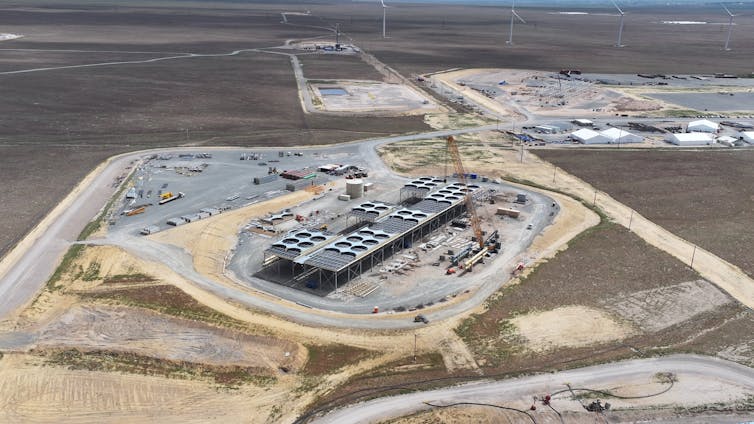
Geothermal is capable of providing significant quantities of energy. For instance, Fervo Energy’s Cape Station project in Utah is reportedly on track to deliver 100 megawatts of baseload, carbon-free geothermal power by 2026. That’s less than the amount of power generated by the average coal plant in the U.S., but more than the average natural gas plant produces.
There are several ways to get energy from deep within the Earth.
Hydrothermal systems tap into underground hot water and steam to generate electricity. These resources are concentrated in geologically active areas where heat, water and permeable rock naturally coincide. In the U.S., that’s generally California, Nevada and Utah. Internationally, most hydrothermal energy is in Iceland and the Philippines.
A drilling rig sits outside a home in White Plains, N.Y., where a geothermal heat pump is being installed. AP Photo/Julia Nikhinson
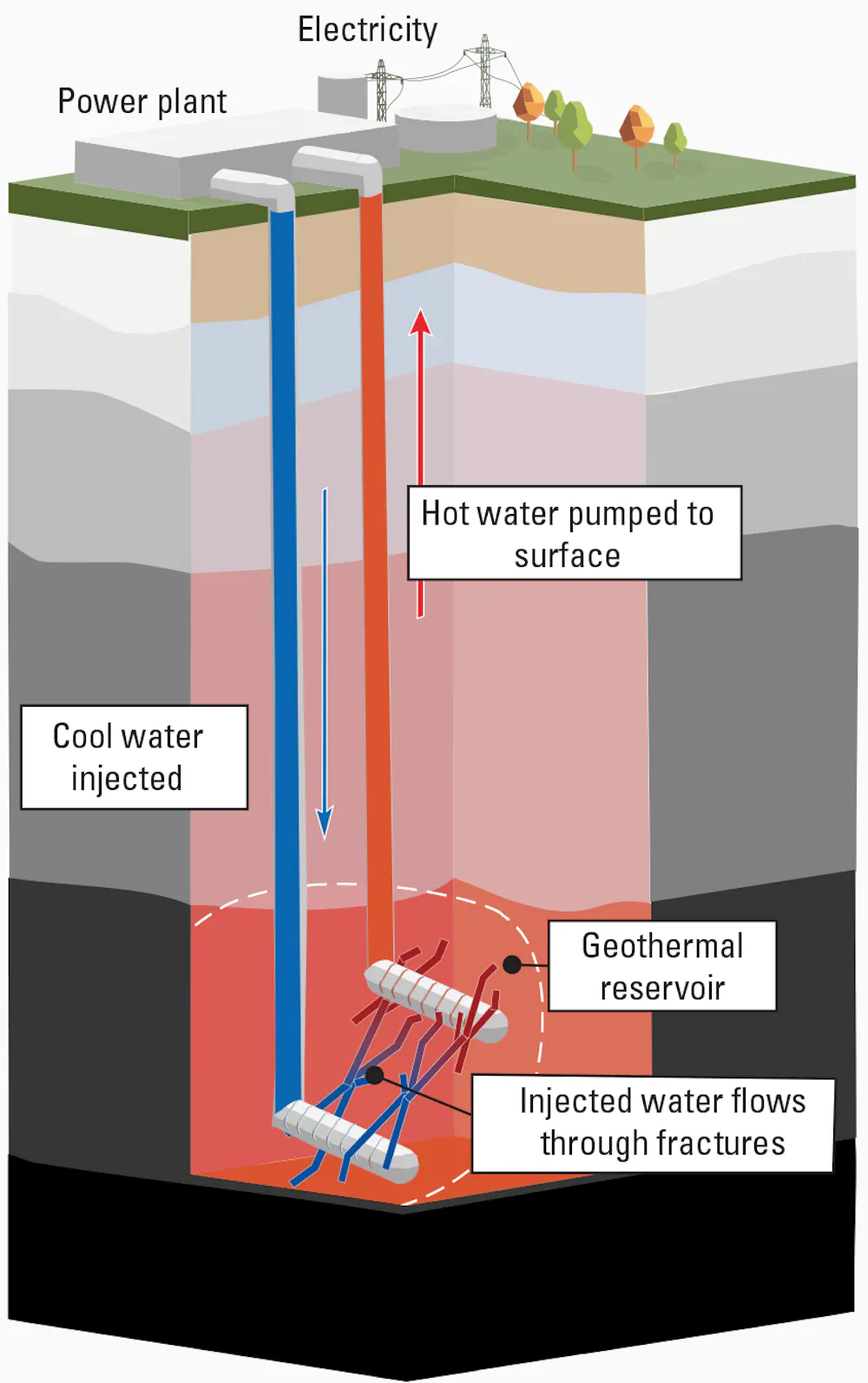
Enhanced geothermal systems effectively create electricity-generating hydrothermal processes just about anywhere on the planet. In places where there is not enough water in the ground or where the rock is too dense to move heat naturally, these installations drill deep holes and inject fluid into the hot rocks, creating new fractures and opening existing ones, much like hydraulic fracturing for oil and gas production.
A system like this uses more than one well. In one, it pumps cold water down, which collects heat from the rocks and then is pumped back up through another well, where the heat drives turbines. In recent years, academic and corporate research has dramatically improved drilling speed and lowered costs.
Ground source heat pumps do not require drilling holes as deep, but instead take advantage of the fact that the Earth’s temperature is relatively stable just below the surface, even just 6 or8 feet down (1.8 to 2.4 meters) – and it’s hotter hundreds of feet lower.
These systems don’t generate electricity but rather circulate fluid in underground pipes, exchanging heat with the soil, extracting warmth from the ground in winter and transferring warmth to the ground in summer. These systems are similar but more efficient thanair-source heat pumps, sometimes called minisplits, which are becoming widespread across the U.S. for heating and cooling. Geothermal heat pump systems can serve individual homes, commercial buildings and even neighborhood or business developments.
Enhanced geothermal systems can be built almost anywhere and can take advantage of existing wells to save the time and money of drilling new holes deep into the ground. U.S. Geological Survey
And converting abandoned oil and gas wells for enhanced geothermal systems could significantly increase the amount of energy available and its geographic spread.
Those projects include repurposing idle oil or gas wells, which is relatively straightforward: Engineers identify wells that reach deep, hot rock formations and circulate water or another fluid in a closed loop to capture heat to generate electricity or provide direct heating. This method does not require drilling new wells, which significantly reduces setup costs and environmental disruption and accelerates deployment.
Despite its challenges, geothermal energy’s reliability, low emissions and scalability make it a vital complement to solar and wind – and a cornerstone of a stable, low-carbon energy future.