I am up to my hips with reading for World Fantasy, but I was reminded of this piece which I wrote about 10 years ago. Sadly, it is still topical…
 I was once chased around my parents’ kitchen by a friend of my father’s. But I’ll come back to that.
One of my favorite things to do when I was a kid was to leaf through a 25-year collection of New Yorker cartoons. Even at the time (the mid 1960s) many of them referred to a world that was vanishing or had vanished: references that must have been side-splitting at the time they were published, but were totally opaque to ten-year-old me. I still remember some of the cartoonists fondly–Chas. Addams, of course, but also James Thurber, Helen Hokinson of the deep-bosomed, slightly clueless club women, and Syd Hoff. But there was a class of cartoons–by guys like Peter Arno and Whitney Darrow, Jr.– that might loosely be termed a critique of modern relations between the sexes. They weren’t opaque, but even to me as a kid they were troubling.
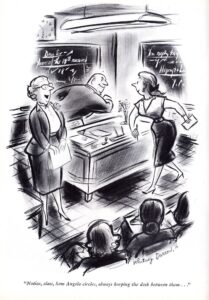
A staple of these cartoons was the young, buxom woman being variously leered at, groped at, chased, etc., by an older, usually wealthier white man (well, yes, in the New Yorker of early days everyone was white). In some of these the woman is clearly playing along in hopes of–what, a diamond bracelet? A fur coat? As Cole Porter had it in Kiss Me Kate, “Mr. Harris, plutocrat, wants to give my cheek a pat: if a Harris pat means a Paris hat, Okay!” But in others, the woman looks uncomfortable and apprehensive.
As for the men in these cartoons, a few of them look hapless, as if they’ve stumbled into a situation where a woman is forcing them to ogle etc. “Honest, officer, I was just sitting here at my desk in my loud checked suit when my secretary perched on my desk to take dictation. What could I possibly do?” Others appeared to at least pretend to be looking at something other than the cleavage–pearls were a frequent fixture–but that was the joke, right? Because everyone, even a ten-year-old girl, knew that he was really ogling the woman’s breasts. But mostly these men look like they’re predators.
As a eight-, nine-, or ten-year old, what was I to make of all this? The takeaway appeared to be that all (powerful, elderly, white) men were letches. That working for such men inevitably meant some sort of harassment. That the wives of these men (who were all portly and dripping in the signifiers of their husbands’ success–furs and diamonds etc.) could do nothing but occasionally fume and nag. That the women being ogled etc. deserved it because they had breasts, because they wore provocative outfits and should have known what would happen, because they had jobs that took them out of their homes and into contact with the aforementioned predators. Some of the cartoons also suggested that there were young women who made the attraction of older, wealthier men into their jobs. All those portly, powerful, older white men were their marks (in which case it must be reasonable that the men would treat the women as prey, because the women were treating them as prey and…).
So there I am in my parents’ kitchen. I was 16 and home from school with a really horrendous cold of the streaming variety–my recollection is that I was a walking river of snot in a plush bathrobe. As I’ve said before, I grew up in a barn, and the living room windows overlooked a valley and a river and fields… very picturesque. One of my dad’s friends, a very fine painter, was painting a landscape of that view. I heard the downstairs door open, went out to the landing, saw it was–let’s call him Fritz–said hi, excused myself on accounta sick, and went back to bed. An hour or so later I went downstairs to the kitchen to make myself some tea and, being a well-raised child, I asked Fritz if he wanted a cup. He said sure, and I put the kettle on.
I’m not clear exactly how the subject of wouldn’t I like to have an affair came up–I was standing there in my blue plush bathrobe with a handful of tissues, blotting my nose and waiting for the kettle to boil. I answered in the negative (this was all rendered more surreal by the fact that I had a crush on Fritz’s son) and may have made some comment about Fritz being my parents’ friend, and it would be weird, shading toward wrong. I was still trying to be polite, and perhaps he took that as an invitation to explain why it would be fine, don’t worry about it. Note: our stove was on an island in the middle of the kitchen floor. Gradually, Fritz moved around the island toward me, and I moved around and away. I felt rotten, and this was the last straw, but I did not want to be rude to my father’s friend. And all the time the image in my head was the one above: “Notice, class…”
The kettle boiled. I poured the water, told him where to find milk and sugar, should he want them, and decamped to my room. I think I may have locked the door, but in the event, Fritz didn’t push the issue, and while I saw him a number of times after that, his invitation was never mentioned between the two of us.
When older people excuse men for predatory workplace behavior (or predatory behavior generally) by saying “they came up in a different time,” well, yes, they may have done. But even in that “different time,” the cartoonists who were depicting these “funny” chases got the look of dismay on the faces of the women, the look of “I need this job but…” The look of being trapped. Even when I was eight- or nine- or ten-years-old I couldn’t see how that was funny.