
When civil rights protesters are killed, some deaths – generally those of white people – resonate more
AP Photo/Ryan Murphy
Aniko Bodroghkozy, University of Virginia
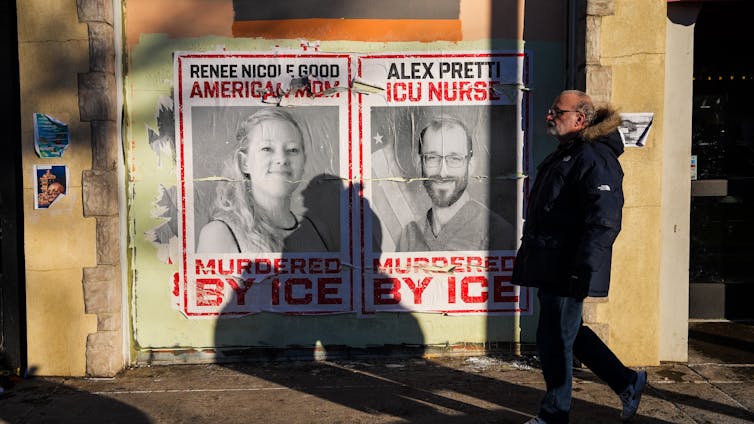
Renee Good and Alex Pretti, two white Minneapolis residents killed in January 2026 by federal agents while protesting the Trump administration’s immigration policy, have become household names. National media outlets continue to focus on their deaths and the circumstances around them.
Neither of them was the first person to be shot and killed by immigration enforcement officials over the past year. There have been numerous shootings and some deaths.
In September 2025, Silverio Villegas González was killed in Chicago under circumstances similar to Good’s death. Ruben Ray Martinez was shot multiple times by Immigration and Customs Enforcement agents in Texas in March 2025, but their involvement was not revealed until nearly a year later. Neither Martinez nor Villegas González has become a household name, and their deadly encounters with federal agents have not drawn nearly the same level of media attention as Good’s or Pretti’s.
As a media historian, I’ve been struck by the similarities between the media’s coverage of Minneapolis and its coverage of Selma, Alabama, in 1965, when voting rights protests led to violence that left three people dead, including two white victims.
I’ve written about the Selma campaign, as well as the media’s treatment of white female activists killed during racial justice protests, in my books “Equal Time: Television and the Civil Rights Movement” and “Making #Charlottesville: Media from Civil Rights to Unite the Right.”
These two events reveal that the deaths of white activists often draw and sustain far more attention than the deaths of Black or Latino people in similar contexts. But the Selma and Minneapolis events also show that male and female white activist victims aren’t necessarily treated the same way.
Remembering Selma
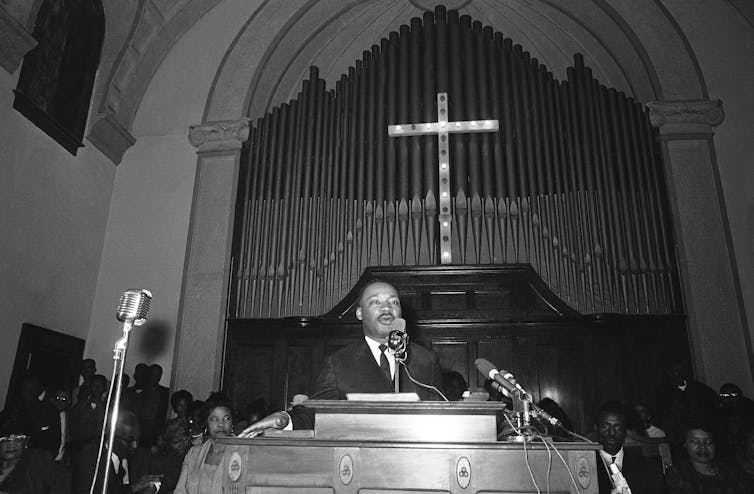
Video footage of law enforcement beating and gassing marchers on Selma’s Edmund Pettus Bridge remains an iconic visual document of the Civil Rights Movement. John Lewis, who later became a congressman, was an activist at the head of the march on March 7, 1965, and was beaten in the head at the base of the bridge by Alabama state troopers. But he was not a household name in 1965, and media coverage at the time did not identify him.
Reporters also didn’t pay much attention to what had motivated the march: the killing of Black voting rights activist Jimmie Lee Jackson by an Alabama state trooper during a nighttime march a week earlier.
AP Photo
Still, the prime-time television broadcast of footage from “Bloody Sunday” at the Pettus Bridge shocked Americans, just as footage from Minneapolis has similarly distressed and disturbed many people today.
In 1965, a small number of white Americans from around the country, including numerous members of the clergy, descended on Selma to stand with the brutalized voting rights activists. They included James Reeb, a Unitarian minister from Massachusetts, and Viola Liuzzo, a wife and mother of five from Michigan.
Reeb, following a second aborted march across the Pettus Bridge two days after Bloody Sunday, was viciously beaten by a group of white racists and left lying on the ground, mortally wounded. His beating and subsequent death received plentiful media attention.
President Lyndon B. Johnson contacted Reeb’s widow. She gave media interviews about her husband. Johnson also extolled Reeb at the beginning of his joint address to Congress calling for robust voting rights legislation, four days after Reeb’s death. Johnson never mentioned Jackson’s death.
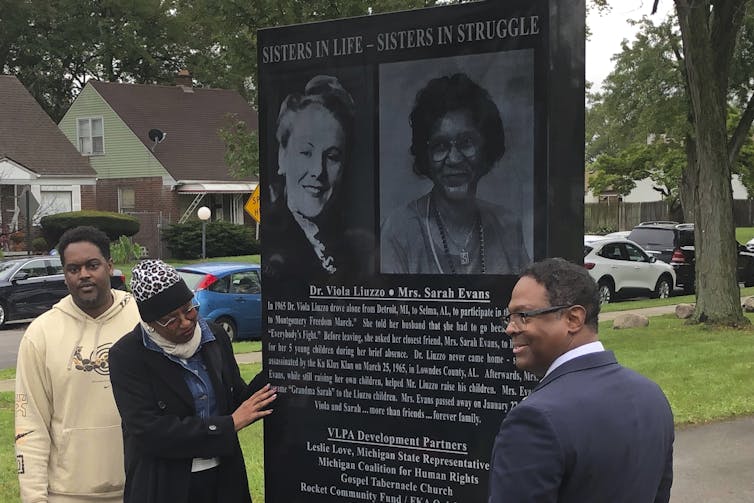
Liuzzo was ferrying people back to Selma from Montgomery on March 25 after the conclusion of the final, successful march to the state capital when a carload of Ku Klux Klansmen, one an FBI informant, chased her down and shot her through her car window. Her death received even more coverage than Reeb’s, keeping Selma in the news.
The Voting Rights Act passed five months later.
Smearing the victim
So how does coverage of Reeb and Liuzzo echo the portrayals of Pretti and Good? And why does it matter?
Initial media treatment of Liuzzo focused on her status as a wife and mother. She was characterized as brave, putting the rights of others above her own. “Mrs. Liuzzo ‘Felt She Had to Help,’” was the headline of a New York Times profile.
Good’s status as a devoted mother and wife also characterized initial media reporting following her death. This kind of framing can often shield “nice white ladies,” as scholar Jessie Daniels has termed them, from the derogatory treatment that women of color have often endured in the public arena.
But in both cases, although separated by six decades, condemnation, disparagement and misogyny soon followed. Government officials, commentators and far-right forces framed these women and their activism in darker terms. Liuzzo was smeared by a KKK grand wizard who blamed her for her own death, saying, “If this woman was at home with her children where she belonged she wouldn’t have been in any jeopardy.” Liuzzo was falsely accused of having sexual relations with a Black man, thereby being characterized as a traitor to the white race.
AP Photo/Corey Williams
This kind of racist vitriol might have stayed on the fringes, but FBI Director J. Edgar Hoover amplified the stories, while a Detroit police officer’s file on Liuzzo, which included highly personal information and speculation about her mental health, was shared with segregationist Sheriff Jim Clark of Selma.
The material ended up in The New York Times, and Liuzzo’s posthumous reputation was marred. When Ladies’ Home Journal polled its readers about Liuzzo, 55% responded that she should have stayed home with her children.
Echoes of the past
Official government and law enforcement responses to Good’s death echo the Liuzzo case; in fact, the responses have arguably been magnified. Vice President JD Vance blamed Good for her own death, claiming it was a “tragedy of her own making.” President Donald Trump characterized her as “disorderly” and vicious. Homeland Security Secretary Kristi Noem and other administration officials labeled Good a domestic terrorist.
This attempt to influence the media’s framing of Renee Good clearly had an impact, since much of the early media coverage focused on questions about her actions and motives, with the New York Post derisively labeling her an “‘ICE Watch’ ‘warrior’ who trained to resist feds before shooting,” before attention shifted to Pretti’s killing.
Good, like Liuzzo, was also derided as a race traitor, somehow betraying white Americans by supporting nonwhites. Podcaster Matt Walsh disparaged her for giving her life “to protect 68 IQ Somali scammers,” a smear that made its way into mainstream media, including its appearance in an opinion piece by The New York Times’ columnist David French that criticized inflammatory MAGA rhetoric.
Walsh and other right-wing commentators, along with comedian Ben Bankas, underscored Good’s sexuality to further demean her.
It’s different for men
Men have been treated differently in both press coverage and political response. Reeb, a father of four, never faced the level of condemnation heaped on Liuzzo. Southern white segregationists certainly questioned the motives of the many clergy members who descended on Selma. Those sentiments, however, did not circulate much outside of segregationist press. Reeb’s status as a minister, along with being a white man, may have shielded his reputation.
Here’s where there are some similarities to the response to Pretti’s death. Initially, Trump administration officials brought out the same playbook they’d used with Good. Noem and Stephen Miller, the White House homeland security adviser, called Pretti a domestic terrorist. Greg Bovino, the leader of Operation Metro Surge in Minneapolis, along with a Homeland Security spokeswoman, claimed Pretti intended to “massacre law enforcement.”
Such charges quickly unraveled as media outlets questioned them. It helped that the video footage of Pretti’s killing was clearer than that of Good’s.
Like Good, Pretti became the target of vitriol in far-right media platforms. But little of that has gotten much purchase in mainstream media, just as the segregationist contempt for activist clergy members in Selma was not amplified.
Pretti’s status as a licensed gun owner who was exercising his Second Amendment right to bear arms, as well as his First Amendment rights to protest, may also have assisted his posthumous reputation. Right-wing critics who condemned a lesbian who was not adhering to a set of standards regarding femininity had a much harder time condemning a man licensed to carry a gun.
Liuzzo, Reeb, Good and Pretti all put their bodies on the line and made the ultimate sacrifice on behalf of vulnerable nonwhite people. Liuzzo and Good suffered significant character assassination that their male partners-in-protest avoided.
Whiteness may help bring massive media attention, but being a dead white woman doesn’t necessarily bring respectful treatment. For some, especially those who put their bodies on the line for nonwhite communities, they are just “AWFL,” the current right-wing acronym for “affluent, white, liberal women” who step out of bounds.
Aniko Bodroghkozy, Professor of Media Studies, University of Virginia
This article is republished from The Conversation under a Creative Commons license. Read the original article.


 Then the 2016 elections happened and I couldn’t read the damned book at all. Haven’t been able to go back to it since. Lewis wrote It Can’t Happen Here after a trip to Europe in the mid-1930s, when fascism was getting its teeth into Germany and looking hungrily around the continent. He came back to the US urgently talking about the danger, and was told “It can’t happen here.” America was too folksy, too smart to fall for demagoguery. Wouldn’t happen. So Lewis did what writers do: he wrote a book where an apparently clownish politician plays on the worst impulses of the citizenry, wields division and prejudice, and gets himself elected President. Then things get really bad, all within the first 100 days of Berzelius Windrip’s election. Yes, concentration camps, ginned up wars with neighboring countries, the wholesale overtaking of not just state education but private colleges to bring them in line with the “corporate” mindset.