Reprint: Is My Brain Wired To Never See a Ghost?

Is my brain wired to never see a ghost? A psychologist on three factors that make a paranormal experience more likely

When you experience something that can’t easily be explained, do you think of the supernatural?
Zeferli/iStock via Getty Images Plus

Melissa Maffeo, Wake Forest University

Around 1 in 5 Americans say they’ve seen a ghost. I’m not one of them, and I probably never will be. I blame my brain.

Let me explain. No one can say definitively that ghosts exist, but many people believe they do. Roughly three-quarters of Americans believe in some form of paranormal activity – not only ghosts, but psychic abilities, precognitive dreams, mediums and anything else that conventional explanations can’t account for.

As a psychology professor, I often think about the subjectivity people use when interpreting experiences. I wonder, then, if there are perfectly ordinary explanations for seemingly extraordinary experiences. Maybe a perfect storm of everyday factors can converge and trigger the sensation of a paranormal experience.

In my new book, “Science of the Supernatural,” I explore the idea that the human brain might be creating an experience of the supernatural by misinterpreting the external world. Here are three factors that might trick your brain into creating a fake ghost:

Haunted factor #1: Environmental stimuli

Anyone who’s ever watched a ghost hunting show has seen the paranormal investigator mutter something like “The EMF’s going crazy” when there’s purported supernatural activity afoot. Electromagnetic fields, or EMFs, are invisible areas of energy created by electrically charged particles.

At present, there is no direct evidence that humans can consciously sense EMF the same way we can touch, see or hear things in our environment. But with a handheld device purchased at a local hardware store, you can measure them anywhere. An EMF detector picks up electrical or magnetic activity, whether human-made or otherworldly. But do EMF fluctuations relate to paranormal activity?

The scientific method might help answer this question. In one study, conducted in the South Street vaults underneath Edinburgh, Scotland, EMFs fluctuated more in areas with a history of ghostly happenings. Another study found greater variability of EMFs in the more “haunted” areas of Hampton Court Palace in England.

People might unknowingly be detecting changes in environmental stimuli, like electromagnetic fields. The question then becomes: Did the ghost cause the EMF, or did the EMF cause the ghost?

To date, only one research group has attempted to experimentally manipulate environmental factors, including complex EMF, and measure subsequent perceptions of the paranormal.

Participants did report many peculiarities, ranging from feeling dizzy to feeling like they were detached from their bodies and even sensing a presence – but these experiences didn’t correspond to how the researchers varied environmental conditions, like EMF intensity. Interestingly, the people who described anomalous experiences were the same people who believed more strongly in the paranormal.

Do environmental factors like EMF lead to perceptions of the paranormal? On the one hand, there is a correlation between reportedly haunted places and EMF variability. And there are some indications that humans can detect magnetism. On the other hand, experimental manipulation of EMF did not relate to weird perceptions in a lab setting.

I think we need to look into other haunted factors.

Haunted factor #2: Neurological mix-ups

By applying a small electrical current to the side of the head, usually to evaluate a patient for a clinical procedure, researchers have observed some strange effects. One case study described a patient who experienced an “illusory shadow figure” that was mimicking, and even interfering, with their movements. Other people have reported out-of-body experiences.

diagram of brain with lobes labeled and TPJ region circled in the middle
The temporoparietal junction is on each side of the brain; this region helps you feel that you are within your own body.
John A Beal/Wikimedia Commons, CC BY

Experimental evidence suggests that this brain area, the temporoparietal junction, is probably crucial for the feeling of embodiment – that you inhabit your own body. Disrupting this brain area seems to trigger a sensation of disembodiment.

Neuroscientists aren’t completely sure how the sense of embodiment is built in the brain. The brain probably integrates bodily senses, like balance and position, with other internal processes, like a sense of self and agency. When this integration is altered, a person will experience very strange sensations.

Sometimes, misinterpretation of sensations from the body can happen during sleep, when your brain shuts out the external world. During rapid eye movement, or REM, sleep, when most vivid dreams occur, the brain sends messages that prevent movement of skeletal muscles. This inhibition causes complete paralysis during REM sleep. It is a neurological safeguard; without it, you would be likely to act out your dreams.

woman lying in bed with transparent image of woman rising away from her reclined body
Mixed-up sensory input during sleep paralysis can lead to the perception of an out-of-body experience.
Ralf Nau/The Image Bank via Getty Images

Some people, though, wake up during REM sleep and find that they cannot move. They may simultaneously experience rich hallucinations – the remnants of their dream. This experience passes quickly. But in that moment of sleep paralysis, the neural signals that control skeletal muscle movement are inhibited, resulting in a mismatch of feedback from the body to the brain. Most people respond to the missing sensory information with fear, which makes them more likely to experience the sights and sounds from their dreams as reality.

Haunted factor #3: Personality traits

Living through a paranormal encounter requires that a person label their experience as such. If a believer were exposed to fluctuating EMFs, for example, they might be quick to categorize the strange sensation as paranormal. A skeptic might note they felt weird or off, but probably not point to a paranormal explanation.

There’s a growing body of research that suggests people with certain personality traits are more likely to believe in the paranormal.

For instance, some people are hyperaware of unconscious perceptions and ideas, which then permeate their consciousness. Often, these traits are associated with magical thinking, distorted or unusual thoughts, disorganized behavior and, sometimes, trouble forming close relationships.

Psychologists refer to this set of traits as schizotypy. They’re related to schizophrenia, although being high in schizotypy doesn’t mean you will be diagnosed with the disorder of schizophrenia. People with high levels of schizotypy are more likely to believe in the paranormal. They’re also more likely to experience disembodiment and spontaneous sensory perceptions and have trouble discriminating between self and others.

All of these traits relate to the function of the temporoparietal junction – the brain area that helps you know you’re located within your own body.

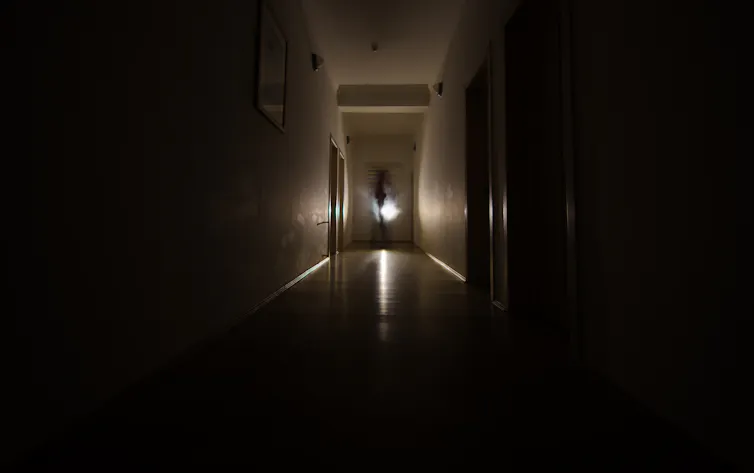
transparent outline of a girl in a creepy hallway
A perfect storm of factors can make a ghost seem like the only explanation.
urbazon/E+ via Getty Images

When haunted factors add up to a ghost

While I cannot say for sure whether ghosts exist, I can propose a plausible explanation for why some people might be more prone to apparent paranormal experiences than others.

Consider a person who believes in paranormal phenomena who experiences a natural change in electromagnetic fields or an episode of sleep paralysis. Those experiences induce unusual sensations that this person cannot explain. Searching for meaning in ambiguity, this person distorts their distinction between internally and externally generated sensations. They settle on the only explanation that makes sense to them – that this strange feeling they experienced was a ghost.

My guess is that belief in the paranormal is the glue that holds the haunted factors together to create the (mis)perception of a ghost.

One experiment asked participants to walk through a disused theater in Decatur, Illinois. Some were told that the theater was haunted, and some were not. Several participants noted weird sensations that they attributed to paranormal activity – but only those who believed that the theater was haunted reported these sensations.

Belief alone might not create a ghost, but belief combined with at least one haunted factor – environmental stimuli, neurological hiccups or psychological conditions – might be enough to make a ghost real.

This becomes a chicken-or-the-egg riddle – or in this case, the ghost or the EMF. Someone who is more likely to be sensitive to environmental factors or who experiences sleep paralysis might create belief from their experiences. When someone cannot explain these experiences with any “natural” explanation, a supernatural explanation might be the only one that makes sense.

I’ve never noticed EMF. I’ve never experienced sleep paralysis. I’m pretty sure I don’t have personality traits like schizotypy. I don’t believe in the paranormal. And I don’t think I’ll ever see a ghost.The Conversation

Melissa Maffeo, Teaching Professor of Psychology, Wake Forest University

This article is republished from The Conversation under a Creative Commons license. Read the original article.
Continue reading “Reprint: Is My Brain Wired To Never See a Ghost?”

Reprint: The Joy of Mindful Reading

Deep reading can boost your critical thinking and help you resist misinformation – here’s how to build the skill

Just slowing down gives you time to question and reflect.
Morsa Images/DigitalVision via Getty Images

JT Torres, Washington and Lee University and Jeff Saerys-Foy, Quinnipiac University

The average American checks their phone over 140 times a day, clocking an average of 4.5 hours of daily use, with 57% of people admitting they’re “addicted” to their phone. Tech companies, influencers and other content creators compete for all that attention, which has incentivized the rise of misinformation.

Considering this challenging information landscape, strong critical reading skills are as relevant and necessary as they’ve ever been.

Unfortunately, literacy continues to be a serious concern. Reading comprehension scores have continued to decline. The majority of Gen Z parents are not reading aloud to their young children because they view it as a chore. Many college students cannot make it through an entire book.

With their endless scrolling and easy reposting and sharing of content, social media platforms are designed to encourage passive engagement that people use to relieve boredom and escape stress.

As a cognitive scientist and a literacy expert, we research the ways people process information through reading. Based on our work, we believe that deep reading can be an effective way to counter misinformation as well as reduce stress and loneliness. It can be tough to go deeper than a speedy skim, but there are strategies you can use to strengthen important reading skills.

woman sits on end of bed holding head in hand while looking at phone
Counterintuitively, social media can make you feel more bored and lonely.
Dmitrii Marchenko/Moment via Getty Images
Deep reading versus doomscrolling

People use smartphones and social media for a variety of reasons, such as to relieve boredom, seek attention, make connections and share news. The infinite amount of information available at your fingertips can lead to information overload, interfering with how you pay attention and make decisions. Research from cognitive science helps to explain how scrolling trains your brain to think passively.

To keep people engaged, social media algorithms feed people content similar to what they’ve already engaged with, reinforcing users’ beliefs with similar posts. Repeated exposure to information increases its believability, especially if different sources repeat the information, an effect known as illusory truth.

Deep reading, on the other hand, refers to the intentional process of engaging with information in critical, analytical and empathetic ways. It involves making inferences, drawing connections, engaging with different perspectives and questioning possible interpretations.

Deep reading does require effort. It can trigger negative feelings like irritation or confusion, and it can very often feel unpleasant. The important question, then: Why would anyone choose the hard work of deep reading when they can just scroll and skim?

Motivating mental effort

Mindless scrolling may come with unintended consequences. Smartphone and social media use is associated with increased boredom and loneliness. And doomscrolling is related to higher levels of existential anxiety and misanthropy.

In contrast, attention and effort, despite being exhausting, can deepen your sense of purpose and strengthen social connection. People also feel motivated to complete tasks that help them pursue personal goals, especially when these tasks are recognized by others. For these reasons, sharing books may be one tool to promote deep reading.

One example is a teacher who guides students through longer texts, like novels, paired with active discussions about the books to reinforce comprehension and interpretation. While the debate over the ongoing practice of assigning excerpts over full books in schools continues, evidence does suggest that sustained reading in social settings can promote lifelong enjoyment in reading.

With social connection in mind, social media can actually be used as a positive tool. BookTok is a popular online community of people who use TikTok to discuss and recommend books. Fans post in-depth analyses of “K-Pop Demon Hunters” and other movies or shows, demonstrating that close analysis still has a place in the endless scroll of social media.

three people laughing together at a table, with books open in front of them
Talking about what you’ve read can add a social dimension to what can be a solitary activity.
Alfonso Soler/iStock via Getty Images Plus
Slowing yourself down to read deeply

There are steps you can take to meaningfully engage with the constant stream of information you encounter. Of course, this process can be taxing, and people only have so much effort and attention to expend. It’s important to both recognize your limited cognitive resources and be intentional about how you direct those resources.

Simply being aware of how digital reading practices shape your brain can encourage new attitudes and habits toward how you consume information. Just pausing can reduce susceptibility to misinformation. Taking a few extra seconds to consciously judge information can counteract illusory truth, indicating that intentionally slowing down even just a bit can be beneficial.

Reading deeply means being able to intentionally choose when to read at different speeds, slowing down as needed to wrestle with difficult passages, savor striking prose, critically evaluate information, and reflect on the meaning of a text. It involves entering into a dialogue with the text rather than gleaning information.

Awareness does not mean that you never doomscroll at the end of a long day. But it does mean becoming conscious of the need to also stick with a single text more frequently and to engage with different perspectives.

You can start small, perhaps with poems, short stories or essays, before moving up to longer texts. Partner with a friend or family member and set a goal to read a full-length novel or nonfiction book. Accomplish that goal in small chunks, such as reading one chapter a day and discussing what you read with your reading buddy. Practicing deep reading, such as reading novels, can open you up to new perspectives and ideas that you can explore in conversation with others, in person or even on TikTok.The Conversation

JT Torres, Director of the Harte Center for Teaching and Learning, Washington and Lee University and Jeff Saerys-Foy, Associate Professor of Psychology, Quinnipiac University

This article is republished from The Conversation under a Creative Commons license. Read the original article.

Coping Strategies in an Ongoing Pandemic

From time to time, I focus on an article that in my estimation offers valuable information or reflection on the stresses of the times. These last four years have presented one crisis after another. And now a pandemic that threatens not only my life and health, but those of my loved ones and friends. So it’s a good time to review what enhances our resilience and remind ourselves that we are indeed resourceful. We are not always so, and not all of us are at the same time. Not every piece of advice will seem appropriate to each of us. One of the many benefits of community is that we can remind one another of our strength, we can role model sanity and self-care, and those of us who have hope at any given moment can carry those of us who are mired in despair through the dark hours.

We’ll get through this. Together.

On to the article: This is by Craig Polizzi, a PhD Student in Clinical Psychology, and Steven Jay Lynn, Distinguished Professor of Psychology, both at Binghamton University, State University of New York.

Your coping and resilience strategies might need to shift as the COVID-19 crisis continues

The authors highlight three strategies we might use to reduce stress and rebuild our lives, even while the pandemic is still raging. This is going to go on for a while, folks, so let’s see what we can do to make the best of this episode in our lives.


Cognitive reappraisal involves reframing the way one interprets an emotional or stressful event or situation to regulate or neutralize its harmful impact. You can think about working from home, for example, as an opportunity to spend more time with family, engage in hobbies or get caught up on projects, rather than as a threat to job security. This strategy tempers the kind of all-or-nothing thinking – such as “the world is unsafe,” “I cannot do anything to help” and “our leaders know nothing” – that can take people down a road of anxiety, worry and mistrust of others. Instead, reappraisal helps you move toward healthy perspectives on stressful situations, dampens negative emotions and boosts positive emotions and keenness to participate fully in life.


Problem-focused coping can be another helpful strategy. It frames a stressful situation as a problem to be solved and fuels planning and the search for practical solutions. For example, people who know they feel worried or depressed after consuming news can plan to monitor and control the timing (such as not before sleep), nature and amount of news they consume. Effective problem-solving increases positive emotions, self-confidence and motivation. It also lessens the psychological impact of stressors.
As society opens up, you need to weigh the pros and cons of shopping, eating in restaurants, or seeking medical treatment, informed by the best available evidence. Problem-focused coping can help you make decisions about whether an activity is safe and consistent with your personal values and the needs of others.

Lovingkindness meditation can help you get through trying times. It involves contemplating and generating positive feelings and tolerance towards yourself and others. Combining lovingkindness meditation with empathy for those with different political views, for example, can help heal frayed bonds of friendship when social support is most needed. Pausing each day to embrace love and kindness counteracts self-blame, guilt, feelings of alienation and social isolation.

And anything that increases the amount of compassion and love in the world is surely a good thing.
For the complete article, click on the title link.