Alex Washoe, a writer I follow on Facebook, posted this quote the other day:
Your style is a function of your limitations, more so than a function of your skills.
– Johnny Cash
It got me to thinking, which was her purpose in posting. It’s certainly something that applies to all kinds of artists.
There are many different kinds of limitations. I recently finished the book What Can A Body Do? How We Meet the Built World by Sara Hendren, who teaches design for disability at Olin College of Engineering. The book is much more than an explanation of cool methods developed to address various disabilities (created both individually and as systems); it also gets into discussions of social and philosophical complexities.
For example, she discusses the experience of Audre Lorde, who had a mastectomy and declined to use a prosthetic, only to discover the expectation that she should wear one to make other people comfortable even if it was not comfortable for her. Hendren observes:
Her post-op prescription for prosthetics was never solely about functionality; it carried a social meaning.
And a discussion of humans as tool users – one of the most basic things we do – leads her to muse “your everyday life offers non-stop evidence that the body-plus may actually be the human’s truest state.”
Because I’d recently read the book, my first reaction to the word limitations was to think of those that come with every human body. Even if you aren’t disabled, there are things your body won’t do that someone else’s does easily.
Some people are very physically flexible; others will never be no matter how much stretching they may do. Certain activities require certain body types – ballet dancers are a good example, one made most stark by the fact that so many of them are retired by the time they are forty because even with the perfect body they are doing things that cannot be sustained into old age.
However, a lot of people who have a passion for dance have found ways around that, ways that incorporate their limitations. There are dancers who perform in wheelchairs, dancers that have curvy bodies and big hips, dancers who are not remotely young. Their limitations are part of their style.
A singer might have a voice others find pleasing, but still have a limited range, which affects the songs they sing and the way they sing them. That is style. In fact, there are some singers whose voice is not necessarily pleasing to all – Bob Dylan comes to mind – who make a virtue of that necessity. Continue reading “Limitation as a Virtue”…
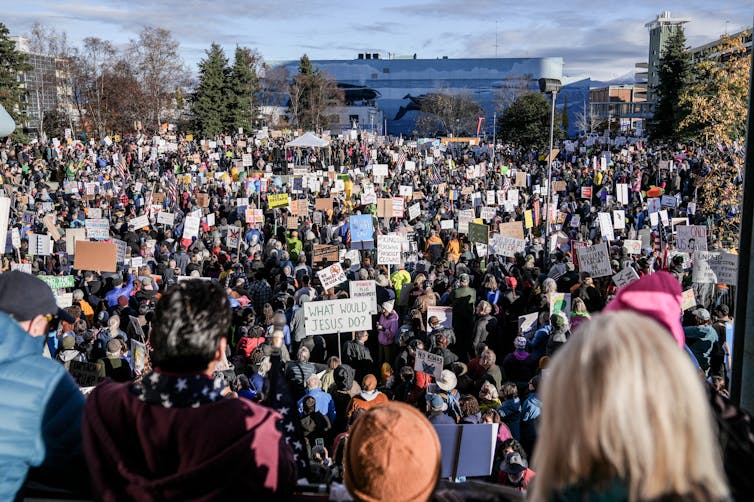
That may well be the question being asked by “No Kings” protesters, who marched, rallied and danced all over the nation on Saturday, Oct. 18, 2025.
Pro-democracy groups had aimed to encourage large numbers of Americans to demonstrate that “together we are choosing democracy.” They were successful, with crowds turning out for demonstrations in thousands of cities and towns from Anchorage to Miami.
And while multiple GOP leaders had attacked the planned demonstrations, describing them as “hate America” rallies, political science scholars and national security experts agree that the current U.S. administration’s actions are indeed placing the world’s oldest continuous constitutional republic in jeopardy.
Once a democracy starts to erode, it can be difficult to reverse the trend. Only 42% of democracies affected by autocratization – a transformation in governance that erodes democratic safeguards – since 1994 have rebounded after a democratic breakdown, according to Swedish research institute V-Dem.
Often termed “democratic backsliding,” such periods involve government-led changes to rules and norms to weaken individual freedoms and undermine or eliminate checks on power exercised by independent institutions, both governmental and non-governmental.
Even so, practices used globally to fight democratic backsliding or topple autocracies can be instructive.
In a nutshell: Nonviolent resistance is based on noncooperation with autocratic actions. It has proven more effective in toppling autocracies than violent, armed struggle.
But it requires more than street demonstrations.
One pro-democracy organization helps train people to use video to document abuses by government.
That momentum can be challenging to generate. Would-be autocrats create environments of fear and powerlessness, using intimidation, overwhelming force or political and legal attacks, and other coercive tactics to force acquiescence and chill democratic pushback.
Autocrats can’t succeed alone. They rely on what scholars call “pillars of support” – a range of government institutions, security forces, business and other sectors in society to obey their will and even bolster their power grabs.
However, everyone in society has power to erode autocratic support in various ways. While individual efforts are important, collective action increases impact and mitigates the risks of reprisals for standing up to individuals or organizations.
Here are some of the tactics used by those movements across the world:
1. Refuse unlawful, corrupt demands
When enough individuals in critical roles and institutions – the military, civil servants, corporate leaders, state government and judges – refuse to implement autocratic orders, it can slow or even stop an autocratic takeover. In South Korea, parts of the civil service, legislature and military declined to support President Yoon Suk Yeol’s imposition of martial law in 2024, foiling his autocratic move.
2. Visibly bolster the rule of law
Where would-be autocrats disregard legal restraints and install their supporters in the highest courts, individual challenges to overreach, even if successful, can be insufficient. In Poland, legal challenges in courts combined with public education by the judiciary, lawyers’ associations initiatives and street protests like the “March of a Thousand Robes” in 2020 to signal widespread repudiation of the autocratic government’s attacks on the rule of law.
3. Unite in opposition
This year’s Nobel Peace Prize winner, Maria Corina Machado from Venezuela, is an example of how political parties and leaders who cooperate across differences can offer an alternative vision.
Voting autocrats out of office remains the best way to restore democracy, demonstrated recently by the u-turn in Brazil, where a pro-democracy candidate defeated the hard-right incumbent. But this requires strategic action to keep elections truly free and fair well in advance of election day.
6. Organize your community
As in campaigns in India starting in 2020 and Chile in 2019, participating in community or private conversation forums, local town halls or councils, and nonpartisan student, veterans, farmers, women’s and religious groups provides the space to share concerns, exchange ideas and create avenues to take action. Often starting with trusted networks, local initiatives can tap into broader statewide or national efforts to defend democracy.
Bringing together people across ideological and other divides can increase understanding and counter political polarization, particularly when religious leaders are involved. Even in autocratic countries like Turkey or during wartime as in Ukraine, deepening democratic practices at state and local levels, like citizen assemblies and the use of technologies that improve the quality of public decision-making, can demonstrate ways to govern differently.
The end of American democracy is not a foregone conclusion, despite the unprecedented rate of its decline. It will depend, in part, on the choices made by every American.
It probably doesn’t surprise anyone that I was reading science fiction and fantasy books for this project, which includes books from just about every genre you can think of, including poetry as well as prose. I noticed in going through the list that it includes several horror books as well as literary fiction and a lot of creative nonfiction.
Each reviewer was only able to provide capsule reviews of two or three books, which made the task very difficult. I read many other books that I really liked. Small presses are really publishing great things these days.
While you read this, I will be Medievalisting in Melbourne. Monday is my recovery day, so I’m seeing friends and family Tuesday I have in-service training which basically means really good behind the scenes tours at a major library and a major art gallery. Wednesday to Friday is the conference proper. My paper is written, my slides are almost there* and I don’t feel at all ready for any of it.
I’ll report back next week! There may be pictures, or there may not. It depends…
It’s rare that I can visit any campus these days, because I’m Jewish, but a friend has given me her phone number and the security number and, hopefully, all will be well.
My cutest slide is of the word ‘ritter’ scratched on a slate in Hebrew characters. I am so dreaming of writing a story where a Medieval Jewish school boy dreams of becoming a knight. If you want to see this picture, let me know, and I’ll share it when I’m at my own desk.