
History and fiction and time out from hate

I found my missing post. Here it is!

I logged in, expecting to tell you how the hate in Australia (which began as antisemitism and is now extending) is so tightly focused that your best friend might be bullied and you might not see it. When I’m alone, that bullying eats up a chunk of my day each and every day. This last week, however, it was less than a minute of each day and it was not every day. I was able to talk work with colleagues. When I sat down here, it struck me that I don’t often talk about that side of my life.

I used to. I used to be the kind of irrepressible historian who got excited for everyone. I’m still that historian. I don’t get to talk about it so often, is all.

Instead of dwelling on the bad side of life, then, let me find one page of notes from one day of the conference (one in forty-five pages of notes from the conference) so that you can enjoy history with me. We all need time out from hate, after all and every single US reader here had a lot more trouble to handle in the every day.

Some of you know that one of my novels (Poison and Light) is about how future humans use the past to hide from a present they found uncomfortable. Right now, a group of Australian scholars is examining how people in Early Modern England (and elsewhere, but the papers I heard were on Early Modern England) use history to imagine the future. The discussion was wide-ranging. They talked about witches and about ghosts, about predicting disaster and about what happened when the disaster failed to occur, about pamphlets and politics and poetry. It was the perfect panel for fiction writers and an exceptionally strong example of why fiction writers should get to know Medievalists and Early Modern scholars. Every other minute I thought of a writer who should have been there, asking questions about the ghosts and about the politics. The worlds they explain and the concepts they explore help us understand what we write and help us write it the best we can.

How does this understanding work in practice? My notes have an outline describing how the chair (and the head of the research project, who of course I talked to afterwards and of course we’ve planned to meet to talk about the science fiction side of things) breaks down the concepts of Imagining the Future into categories that can be explained.

She spoke about writing that give models of temporality: utopias, dystopias, and the mundane. Think about how these categories fit modern science fiction. Poison and Light is half-dystopia and half mundane, because all of my fiction talks about the lives of individuals and so the mundane is important to them. China Mieville (to my mind) writes dystopias and so does Sheri S Tepper.

But who writes utopias? I can think of earlier writers, like Sir Julius Vogel. Help me out! Who is writing now and has written a utopia that brings history into the future? We were given the theory of Star Trek, because it claims to be in a perfected future (at least for humans) but the reality of Star Trek is not utopian. Star Wars is, however, dystopian. It’s much easier to find examples when one looks to television. But I want to talk about novels!

She then moved to scales of temporality, whether the novel is set near (Earth!) or far away (Poison and Light again, since it’s in a solar system far far away – I may have attended the conference as an historian, but during this panel I felt so seen as a writer). With TV, my mind goes straight to the Jon Pertwee years of Doctor Who and compares them with (of course) Star Wars … again.

Why is the near and far important? Because so much of historical writing is used to discuss this apocalypse, or that. How far is apocalypse from our everyday? Much further, if it’s not on Earth. And here Poison and Light fails. It’s set far away, but Earth faces apocalypse while the people on New Ceres pretend they live in the eighteenth century. (I’m seeing this now with the lucky souls who are not enmired in hate – they are the people on New Ceres, while most of us are, alas, on Earth.)

I keep thinking that this whole project can help me understand my own New Ceres universe. I’m writing a second novel set on Earth next year, where the 14th century and the 17th century and how we deal with post-apocalypse join the party. My project echoes the ideas of people hundreds of years ago as humanity faces a bleak present. Where some people find refuge in fancy dress, others find refuge in explaining the world through ghosts and looking at neighbours as if they themselves are the catastrophe.

The last category asks whose future it is. Is it personal and everyday? Is it national? Is it a global future (my New Ceres again), a human one… or is it post-human.

The experts were historians and literary historians and most of the examples (by a long, long way most of the examples) belong to our past. The categories were however, really handy for questioning and understanding science fiction. And now you know why I will not give up that side of my life. I have learned so much in such a short time, and my fiction benefits.

Every time universities lose these experts, we lose the benefit of their thought and learning… and our everyday suffers.

Let me go away and think about what our lives would be like if we didn’t have these little injections of learning to help us tell better stories. No, let me not. Let me go away and write more fiction, celebrating the worlds of both historians and writers.
Such a week…

Part of the annual report into antisemitism in Australia was released last week. Also last week (just before I left Melbourne to come home, in fact) a synagogue was firebombed. Thankfully there were no casualties in the attack. But..

I am now facing the deluge of comments one gets after the news was released. So many of those talking about the attack believe it is by “Zionist Jews.” I want to stand up and shout that every single one of these people is a bigot. They’re using the fourth definition to “Zionist” to replace most of the poison inherent in the words they’re using to replace “Zionist”, such as “Jews.” This definition reflects the emotion and hate in the mind of the user. It does not reflect Australian Jews at all. Take my siblings: some support Israel, some don’t, some are quiet on the subject because they believe it’s not anyone else’s business. And one of us (not me) is Ultra-Orthodox and has links to the burned synagogue. None of us have any wish to burn down any synagogue, much less one filled people books we love and people who know members of our family.

I saw walls of Talmud charred to black and it reminded me of the times when (in Europe) supersession saw Jews expelled from their homeland of hundreds (possibly up to 1400) years, and in other places saw cartloads and cartloads and cartloads and cartloads of Talmuds burned. Those burnings were to make certain that Jewish culture and religion was frozen at the time of Jesus, because that was the only relationship with Jews that these particular Christians could handle. Note I said “these particular Christians.” Most contemporary Christians and contemporary Muslims do not condone barbaric acts. They are not the people crying that all Jews need to be deported from Australia, to make way for a return of the old White Australia.

The ‘old White Australia’ is a fiction. “White Australia” is complex but has very little in common with what those shouting think. I want to sit down and teach them some history. Literally, in terms of people, before Europeans came it was not White at all, and when the First Fleet arrived… there were Jewish convicts on it. The members of the public shouting about Australian Jews not being White and not being wanted here has returned, but I’m still told I have White privilege. Most of those telling me I have White privilege and should be deported came from families who arrived here after my own. And the shouts are louder right now.

I can give you the old and new definitions of Zionism if definitions can help you deal. I can also give you a photograph. The photograph is more, fun, so I’ll only give you the definitions if you want them (just ask!).

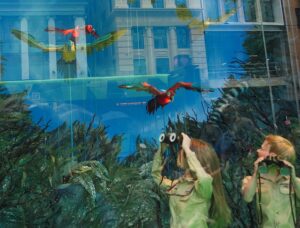
Why the photograph? The Myer Christmas windows are a feature of the Melbourne landscape at this time of year. This year, the pro-Palestinians marchers (some of them are the same people who want me deported and blame Jews for everything that hurts) protested against them. We all looked for reasons. Maybe it was because Myer was founded by someone Jewish… except Sidney Myer converted to Christianity. Maybe they hate all people who have Jewish ancestry? That’s the purity of blood notion, used to hurt those who could not shake off their Jewishness enough in Early Modern Spain and Spanish territories. If you’re not familiar with this long moment in the history of the Spains, look up ‘Torquemada.’  Jewish ownership of business? Myer is not owned by Jews. This means that either the Christmas windows themselves are deeply offensive (and aimed at children, therefore problematic) or those protesting them are idiots. I’ll let you decide:


The Irwins looking at parrots in the Australian Outback, Myer windows 2024
Melbourne, December 2024

Some Days

I’m writing this late on my Monday evening because I was so worried about what was happening in my hometown. Not where I live now (Canberra) but where my family has lived since 1858. Outside a synagogue not at all far from my own childhood one, and half a suburb away from where my mother lives, there was going to be a pro-Palestine demonstration. Given what happened in Montreal over the weekend, I did not like this at all. Given what happened a few minutes away last year, during a Friday service on the anniversary of Kristallnacht, where my mother’s first cousin was one of the people ‘evacuated’ into a violent anti-Jewish crowd… I was very worried.

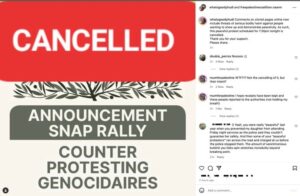
I’ve just seen the video clips of what transpired and Australia can sometimes be quite uniquely itself. Before I saw the video clips, however, I realised the angry crowd might be a bit smaller than last time. This notice was circulated on the interwebz shortly before the event:

Protesters still came. They were thoroughly covered, except for their eyes, and while this might have been sensible to hide their identities, it wasn’t such a good idea. Melbourne was not as hot as Canberra today, but Canberra was in the thirties… so these poor blokes must have been seriously uncomfortable.

I saw a bunch of clips of what happened after they arrived and there was no violence. Two of the pro-Palestine protesters were gently ushered into a police van and I’m pretty sure I heard someone say “Have a good day.” The angry violent Jews shouted “Go home. Leave us alone” in unison. well away from where the protesters stood.  I interpreted this (since I come from that community, I trust my interpretation) as “You’ve driven half an hour or an hour to be a pain, now just turn around and drive back, please.” They waved Israeli flags and Australian flags. They sang Hatikvah (mostly off-key) and several of them used the great Australian salute to the group of protesters.

No-one was hurt. Everyone got their point across, including the police. The worst loss was to the dignity of those who were scared of the young woman who led the “Go home” shout.

I wish more protests were like this.