
One of the (many) reasons to browse bookstores is that you stumble across books that you never heard of and would not have known to look for because it would never have occurred to you that you wanted to read a book about that particular thing until you stumbled across it.
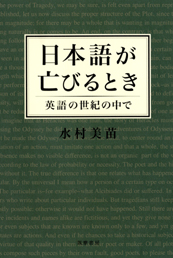
Right now my morning book is one that fits that description. It’s called The Fall of Language in the Age of English, by Japanese writer Minae Mizumura (translated by Mari Yoshihara and Juliet Winters Carpenter). I’m sure I bought it at East Bay Booksellers, because they sell a lot of small press and academic books and are a very likely place to run across the books you didn’t know you wanted until you picked them up.
I’m not 100% sure I bought it there because I’ve had it awhile and just got around to reading it. (Yes, I do that all the time. Doesn’t everybody?) It is a perfect book for my daily reading practice, which requires books that are best read a few pages at a time because they give you something to chew on.
(I should note that this daily practice of reading for about 15 minutes in the morning is far from the only reading I do. It is in a way of reading akin to meditation, which is very different from diving into the world of a novel.)
This book is about writing in national languages (and what constitutes a national language) when so much of the world’s written work is written and published in English, which is a universal language in much the same way that Latin was a few centuries back. But it makes its points slowly, clearly discussing important points along the way.
The whole book is fascinating, but here’s the concept that got to me on a personal and gut level as a writer:
The first prerequisite for fine literature is that the writer must see the language not as a transparent medium for self-expression or the representation of reality, but as a medium one must struggle with to make it do one’s bidding.
This, I think, is the essence of being a writer, the combination of having something you want to convey – be it a story, a philosophical approach, an understanding of the world – and struggling to find the right words for expressing it.
(The term “fine literature” makes me, as a science fiction writer, uneasy, since it is often used to exclude many pieces of writing I consider very fine indeed, but I define it more broadly as work that aspires to more than basic communication.)
This is in no way the same as learning how to apply the rules of grammar, though understanding them is one of the underpinnings of writing. It does, however, require a deep and abiding familiarity with the written language you use.
You certainly cannot write effectively in a language unless you have read in it deeply and thoroughly. Continue reading “Language and Writing”…