
One of the (many) reasons to browse bookstores is that you stumble across books that you never heard of and would not have known to look for because it would never have occurred to you that you wanted to read a book about that particular thing until you stumbled across it.
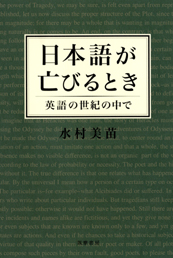
Right now my morning book is one that fits that description. It’s called The Fall of Language in the Age of English, by Japanese writer Minae Mizumura (translated by Mari Yoshihara and Juliet Winters Carpenter). I’m sure I bought it at East Bay Booksellers, because they sell a lot of small press and academic books and are a very likely place to run across the books you didn’t know you wanted until you picked them up.
I’m not 100% sure I bought it there because I’ve had it awhile and just got around to reading it. (Yes, I do that all the time. Doesn’t everybody?) It is a perfect book for my daily reading practice, which requires books that are best read a few pages at a time because they give you something to chew on.
(I should note that this daily practice of reading for about 15 minutes in the morning is far from the only reading I do. It is in a way of reading akin to meditation, which is very different from diving into the world of a novel.)
This book is about writing in national languages (and what constitutes a national language) when so much of the world’s written work is written and published in English, which is a universal language in much the same way that Latin was a few centuries back. But it makes its points slowly, clearly discussing important points along the way.
The whole book is fascinating, but here’s the concept that got to me on a personal and gut level as a writer:
The first prerequisite for fine literature is that the writer must see the language not as a transparent medium for self-expression or the representation of reality, but as a medium one must struggle with to make it do one’s bidding.
This, I think, is the essence of being a writer, the combination of having something you want to convey – be it a story, a philosophical approach, an understanding of the world – and struggling to find the right words for expressing it.
(The term “fine literature” makes me, as a science fiction writer, uneasy, since it is often used to exclude many pieces of writing I consider very fine indeed, but I define it more broadly as work that aspires to more than basic communication.)
This is in no way the same as learning how to apply the rules of grammar, though understanding them is one of the underpinnings of writing. It does, however, require a deep and abiding familiarity with the written language you use.
You certainly cannot write effectively in a language unless you have read in it deeply and thoroughly.
Ah, yes, that is another argument for why it can take a very long time to become a great writer, because you need many years of reading as well as writing to take your struggle with the way something needs to be said for a particular piece to the highest levels.
I often find myself thinking, when reading something I’d consider fine literature, “how the hell did they do that?” Sometimes I can analyze it; sometimes I just soak it in. But it pleases me greatly to find those amazing places.
I tend to absorb ways of writing on a more intuitive level; I find it hard to reduce those things to specific rules. Following spelled-out rules – show don’t tell, don’t use the passive voice – gets in my way. I have read a lot and continue to read a lot and I try to absorb the structure as well as the story to develop a gut understanding of what works.
(I’m not recommending my method; just explaining it.)
What you put down on the page is more than the sum of grammatical (or purposefully ungrammatical) sentences and a story you’re telling. The language and the structure have to fit what you’re doing.
This is another one of the many reasons why ideas are not the point. It’s what you do with the idea that matter.
And this, of course, is why large language models – so-called AI – cannot create anything resembling literature. Since “AI” is not, in fact, intelligent and cannot, in fact, think, it cannot struggle with the ways of constructing the story.
Writing is not predicting the most likely next word. It is finding the perfect next word and puting all the words together in the sentence that tells the story you want told in the way you think it should be told.
And no, this incorrectly labeled AI is not going to somehow become sentient just because it has been programmed with massive amounts of the written word. It’s not reading those words, absorbing them, looking at them to figure out why one sentence works better in a particular location but would be unreadable somewhere else.
It can’t reason. I won’t say there will never be a constructed intelligence that can reason, only that I don’t think we’ll get one by building data centers and stealing everyone’s written work.
Brains aren’t computers. Computers can do many useful things that one human being cannot, but they don’t do it in a way that implies sentience and there are so many connections that brains can make that are completely foreign to computers.
It occurs to me that I have spent my life immersed in English. I regret not knowing other languages well – I have some Spanish and less French and though I can read both and sort of converse, I cannot write either well enough to construct more than rudimentary sentences.
But I do know English, inside and out. It is the universal language at present – I think Mizumura is quite right about that – but for me it is the language I grew up with, the one I think in, the one I can play with.
I write in English for the same reason that other writers Mizumura discusses write in their native language, not because it is universal.
I’m getting close to the end of the book where she writes about the effect of English on other languages, most notably Japanese. I’ll write more about that another time, as I suspect she has more ideas that are worth my time.
I’m especially interested in her idea that language is “a medium one must struggle with to make it do one’s bidding.” I often feel that language for a writer is a medium like paint is for a visual artist. But I don’t feel it necessarily does my bidding. It’s more like (when a poem works) there is an interchange — conversation, struggle — between the words and what I’m thinking and feeling.
As Victoria Chang writes in her poem “Agnes Martin, Fiesta, 1985”:
What is art but trying to make something resemble what it was before it was made, when it was still unknown and free?
Ooh, I like that quote from Victoria Chang’s poem. I’ve been telling myself pieces of my novel to fall asleep at night and I’m a little nervous about writing them down for fear they won’t match that image.
I don’t think I’m trying to make words do my bidding either. For me it’s more like an expedition to find the perfect way of saying something. And then when it isn’t quite right, the ongoing conversation, as you say.