Miss Vickers Does Not Regret

This week got away from me (or I thought it was last week, or something. In these times, who knows?). So here is a post from a few years ago, from my website. I still love Ann Vickers.

I love the work of Sinclair Lewis.  Even though I know better. Even when his prose is didactic and braying and he can’t make up his mind who he most disdains: country folk, city folk, religious folk, doctors, lawyers, academics, politicians. Ever since high school I have felt like I needed to apologize, maybe even join a 12-step program, for my fascination with Lewis. And yet fascinated I am.

Why apologize? Lewis is respectable, albeit not much in fashion these days. He gave us the terms “Main Street” and “Babbit.” He won a Nobel Prize for Literature. He was passionate and passionately observant.  He had a sharp ear for dialect, for the self-congratulating boosterism of early 20th century America, for the moral compromises that even his most heroic characters (I’m thinking of Martin Arrowsmith in particular) find themselves making. And his portrait of America in the toils of a fascist take over, It Can’t Happen Here, is dated, folksy, and scary as hell. Every time I have found myself thinking of an incoming politician I distrust, “Hey, it’s only a few years, what damage can he really do?” It Can’t Happen Hereswims before my eyes.

Sinclair Lewis wrote Main Street and Babbit and Elmer Gantry and Arrowsmith, all of which I love. But my favorite of his books is one that no one I know has ever heard of: Ann Vickers. It’s not that Ann is Lewis’s only heroine. Carol Kennicott of Main Street was his first; and he’s got some remarkable women in Elmer Gantryand Arrowsmith (I love Martin Arrowsmith’s wife Leora; I don’t think he really deserved her, and I’m not sure Lewis did either). But Ann Vickers

It’s a book that follows Ann from tomboy to Sunday School teacher, to college, to work; she stumbles into a career that works for her, becomes successful–and on the way manages to make mistakes, build a whole life for herself, love the wrong men. Ann is smart but not brilliant; stubborn and strong but not unbreakable; she’s got a powerful moral center but doesn’t always have the strength or direction to change things, but when she does, she raises Hell. And she doesn’t have a plan, not really–she acts sometimes before she considers, and she sometimes wanders onto the easiest course. I found Ann Vickers immensely comforting when I first found it, because when I was in college I didn’t have a clue what I was going to do with my life, and Ann Vickers suggested that I’d figure it out in time.

Reviewers loathed Ann Vickers when it was published in 1933.  Not only does Ann have an affair with a soldier, but she becomes pregnant (and the guy drops her…did I say she loves the wrong men?).  And has an abortion, performed by a doctor who essentially says I hate abortion, but hate even more what the society we live in would do to Ann as an unmarried mother.  The abortion has an effect on Ann–she imagines the child she might have had, even (rather revoltingly) names her “Pride”–but it doesn’t stop her.  She isn’t punished.  Consider how that went over in 1933.  She goes on to be successful–very successful–in her career.  She has an affair with a married man, marries herself, has a child…and at a point when it seems like her world is falling apart (the man she marries is a manipulative creep, the man she loves has been arrested for corruption which might spill over into her work) she finds the strength we’ve seen in her all along.

She doesn’t apologize.  She’s a tremendously human person.  Where Carol Kennicott of Main Street ends the book at a standoff with her husband and her life in the tiny city of Gopher Prairie, the Ann Vickers Lewis leaves us with at the end of the book is heroic–The Woman, as Lewis styles her. Lewis can get a little icky when he’s moved or lyrical–he’s much better when he’s angry, pointing out hypocrisy.  But I can forgive his style for love of Ann.

Golden threads and weirdness and Australia.

I haven’t forgotten that I was going to introduce tsedakah last week. Stuff happens. And then more stuff happens. Much of the stuff has links to matters Jewish.

First we had the Bondi murders, and then a major literary conference fell to bits largely because of internal clashes about ethics. These internal clashes became a national mess. And now, Parliament’s back early and we had so many kind words about those lost at Bondi, and a national day of mourning later in the week and I think the whole country is confused. The latest political opinion poll suggests this. A far right party is coming out of the shadows and making one of the two largest parties in the country scared. The far left has most of its old vote, but not all. And our prime minister has lost most of his personal support: if Labor want a safe election next time, they might need to change their leadership. Or not. Labor is stubborn and full of factions.

All this pales compared with what’s happening in the Middle East, in Iran, in the US, and even in the UK. But it’s our mess, and we must handle it. One thing I would like to see us return to is civil society. Discussions and analyses rather than street marches.

Why? The big Sydney Harbour Bridge march last year had a lot of wonderful people doing what they thought was the right thing. Marching alongside them in support of Gazans were the Bondi shooters, and the rather antisemitic writer who upset the applecart in Adelaide and led to one of the most important writers’ festivals in the country being cancelled. Marching alongside this writer was almost everyone I’ve seen who is loudly and opinionatedly antisemitic. Many of these individuals were grouped near a guy holding a picture of Khomeini. I don’t know if it was a photo op, or if all these people actually work together, but the cluster of them in the most famous photo of the march indicates a cluster of problems.

It’s going to be difficult to roll back the performative and to return to the Aussie politics I used to know. I’m not connected in the way I used to be. I was pushed out of the behind-the-scenes stuff through being too Jewish and too ill. Australia admires health. It also has this really stupid habit of sweeping people who belong but should not be heard under the front stairs.

Why am I thinking of front stairs?

I’m back in the Middle Ages this week and ought to be talking about foodways, but have been focused on trying to understand our current very strange politics. What happens when the Middle Ages is there and I try to pretend it isn’t? Literary references happen, most frequently.

The boy under the stairs was Saint Alexis being holy. I’m probably under the stairs, but being sarcastic. The sarcasm means that old friends and new sneak in to join me, and we watch the goings on and are surprised at how people we know to be intelligent get caught up in performance and leave a goodly portion of their intellect behind.

Tsedekah is much nicer, but must wait until life is less exciting.

Just for the record, I could have gone to Parliament House and heard all the sorrowful speeches today. Instead, I watched the second last season of Stranger Things and I did some work and filled in all kinds of questionnaires. I decided it was not wise to hear those who ought to have sorted out the hate when it was straightforward being terribly sorry at all the murders. All those people should still be alive. Synagogues and mosques should not be burning. And all the time we spend trying to find that bolted horse could have been spent in doing so many things that Australia needed.

It will be Purim soon and gifts to two charities are traditional for this festival. I’ve chosen two that are important to me. It’s early, but all this thought led me to think what I could do. One charity gives reading to children. Those children are very rural and living on the land of their ancestors. They do so much better when they have books that concern themselves and are written by people they know in the language they speak. The other is for OzHarvest, which helped me out when I was under the poverty line. It rescues food and makes sure that food reaches people who don’t have the money to buy it.

Maybe around Purim will be an appropriate time to explain why the books are more Jewish as a gift than the food. Not more Jewish. I’m explaining badly. Ranked more highly as a type of gift. You’ll have to wait until March for the explanation.

Tomorrow is research-for-writing. I am interviewing a group of Jewish teenagers for a novel. A rather special novel, and one that I was not expecting to write. It’s not a guaranteed publication, but it’s a guaranteed “I’d love to see this if you’d consider writing it.” It’s the kind of book I’ve been saying we need for the last 20 years, one where Jewish Australia is shown as the driver of a story about Jewish Australians. The US has many YA novels that do just this for Jewish readers, but Australia, far less so.

I’m also finishing a short story where the King of Demons meets a very English vampire in Sydney. I have other fiction happening, including a novel emerging later in the year, but this week everything is Jewish.

The more hate there is, the more I write Jewish stories and Jewish history. Hate has reinforced my Jewishness ever since I was a child. When I was accused of eating baby’s blood in unleavened bread (in primary school), I taught the accusers basic kashruth. These are the type of stories I always tell.

What I don’t always tell is the reason I learned the Grace After Meals (the long one, all in Hebrew). I was so annoyed with several bigots and I decided I would say it every single lunchtime until the haters stopped bugging me. I kept saying it even after they stopped bugging me. Also they would have stopped bugging me anyhow, but I didn’t know this until it happened.

They didn’t stop because I could babble in Hebrew. They stopped because I became the high school student everyone else needed to ask questions of, especially in the lead up to exams. I could teach and I remembered everything teachers’ said and I understood it all. This gave me a place to belong, a role that was so very much mine. After I put the siddur away, someone would sit next to me and ask “Gillian, do you remember the calculus from yesterday?” or, a couple of years later, “Gillian, tell me about this piece of Chaucer.”

What most Jewish Australians have been pushed out of are those places we belong in the wider community. Since Australia is so secular, this is rather more important than it looks. Changing definitions, not listening to our voices, not publishing our books, telling us we have to leave our home country because we’re Jewish, accusing us of all kinds of impossible crimes… this all smudges together and makes an everyday that’s very difficult to handle.

Every single Australian organisation that still accepts me as Gillian (right now, my professional Medieval one, the Tolkien folks, and the Perth science fiction convention) gives me a golden thread to hold and to guide me through this labyrinth. Every single one that cuts off that thread (more than one writers’ organisation), leaves me stumbling. I find my balance within Jewish Australian culture, because that’s the place where my identity is not questioned.

As has been said so many times about Australia, we’re a weird mob. This is just another facet of that weirdness.


Outrage at the Outrageous

Back when I was a kid, the idea that any kind of authority could stop a person and demand their papers was considered outrageous, the sort of thing that happened in “bad” countries, not in the USA.

I was an Anglo kid, of course – Anglo in the Texas sense of being white and not Mexican American. Black people knew better as did Mexican Americans, including those whose families had lived north of the Rio Grande since before Anglo settlement in Texas in the early 1800s.

These days I know enough history to understand the amount of racial privilege packed into my outrage. Our history is littered with stories of people forced again and again to prove their right to exist while others are accepted even when they’re doing harm.

But I still feel that outrage on behalf of all the persons being harassed by trumped-up semi-cops right now. And I would get very angry if someone asked me for my papers.

I mean, I still get mad every time I’m driving near the Mexican border and have to stop at one of the border patrol stations that are inland from the actual border.

Not that I ever have any problem there. I’m very obviously Anglo and dealing with cops brings out my Anglo Texan accent. But it still pisses me off in a deeply personal way, and not just because I’ve noticed at those places that people whose skin is a little darker than mine end up spending a lot more time answering questions.

In his January 15 issue of his Law Dork newsletter, Chris Giedner reports that the awful woman who is running our Department of Homeland Security (an agency whose very name evokes Nazi Germany in my mind and has since the right wing came up with it after September 11) says anyone in the vicinity of an ICE operation can expect to have to prove their identity.

And of course, even proofs of identity don’t work if they want to abuse you. Or shoot you.

It is reported that a couple of the thugs doing these raids have said to people after the murder of Renee Good, “Didn’t you learn your lesson?” Continue reading “Outrage at the Outrageous”

Summer

I have two draft posts, lurking. They’re serious. Very serious. Full of the stuff of the moment. Half my day is spent fighting against hate, and those posts are about different facets of that.

I need a break. You need a break. We all need a break.

This is the perfect day for a break. It’s only 33 degrees C outside! And there’s only mild bushfire smoke! Positively salubrious. Also, someone has replaced the flag on the Iranian embassy (which is just a few miles from where I live) with the flag of the rebellion.

Let me give you an update on some of my 2026. It might be quite busy. I have 2 books to find homes for, novels emerging from the difficult period, short stories and essays emerging from the difficult period… and a conference the weekend after next where I get to talk about food and Tolkien. I have a meeting with an organiser to introduce them to the types of Jewish writing in Australia so that they can consider them for their annual programme and I have been tentatively approached about possible actual paid work.

This gives me hope.

I’ll let you know about the books and chapters and short stories as they appear. And now I go to consider how Sam Gamgee adoring potatoes is actually a Really Important piece of worldbuilding.

We Got Cats!

These are the times that try human souls.

I know that’s not how Thomas Paine said it – he wrote “men’s souls” of course. That’s usually excused by the explanation that “men” used that way includes all of us, but – not to disrespect Paine, who was a force for good in the Revolution – it really means that no one considered the thoughts, or even the souls, of women important.

At the moment, I am angry and depressed over the murder of a woman by an agent of an over-funded federal police agency that shouldn’t even exist, by the various actions against the people of Venezuela, by the way surveillance tech is creeping into all of our lives, and by the efforts (and not just by the regime controlling our federal government, but by local utilities) to slow walk renewable energy and keep polluting.

That’s just the short list for this morning. There are many other things I’m mad about.

However, I interrupt this listing of horrors for an important announcement:

We got cats!

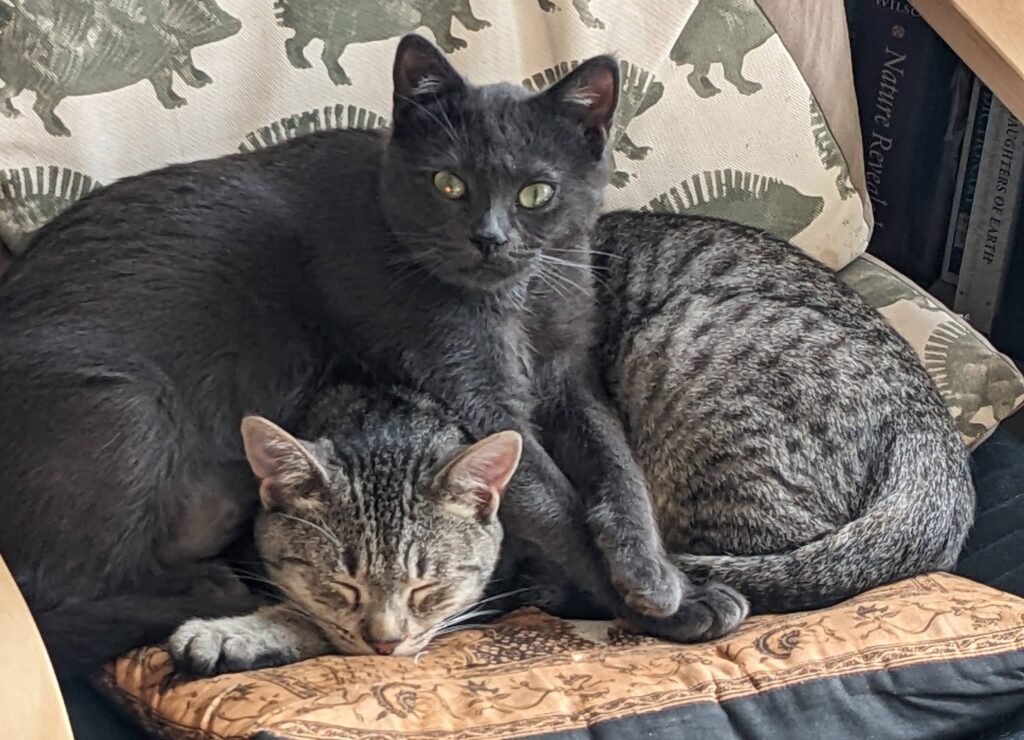
Meet Shadow (female dark gray) and Piper (male gray tabby), our new beloved and chaotic housemates.

A dark gray cat stands protectively over a sleeping gray tabby.

Continue reading “We Got Cats!”

Making and Tools

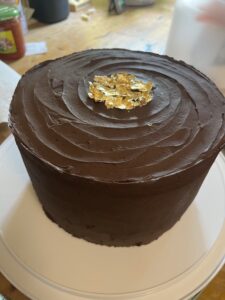
8 inch three tier chocolate cake with chocolate frosting, decorated with torn gold paper in the center of the top.
Birthday cake made for Chaz Brenchley. Chocolate cake with black-cocoa frosting.

I like to make things. In particular, I like to cook (in very particular, I like to bake). There are other things I do when the spirit takes me: bead, sew, very occasionally, knit. And write. And for all of these things making is rendered easier, not to say better, with the right tools. 

I began to think about this after seeing a clip on the internet where someone was asking “what is your favorite kitchen utensil.” And at least one of the people who was asked the question drew a total blank. “Who has a favorite kitchen utensil? Like, a spoon or something?” I can only assume that this person doesn’t cook, and regards the kitchen as a sinister place where wine glasses and bottled water are kept.

My initial problem with the question was kind of the opposite. Choose my favorite utensil? Outrageous: they’re all my favorites (and I don’t want to hurt my round Dutch oven’s feelings by preferring the oval Dutch oven, clearly). But as I was working in the kitchen this weekend I realized that, for certain purposes, I do have favorites, and they’re not unreasonable.

This weekend I made a cake for Chaz Brenchley’s birthday. Chaz, if you don’t already know, is a wonderful British writer of mysteries and fantasy (also writing as Ben Macallan and Daniel Fox), who married the lovely Karen Williams (now Brenchley) here in California and moved to the States. Usually when I visit Chaz and Karen I bring some baked goods, because it’s an excuse to bake without having the products in my own house. But a birthday requires something special and cake-like. And Chaz (unlike the man I married) does not turn up his nose at chocolate. So a chocolate cake it was, with dark chocolate frosting.

Rectangular stainless steel electronic scale, and folded instant-read thermometer.It was as I was making the cake that I realized I do have some very favorite kitchen tools: my instant-read thermometer, my kitchen scale, my decorating turntable, and my cake lifter. The utility of the instant-read thermometer is pretty obvious: no matter if you’re making fudge or rib roast, being able to  know what the temperature of the object is can be crucial. When I bake bread I can be misled as to the doneness by the golden color of the loaf, but my instant-read thermometer will tell me the truth about the interior. If I’m making filling for a cake, the instant read thermometer will keep me from turning the it into something stodgy and unlovely. I use my instant read thermometer daily.
Same goes with my kitchen scale. Particularly for baking. When I was a young, enthusiastic baker, I thought the point was to jam as much ingredients into a measuring cup as possible. More is better, right? Except that the variation between jamming all the flour you can into a measure, and sprinkling flour into the measure and wiping off the extra with the edge of a knife (the preferred method for bakers in the know) can make an actual difference in the finished quality of the baked good. This matters particularly when you’re following a recipe: to ensure success, you want the amount of flour or baking powder you’re using to match what the recipe developer is using*. It’s not that long ago (the late 1800s, I believe) when there was no standardization in measurements: “take a good knob of butter and add to it a spoonful of sugar” where no specification of what either measurement means? Waaaaaay too loosey-goosey.   Precision is a lovely thing. 

As I was making Chaz’s cake I thought about how comforting that precision is: I may screw things up, but it won’t be by putting in the wrong amount of stuff (it might be by omitting a step, but that’s another essay).

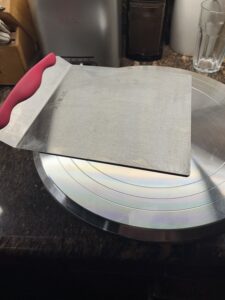
Cake lifter resting on my cake decorating turntable.

Once the cake was baked and ready to be frosted, I got to use two other of my very favorite kitchen tools: my decorating turntable and my cake lifter. Look: did I decorate cakes for years before I even knew these objects existed? You bet. But these are tools that make life easier, and isn’t that a good thing? This weekend I did not, aft first, deploy the turntable: after all, I wasn’t going for a highly finished cake. And the turntable lives in the basement along with a lot of my other cake-making paraphernalia (yes, I have that much. My husband still has his model trains in the basement. Don’t judge me). For a moment I didn’t feel like going downstairs to get the turntable. But as I started applying frosting to the cake I remembered how frustrating it is to have to turn the cake while it’s sitting on the counter, and how messy. I yielded to common sense and brought up the turntable, as well as my cake carrier (yet another indispensable tool for the cake maker). The base of the cake carrier is roughly the same size as the turntable, but if I tried to use it as a cake platter… 1) it would slip right off the turntable, with predictably distressing results, and 2) it would look awful. So I put the cake on the turntable and frosted it. Once all the frosting was in place I could rotate the turntable while scraping the sides, so they look nice and straight and smooth. The right tool for the project, right?

Finally, when I was happy with the cake, I used the cake lifter to lift it off the turntable without damaging the bottom edge of the cake, and deposited it on a platter which could then go in the cake carrier. For years I did the same thing using several standard spatulas, and it just… never worked properly. Fully frosted cakes are heavy, and tend to want to slide off smaller spatulas and… please don’t make me explain further. Things sometimes got ugly

So those are (some) of my favorite kitchen utensils. When I get a new one I frequently have a honeymoon period where every time I use it I am just tickled that I have such a thing. I really am a simple soul. Eventually it just becomes another object in my armamentarium of kitchen tools. But I still appreciate it.

For other things–Oh, I could sing you a paean of praise for my thread burner (for beading) or my Oxford Compact English Dictionary (for writing–also an excellent weight when cheddaring cheese). It is an excellent thing to have a tool that helps you do what you want to do.

So what’s your favorite tool? Or tools? 


__________

*Even now, when recipes on the internet can come from all over the world, the astute baker keeps track of whether a recipe is written in Imperial measurements, grams, etc. It’s all well and good to measure vanilla “with your heart;” baking soda, not so much.


More Context

Last week I gave some of the contexts for current antisemitism in Australia.

This week, so many of the Left are arguing that we don’t need a Royal Commission and so many others are arguing that we do need a Royal Commission, but very few of them are talking about the path Australia had taken to reach the point where Jews were murdered on Bondi. For some (especially on the right) it fits a bunch of their conceptions of the Labor Government, and on the Left, they are being very careful to disassociate the shooters from any demonstrations and other hate and very slow to admit the government cutback on investigations of what ASIO had determined was the #1 threat to Australia. In other words, the government may well have seen this coming.

If they didn’t, then they missed the picture of the shooters marching across Sydney Harbour Bridge. My view is (since I had friends marching) that we can’t assume hate on the part of all marchers, but we need to know how much hate was on the Bridge at that time. We also can’t assume that the march itself didn’t (whether intentional or not) support hate towards Jewish Australians. A group of senior people at the head of that march have been very public with their negative thoughts about Jewish Australia. I follow them on X, because I feel I need to understand them, but I always have to clear my mouth from the bad taste of their thoughts.

If you want to follow these people on social media, begin with the Australian Union Movement (Doug Cameron is a good path into that) – not all unionists are such bigots, but some of the leading unionist are. This is not new.

The historical context is that there was a strong Jewish component in the Australian Left. This was especially true in the 1950s and maybe 60s. In the 70s, more and more Jews hid their identities or turned to being a performative “Good Jew” in order to stay in the Left. I’m not that good at being performative, whatever branch of politics we’re talking about, in case you were wondering (which you were not!) This have reached a curious point since the 70s. Now, the further left someone travels, the more likely they are to be in a nest of joyous antisemites. I wait to see what anyone says about who I am and what assumptions they hold about my existence before I know I’m safe with them. This is not only unionists, but, for family reasons, the union aspect contains certain ironies. I can identify how safe I am with the far right (mostly not, but easy to spot) more easily than with the left.

What I thought might be useful today is not a list of those who hate and claim not to, however, but links to places that open the subject in different ways. I don’t agree with everyone and all the things said, but these citations will enable anyone who also needs to understand to explore further. To cross boundaries and begin to understand modern Australia, rather than being fixated on a narrow view,

I want to begin with something that doesn’t even mention Jewish Australia. Let me link to someone who says this better than I can and then I’ll try to explain anyhow: https://x.com/MatthewNouriel/status/2007975770342506846
The subject is performative politics, directly speaking about this week. When are we helping someone, and when are we failing even to listen?

First thing first (and why I talk about Jewish Australia rather than the people of Gaza) listen to those who are being hurt to determine the nature of the hurt. I cannot speak for the people of Gaza. I can speak for myself.

When we listen, we can help more effectively. And the best help is often in ways that support multiple voices of those under attack. I can attest that most performative people will tell me what to think rather than ask what I’m dealing with. I began to post some of my experiences on my Facebook page to address that a little. For the status of this, see the note below.
Just to make it clear that I’m not talking about extremists, a kind soul put some social media screenshots of more extreme thinking. I have not looked into it (I’m not that well right now and everything’s a bit difficult), and I really hope it’s fake. https://x.com/l3v1at4an/status/2007847171723505810

Next is a bit of background about Labor’s relationship with Islamic preaching in Australia. At the time of the Hilaly furor (1980s, when I was working on a PhD in Sydney), I was treated quite unkindly by performative supporters (‘performative’ is my work of the week) and those who kept me safe were Pakistani Australian, Lebanese Christian Australian, and Palestinian Australian friends. In the early 2000s there were places in Sydney I already I had to hide my Jewishness and spend as little time as possible there, but there was far less spitting hate. It was just as difficult to be a woman in those streets as a Jew. And the streets to avoid weren’t many.
Due to my experience over time, I am always going to look for the views of informed individuals. Those who act on the preaching of extremists need to learn to live in a shared society. Those who do not, are getting blamed for the hate of others. This applies to the Jewish community too, but in a different way. All Jews who are not “Good Jews” are in the wrong, I’m told, and be deported from Australia (for existing, I assume) but are not allowed to go to Israel because the same people want it not to exist.

In other words, hate is not shared equally. Rhetoric counts more than checking things through and understanding. The rhetoric is strong in this one, but at the heart of his clamour there is some really interesting (and worrying) Australian history. https://x.com/MarkWRowley/status/2007965362776945037

So what is the Jewish community thinking right now? So many different things, but this article by Adam Slonim in The Australian, shared by the president of the National Council of Jewish Women of Australia sums some of it: https://www.facebook.com/lynda.benmenashe/posts/pfbid0S4dFspFfPFJLSinvEewo17cq1pJQNMhnQZ3qLaLci35Qj8ehwcB8skKuHWoM7Bffl?__cft__[0]=AZYKbgPaM44VBpGF3-7O3tHeBoRT__5gkXWnjvplaV9F7Hrx_z9Xqy80jfFTeg-g64wTEiH6KLvvOKD71r6YQJpQWKzlaWruEbYwGgdEpX1yK1afdv_QmsObJ0_dAlkf770&__tn__=%2CO%2CP-R

And this is some of what it boils down to https://www.facebook.com/adam.klein.7399/ which links to this https://www.commentary.org/articles/eli-lake/asajew-brief-history/

As I said earlier, I don’t agree with everything. This is purely to help those who need to understand things from other (Jewish Diaspora) directions. I cannot speak for Israel, partly because I’m Diaspora and partly because I don’t know enough. I do however, as my historian self, see that most people shouting at Israel are doing it from emotional pedestals and without sufficient evidence. This may be pushed as propaganda, or it may come from deep cultural antisemitism… either way, I need to learn more.

I had intended to give you something more balanced and also some idea of the definitions of Zionism that are used to connect people and t push hate (9 definitions so far and– we can’t talk on common ground without agreed definitions, which doesn’t help at all. What I’ve shared today is an emotional rollercoaster, so I shall stop there. If anyone wants me to talk about definitions and how they help us find what we share and where we disagree on heartland matters, and why some of the defintions contribute so directly to violent hate, say so in the comments and that will be your post next week.

Small update: I have been thrown off Facebook (no reason given, nor any apparent way of sorting things out, though I’m still trying.). I am considering what I can do to keep in touch with everyone.
In case you need to contact me directly and I’m still (or forever) banned from FB, ping me in the comments, please, and when I work something out, I’ll let you know.

Not Inevitable

The only thing inevitable about so-called AI is that it’s creating a huge investment bubble that is going to crash. I don’t know if that’s going to bring down everything or just cause the typical problems caused by crashing of investment bubbles, but there will be a crash.

Nothing grows forever. Sometimes folks say that the only thing that grows forever is cancer, but of course cancer that continues unchecked kills its host.

Use of so-called AI in a multitude of fields is not inevitable. That’s just marketing hype. The whole field is built on hype, starting with the name, because it is in no way intelligent.

What they’re calling AI is software. It’s been developed by several different processes, but the one that most of us are familiar with comes from large language models. That’s what’s behind the various chatbots.

And what that software does is predict words or patterns or images based on all the stolen material that’s been packed into it. It is incapable of thinking or analyzing, which is why it frequently makes up citations or books or other references – it is programmed to recognize what those things look like but since it doesn’t know what they mean or why they’re important, it imitates them.

Which is to say, even when doing what it’s programmed to do, it’s unreliable at best.

There are forms of so-called AI that are useful in the hands of people who know how to use it as an effective tool. But it is not useful for many, maybe most, of the purposes for which it is being sold.

It is particularly not useful for writing or creating art because it has no capacity to think or bring anything new to the process.

I am moved to write all this because of the recent SFWA kerfuffle over whether any fiction produced with even a modicum of “AI” should be considered for awards. SFWA issued one set of rules that indicated that some uses might be OK for purposes of the Nebula awards, and then swiftly backtracked after a number of writers expressed their outrage on social media.

As part of all of this, a writer named Erin Underwood put an essay up on File 770 defending many uses of AI. Many other people have effectively criticized her arguments – Jason Sanford’s overview is an excellent one – so I won’t bother here even though I found her arguments appalling.

Rather I want to focus on the argument that we have to use this error-prone software because it’s part of the progress of tech and inevitable. Continue reading “Not Inevitable”