
I also either walk or take public transit when I go out at night to see a movie or meet someone for dinner or go to an event in San Francisco. I don’t like to drive to social events because I hate traffic, really hate to park, and also might want to have a drink. I do this regardless of whether I’m going with someone or by myself.
I am a little nervous about one thing when I’m out at night, though.
Cars.
Not to sound all old and “get off my lawnish,” but I swear drivers have stopped paying attention to stop signs and even traffic lights. And some of them speed down residential streets. They completely ignore crosswalks, despite the fact that if you take the California written drivers exam at least three of the 20 questions will be about when you’re supposed to yield to pedestrians (all the time).
I’m scared of getting hit by cars. In the winter, when it gets dark early and lots of cars are still on the street, I try to remember my flashlight. And not only do drivers seem more careless than they used to be, but the cars are so damned big.
What I’m not scared of are other human beings on foot.
Unfortunately, other women are. And there are a lot of articles and social media posts and even purported self-defense classes that are aimed at making sure women stay scared.
I always try to debunk the post I see regularly on social media – the one about carrying your keys so that they’re between your fingers (which is only useful if you actually know how to throw a punch) and not going places alone and carrying pepper spray. I work at doing it gently, because people share it in good faith.
They’re scared. The trouble is, they’re mostly scared of the wrong things.
I look up the latest stats, remind people that the biggest risk of sexual assault against women is by people they know – acquaintances, exes, current partners, even family – not strangers. (Murder even more so.) I point out how to pay attention, suggest good self defense classes.
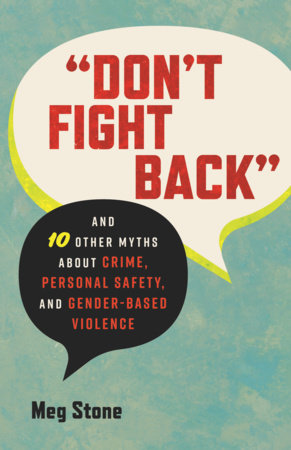
Now, though, I’m just going to tell everyone to read Meg Stone’s new book: Don’t Fight Back and 10 Other Myths About Crime, Personal Safety, and Gender-Based Violence. She’s covered everything I want to say and provided the reader with detailed facts, studies, and statistics to back it up.
Stone is the executive director for IMPACT Boston, an excellent empowerment self-defense program. This is her second book. I wrote about the first one, The Cost of Fear, here.
Don’t Fight Back is part of a series of books called Myths Made in America published by Beacon Press that address some of the significant social issues of the day by wrapping them around the things that “everybody knows” that have turned out to be wrong. In this case, “don’t fight back” represents the kind of incorrect advice that’s been given to women over the years.
The data show that fighting back is often very successful and that you don’t have to be a super-talented fighter to succeed.
Over the years, Stone has frequently questioned much of the accepted wisdom about how women should protect themselves. Some of the myths she bursts in this book include “don’t take the stairs”, “don’t wear a ponytail”, and “don’t park next to a van.”
But she does more than debunk myths; she provides some depth on things that are often misunderstood. Take, for example, trusting your intuition.
As Stone points out, “intuition is actually experience and expertise.” With some years of paying attention, you do develop a gut instinct in a situation, one you may not be able to articulate in that moment.
But without the background, you might well jump to conclusions that aren’t well-founded.
She spend some time talking about evaluating behaviors that seem out of place, pointing out that many things that don’t seem “proper” are also not harmful to you and that many people – for example, those with autism – may engage in some behaviors to keep themselves comfortable in a public situation.
One of the best discussions from a keeping yourself safe point of view is her regular reminder that it is the person who insists on crossing any boundaries you set who is most likely to be a problem, not the person who isn’t dressed neatly or who is singing to himself.
Maybe one of the best things about this book is that it isn’t full of scary stories, unlike far too many self-defense books. Instead, it’s full of useful facts and ways to think about the reality of our lives today.
Violence against women in particular is definitely a problem, but there are things you can do to deal with it effectively, starting with recognizing the real dangers, not the myths.
Violence against women, and violence against children, are so mythologized it’s hard to get a grasp on where real dangers lie. It is dramatically interesting to imagine a woman (or child) being menaced by strangers, but it’s truer that the danger lies in those close to us.
One of the things I liked about my daughter’s karate teacher was that almost the first thing he taught those kids was that they were not equipped to fight off a larger person with bad intentions. The kids (7-10 year olds) came in with ideas informed by the movies, and talked tough about how tough they were going to be, and the teacher disabused them of that notion real fast. “I don’t care if you earn a black belt–and it will take you a lot of time to earn a black belt in my school–If someone tries to hurt you, you you run. If there isn’t a grownup around to help you, then you get in the smallest place you can, somewhere that grownup can’t fit. And you never stop yelling.” He also emphasized trusting their instincts: if someone, even someone you know, makes you feel uncomfortable, you tell a grownup you trust. Right away.
The kids thought they were being prepared to fight off trench-coated strangers. I always worried about people closer to home.
He sounds like a good teacher. I’m glad they got that experience.
It’s fascinating to me that the more you did into danger to women and self-defense issues, the more you find that the most serious risks are much closer to home. Wendy Rouse’s book on the self-defense side of the suffragist movement, Her Own Hero, points to the same thing. Lots of emphasis on stranger danger in a society in which women were legally constrained by fathers and husbands. And stranger danger is almost always an excuse for racism.