
A Story They Didn’t Teach Me

When I was 13 my family moved from New York City to a small town in Western Massachusetts: Sheffield.  For those unfamiliar with Western Massachusetts, it is beautiful, green, hilly and pleasant and quaint. Quaint as can be, with houses full of Colonial charm (which they come by honorably, as they date from the 1700s) and a thriving tourist economy that leans into the quaint. Along with skiing in the winter and summering outside the city in the summer, there is an opportunity for what you might call historical tourism, if you’re into that sort of thing.

At the time, I wasn’t. I was enrolled in the local high school, Mt. Everett Regional. I had come from a left-of-center progressive school in New York, which made for some pretty severe culture shock on my part (and possibly on the part of some of my classmates and teachers–but that might just have been because it was the late 60s and culture shock was everywhere) but I got a good, if somewhat less political, education at Mt. Everett, and I have nothing to say in its dispraise.

But there were things they didn’t teach. And last week I learned one of them.

An account on Threads called “History is Punk” posted a long thread about Elizabeth Freeman, who was directly responsible for the state of Massachusetts outlawing slavery. And this happened in Sheffield, and I had never heard of it until last Saturday, July 4th, when the thread posted. The New York Times Magazine had an article about Freeman this week too. Elizabeth Freeman is having a moment.
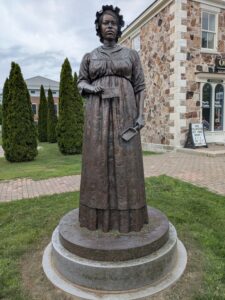
Freeman–originally known as Bett–was born in Claverack, NY, in the household of a well to do, slave-owning Dutch farmer. When she was young she was sent, along with various other household goods and chattels, to the new home of the farmer’s daughter Hannah. Hannah had married a prosperous gentleman-farmer and lawyer in Sheffield, Massachusetts, John Ashley. (The Ashley house is still there; I think I visited it once, but the emphasis at the time was all on Ashley’s place in the community and in the Revolution. I heard nothing at the time about Elizabeth Freeman). One can assume that, as a household servant, Bett did a lot of waiting on the gentlemen who came to talk with Ashley about politics–particularly about a document called The Sheffield Declaration, which is a forerunner of the Declaration of Independence. The Declaration was a 1773 anti-British manifesto which Ashley–and another local lawyer, Theodore Sedgewick–were instrumental in drafting.

So there is Bett, in and out of rooms where phrases like “mankind in a state of nature are free, equal, and independent.” It is pretty clear that these ideas took root. Meanwhile, Bett continued to work for the Ashleys (she had no other choice; she was their slave). Anecdotally, it appears that John Ashley was a fairly reasonable guy, but his wife Hannah was not. She was hot-tempered and treated everyone, but particularly the slaves, badly. So badly that when someone in the kitchen (most likely Bett’s daughter) used some scraps to make herself a snack, Hannah tried to hit the girl with a red-hot iron shovel; Bett took the blow on her arm. It went to the bone, and while she was treated for the wound it never really healed well.

In 1781, when the states had ratified the Articles of Confederation, Sheffield held a celebration on July 4th in the town square. Again, if Bett was there, she would have heard that self-evident phrase “All men are created equal.” The next day Bett visited attorney Theodore Sedgewick and asked him to sue for her freedom. He agreed, filing a “writ of replevin,” which demanded that property improperly held by the Ashleys (that would Bett and another slave named Brom) be returned to the rightful owners: themselves. The case was heard in the neighboring town of Great Barrington, and after legal back and forth (offered the chance to simply free the two slaves, Ashley declined; he might have been reasonable compared to his wife, but…) Bett won her case. The case became the scaffolding on which Massachusetts built an affirmative declaration that slavery was “repugnant” to the terms of the State Constitution.

Bett lived a long life: she took the name Elizabeth Freeman. She worked for wages for the Sedgewick family for some years, bought a house, and amassed enough property to leave it, and many other things, to her descendants. When she died, she was buried in the Sedgewick’s burial plot, the only non-family member there.

And it kills me that I only learned about this last weekend.

I went to High School in Sheffield. The library in Great Barrington was one of my preferred hangs. We heard a great deal about the Berkshire’s role in the Revolutionary War. But in the late 1960s I heard nothing about Elizabeth Freeman. Fortunately, things have changed since I was graduated from Mt. Everett in 1971. Freeman’s story is known and embraced in the area; in 2022 a statue was erected to honor her.

My point (aside from my general crankiness about not having heard of this before) is that history is full of stories like this, stories that don’t get told or don’t get remembered. I believe firmly that if I had stumbled over Elizabeth Freeman’s story in high school and written a paper about it, I would have been congratulated for finding it–they weren’t burying anything, it wasn’t sinister. Just… if you don’t know, you don’t go looking.

The Current Powers That Be would likely be happy if we forgot about this sort of story. Which makes it all the more important that we keep looking for them.

 

The Joy in July

This week my thoughts are on the worst month of the year in Canberra, because that is the month I am living in right now.

It’s simple. It’s winter. There is no snow. The only holidays are school holidays and most people who take them have headed over the mountains and are currently at the beach, where it’s less cold. Last year I did this for a week and my July as so much better. This year I spent a bit more money and flew to Perth for a science fiction convention.

For northern hemisphere folks, it’s January with the memory of Christmas half a year ago rather than days ago. No snow, but much black ice.

It used to be worse. When I first moved to Canberra the only fruit in winter was stale apples and amazing oranges. The first two weeks of oranges were wonderful but it became very dull very quickly. Now we have new varieties of citrus, plus some clever folks realised that all those farms near the coast have different fruit. I bought dekopon and bananas and finger lime yesterday at the market. I can get through July more easily with dekopon and bananas and one luxury fruit.

Also, Canberrans do dinner parties. I don’t get many of those (some people are worried about disability cooties, some about the cooties that older folks bring, some about the cooties generously distributed by childless women, and far too many about Jew cooties), but those I do get make me very happy and make the month tolerable. And some friends visit me. I am about to make vast amounts of chicken soup to feed myself and those friends.

That chicken soup has a second purpose. I suspect lovage might have been replaced with celery or vice versa in some types of chicken soup. This theory is based on not nearly enough knowledge at this tage. Thanks to some Polish friends I have heaps of lovage and thanks to Fyskwick Market I have celery leaf and enough boiling chicken and etc to make two big pots of soup, one with lovage and one with celery. This is just one step of a path I began to walk when the same friends who sent me the lovage sent me (for my 60th birthday) a 1682 book that clearly and wonderfully walks all the way through Polish court food of that time. I’m pulling together lots of things from this and from other sources and from chats with those same friends. One of my more interesting discoveries is that the antisemitism in Poland in the 1920 and 1930s led to poorer food being labelled as ‘Jewish’ in at least one city and led to some really interesting Jewish cooking techniques that were modified when families reached Australia. This chicken soup is, then, a small step in a long journey.

It’s a handy step, because its really difficult to be entirely miserable when one has excellent chicken soup.

John Warner’s More Than Words

cover of the book More Than WordsI’ve subscribed to John Warner’s newsletter, “The Biblioracle Recommends,” for some time now. It’s all about reading and writing, a thoughtful source for ideas on how to teach writing and for clear criticism of so-called AI.

He publishes every Sunday and I set aside time to read his essay carefully because he always gives me something to chew on. With that in mind, I checked his latest book More Than Words out of my library.

I was not disappointed.

Warner writes lyrically about writing in ways that will make perfect sense to all writers. For me, reading this book put a name to many things about writing that I knew but had never put into words.

For example, he says:

If we consider writing as the fully embodied practice that it is, words and sentences are not the basics or base units of writing. To start writing, first you need an idea.

Then he adds, after having spent some time thinking about what he just wrote:

It’s not even a full-fledged idea that’s the base unit of writing. It’s something smaller. Let’s call it a “notion.” If an idea is the atom, the true building block of writing matter, consider the notion a subatomic particle, perhaps along with the “inkling,” “sense,” “suspicion,” and “hunch.”

He also quotes from other good writers.

I often feel that I don’t think hard enough about things until I have to write about them.
—Rebecca Solnit

 A writer is a person for whom writing is more difficult than it is for other people.
—Thomas Mann 

Continue reading “John Warner’s More Than Words

Reprint: Nature’s Way To Clean a Reflecting Pool

When your local reflecting pool or pond turns green with algae, don’t reach for chemicals – nature has better solutions

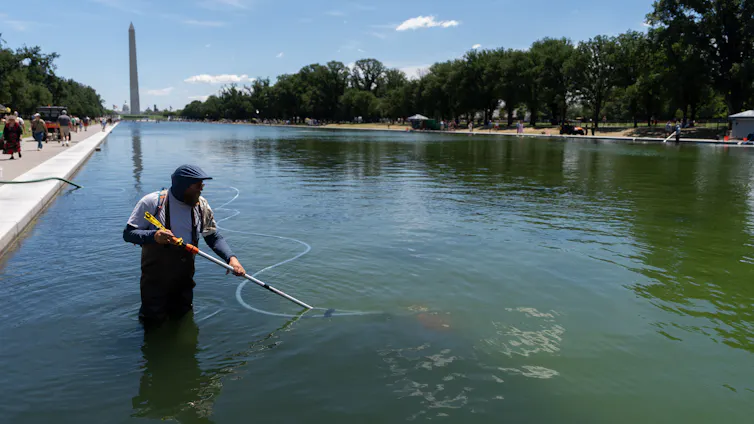
A National Park Service employee uses a vacuum to clean the Lincoln Memorial Reflecting Pool on June 20, 2026.
AP Photo/Mark Schiefelbein

Eric Palkovacs, University of California, Santa Cruz

When the Lincoln Memorial Reflecting Pool turned green with algae just days after a US$15 million renovation, the U.S. government scrambled for chemicals and expensive technical solutions to fix the iconic landmark.

Trying to kill algae with chemicals is a common response when community ponds or other water features go green. But as a scientist who studies freshwater ecology, I can tell you there are better solutions that cost far less, last longer and carry less risk of harm to pets and wildlife.

Rather than battling against nature, these alternatives work with nature for long-term solutions.

What went wrong on the National Mall

The algal bloom that turned the Reflecting Pool a vibrant green shouldn’t have been a surprise.

The pool is big, more than a third of a mile long and around 165 feet wide. But it’s shallow, meaning it warms up quickly in the sun. When it was repainted “American flag blue” during the renovations in spring 2026, the new color darkened the pool, and darker colors absorb more heat.

On top of those conditions, the pool was refilled with water from the nutrient-rich tidal basin of the Potomac River. The combination of warm water and nutrients created prime conditions for algae to bloom, turning the water pea soup green.

A tube into the Reflecting Pool, with the Jefferson Memorial in the background, puts out white bubbles.
In addition to hydrogen peroxide and vacuums, the government ordered nanobubble ozone technology to break up the algae. The nanobubbler contract was for $1.7 million.
AP Photo/Jacquelyn Martin

As the national conversation over the Reflecting Pool shifts to political finger-pointing, an important environmental question deserves careful scrutiny: What is the best approach to maintain water quality in a case like this, whether for a national monument or a community water feature or pond?

Trying to chemically or mechanically remove algae can damage the structure of a water feature and may harm species in the water that could actually help solve the problem.

Importantly, chemical and mechanical solutions are only temporary fixes. When the Reflecting Pool is drained and filled again, there’s a good chance that algae will bloom again.

Natural algae control

Limnologists – scientists like me who study inland water bodies – have spent many decades learning why lakes and ponds turn green and how to clear them up.

Often, nutrient-rich waters fueled by fertilizer runoff from farm fields or sewage from cities are the sources that stimulate algal growth.

However, natural ponds also host grazing zooplankton, which eat algae. For example, a type of zooplankton called Daphnia, known as water fleas because of the way these tiny crustaceans swim, can control algae by consuming it before it becomes a pea soup nuisance. Thus, a thriving Daphnia population can help maintain good water quality in a lake, pond or community water feature, even when nutrient levels spike.

A close-up image of a see-through water creature with eggs inside.
Daphnia are a genus of hundreds of species of tiny, see-through crustaceans that happen to be voracious algae eaters. A female Daphnia magna’s eggs are visible in this magnified image.
Hajime Watanabe, PLoS Genetics, March 2011, CC BY

In addition to being highly effective grazers, Daphnia have another superpower – they can evolve rapidly. Urban waterbodies are often harsh environments with a variety of challenges, including high temperatures, low levels of dissolved oxygen, and pollutants. Daphnia can adapt to tough conditions, making these creatures an ideal source of algae control in many urban ponds.

Rooted aquatic plants are also useful for algae control in ponds because they absorb nutrients. Thus, shallow ponds with thick beds of aquatic plants can often resist algal blooms when nutrient levels rise.

Why draining might not be the best solution

One downside to draining and refilling a pond or urban water feature to try to clean it is that doing so resets the aquatic ecosystem, erasing the signature of any past evolution that has taken place.

Imagine Daphnia in a shallow pond that experiences periodic heat waves throughout the summer. Through repeated exposure to high temperatures, natural selection favors heat-resistant genotypes that can thrive in an urban pond.

Daphnia and other grazing zooplankton can also evolve resistance to some types of cyanobacteria, also known as blue-green algae, which produce compounds that are toxic to people and pets. Daphnia that evolve resistance to those toxins can help control harmful cyanobacterial blooms.

If a Daphnia population that evolved to tolerate warm temperatures, low oxygen levels or cyanotoxins is removed, the new population likely won’t be ready to handle those local challenges. This evolutionarily naive population will perform poorly in its new environment, reducing its effectiveness at controlling algal blooms.

As a result, traditional mechanical and chemical approaches may actually work against the goal of minimizing algae in ponds and other water features.

Nature-based solutions

The use of Daphnia to control algal blooms is just one example of solving environmental challenges with nature-based solutions.

Growing urban forests to provide cooling and improve air quality to help reduce the need for more energy-intensive air conditioning is another example. Maintaining urban wetlands can help reduce flooding, protect property and recharge groundwater more effectively and for less money than building and maintaining levees. Coastal marshes similarly reduce erosion, buffer storm surges and support fisheries.

All these urban ecosystems protect biodiversity and support human health and well-being.

From national landmarks to city parks and backyard ponds, projects of all sizes can take advantage of nature-based solutions. While each specific project is unique, some general principles apply.

Ecosystems are most resilient when they are diverse and connected. So, it is beneficial to use a variety of species and genotypes and provide corridors that support the movement of organisms and their beneficial genes.

Urban climates are changing rapidly, so it helps to use species and genotypes that will thrive under future conditions, including rising temperatures.

Not every solution has to be engineered

The hubbub over the Reflecting Pool holds a mirror up to assumptions about how to solve pressing environmental challenges. The idea of just engineering one’s way out of any environmental crisis has limits.

Understanding ecology and nature’s mechanisms of ecosystem resilience can achieve sustainable solutions that benefit both nature and people.The Conversation

Eric Palkovacs, Professor of Ecology and Evolutionary Biology, University of California, Santa Cruz

This article is republished from The Conversation under a Creative Commons license. Read the original article.

Continue reading “Reprint: Nature’s Way To Clean a Reflecting Pool”