While I was at my recent writers retreat, I was having some trouble settling into work on my current project, which is a sequel to my fantasy novel For the Good of the Realm. I finally decided the best starting point was re-reading the parts of the book that I’ve already written (about 40,000 words). Doing that made me recognize why I was having trouble and will probably continue to have trouble: I am obsessed by things going on in the present.
I don’t just mean being an active participant in my society or my work at Unbreaking.org or even doomscrolling. It’s not just that I’m paying attention and trying to do my political part at a fraught time.
It’s that there’s so much stuff I want to think about and work out about what the future could and should look like, which is rooted in a lot of reading and writing I’ve been doing. Regular readers have probably noticed that I have a lot of thoughts related to so-called AI, but I’m also thinking a lot about climate change, wealth inequality, and how to change things so that we can live well on this planet.
It’s not like the novel is alien to this, for all that it’s a fantasy book in a non-technological reality, because there are things I’m doing there that will be relevant to the present.
But they’re indirect, as much of my best fiction is.
Part of the reason I don’t know how to write good fiction dealing with the realities that interest me right now – economic, technical, political – is that I’m still working out my take on it. I need to not only understand it; I need to internalize it. When I try to write directly about what I see around me, it often sounds polemical.
It’s better if I write essays about a lot of my ideas of the present, which will help me work them out so that they gradually emerge in my fiction.
Right now writing about anything else feels hard. We’re on such a precipice.
But I don’t want to stop writing this novel. I’ve got a lot invested in it and if I can just fix the messy middle, I know it’s going to be good.
I assume this means I’ll just have to keep on juggling and try to carve out more time – like the retreat – when I actually focus on the fiction.
It’s interesting to see what the problem is – not the problem with the novel (still working on that), but the problem with the writer – and maybe makes it easier to fix.
Maybe.
Pretty sure people who use chatbots to “write” their stories don’t have this problem. Of course, chatbots can’t internalize anything. They don’t have angst.
When survivors of trauma recount their experiences, they are often questioned because of how they relay their stories. They may have problems remembering what happened, or their memories may be jumbled or even contradictory. People hearing those stories – attorneys, reporters, healthcare workers or friends – may expect a clearer, linear narrative.
Those unaffected by trauma may also be surprised to hear how the person acted in the moment. It’s easy to assume that someone experiencing a traumatic event would have a “fight or flight” response, instinctively fighting off a perpetrator or fleeing the scene – but that might not be the case.
Understanding the science of how trauma affects memory and behavior reveals why these responses can actually be expected and are not contradictory.
In both my academic and clinical work as a psychologist, I have witnessed the impact trauma has on people’s memories and behaviors, especially when an event in their present life triggers something from their past.
Research shows that taking a trauma-informed approach, which prioritizes understanding and curiosity about someone’s experience as opposed to judgment or critical evaluation, increases empathy for survivors’ thoughts, feelings and behaviors.
How trauma affects the brain
According to the World Health Organization, approximately 70% of people worldwide report experiencing a traumatic event in their lifetime. The majority of these people do not develop PTSD, a clinical diagnosis of symptoms, such as having nightmares and flashbacks about the event, avoiding places that are reminders of it, and increased arousal that can make concentration and sleep difficult. Many survivors don’t meet criteria for PTSD but struggle with feeling distressed, depressed or anxious.
In traumatic situations, people often respond in unexpected ways, and they may second-guess themselves. This may happen particularly when someone experiences a repeated trauma, which is more likely than not due to how many people experience traumatic events.
Research indicates that people experience traumatic memories differently than memories of other significant events, such as sad or positive experiences. Two of the main brain structures scientists believe are involved in storing traumatic memories are the hippocampus – responsible for memory storage – and the amygdala, which is responsible for processing emotions.
During trauma, the amygdala becomes highly active, processing emotions such as fear, and the hippocampus becomes overwhelmed by stress, leading to problems with memory storage.
Traumatic memories do not follow a neat, linear story. Instead, people may experience the memory as disconnected fragments of sensations, emotions, smells or images. Such memories cause the body to reexperience the past threat as if it is happening in the moment. This may cause a person to feel like running away or fighting back – flight or fight. Or they may freeze.
In other words, people don’t have the distant perspective they often feel with other memories from the past. Rather, they may feel they are reliving the original experience.
With this understanding, consider someone who experiences a trauma at the hands of a professional during an appointment. They may appear outwardly calm while it happens and then leave the session as they typically would – checking out, providing payment and possibly even scheduling the next appointment. While their response to act normally may seem odd, such behavior makes sense for someone trying to escape a threat.
Fight, flight or freeze responses have become widely known in popular culture. In a freeze response, a person’s mind goes blank and they may be unable to speak, leading to a “deer in the headlights” behavior.
On the other hand, a person may act paradoxically – perhaps by going on about their day as if nothing happened. They may not report the event or may question whether the incident even occurred. This represents another survival response – the lesser-known fawn response. This way of handling stress occurs when someone acts calm, appeases the threatening person and retreats to de-escalate the situation. Instead of literally backing away, in this example, the person metaphorically backs away by completing the session and exiting as expected without further conflict.
Outsiders may misconstrue these behaviors as evidence that a trauma did not actually happen or that a survivor lacks credibility. But that logic reflects common misconceptions about how people “should” remember or respond to trauma.
If this was the person’s first experience with a traumatic situation, afterward they are likely to feel afraid, disoriented or hyperalert. However, if they had previous similar experiences, this scenario may trigger past memories in the moment. This can muddy the experience even further, making it difficult to recall the incident later, especially under stressful circumstances.
When a survivor reports an incident and ultimately testifies against someone who harmed them, memory recall might be uniquely affected. Most people in this situation would be highly stressed, especially if the perpetrator were in the room.
To make matters worse, the feeling that the recalled memory is actually happening in the moment and not in the past may cause a survivor to convey a more fragmented story. They may also have either a more intense or detached emotional experience, depending on their own trauma responses.
Legal and other professionals unaware of the range of natural responses to trauma can easily misinterpret these behaviors as signs of lying or malingering.
In reality, the percentage of people who falsely report sexual assault, for example, is low – between 2% and 10%.
A trauma-informed approach can also improve legal and justice systems so victims are better supported. This includes understanding why accounts aren’t linear and not equating memory inconsistencies with lying.
Research also shows that trauma-informed responses are equally important in everyday relationships. In friendships and close relationships, or in the workplace, patience and empathy convey a sense of respect, safety and trustworthiness. These offer a strong foundation for positive social and working relationships, which can lower a survivor’s distress and support their healing.
When people have a greater understanding of how trauma affects the brain, they gain insight into how survivors think, act and process their memories. What initially looks confusing or inconsistent is actually behavior that flows logically from a traumatized brain.
Having a trauma-informed perspective helps people to be better friends, co-workers and professionals. By extension, responding from this awareness may even help survivors understand their own reactions and experiences, which may ultimately aid their healing and ability to lead fulfilling lives.
Today I want to talk about cancellation in Australia. I want to talk about it under the same heading as the Green party in the UK, at a meeting where they had to have a ‘safe room’ for Jewish Greens, passing a motion that Zionism is racism but failing to pass the addition that Jews should be safe in the UK. That heading is sometimes “All is well just as long as we make decisions for you.” That heading can also be “As long as no-one knows what’s actually happened here, we can pretend everyone’s safe.” Mostly it’s “Jews must remain silent here. We do their thinking for them.”.
Once upon a time there was a mass murder in Israel. October 7 2023. Many people who had been closet antisemites came into the open. A bunch of Jewish writers and artists and others who create needed to talk, so someone made a Whatsapp channel and lo, they worked towards healing. A few of them (maybe five, maybe six (I read the material in question, but didn’t count) talked about writing letters to make it clear that Jewish Australians and Australian Jews were scared by the rise in antisemitism. Someone doxxed all 600+ people in that group. Their argument was mainly about evil Jews plotting. So many in the Arts in Oz were hurt by this and Jews have been given purity tests for literary festivals. I was not doxxed myself, because I can’t get WhatsApp to work so I never joined the group, so I’m only targeted by those purity tests and by erasure. I didn’t have to move house for safety and over that time, I have only received one death threat.
This was in 2024. So the problems are now past for Jews in the creative industries in Australia? Not at all.
I myself (undoxxed) am still only welcome at most events as an audience member as long as I carry or wear nothing that indicates I’m Jewish. My home town excludes me more than anyone: I am not (at the moment of writing this post) on the programme for anything to do with writing in the Canberra region. When I ask, I am given ‘reasons.’
Some organisers elsewhere won’t let any racism enter their doors and do not exclude Jewish writers. I was both delighted to be a minor part of the Sydney Fringe (I gave a workshop and panel at the science fiction weekend at Old Government House) and why I celebrate whenever I am welcome into a place without anyone wanting to shout “Free Palestine” or “Jews murder babies” at me.
The doxxing happened in 2024. I say this again because something important just happened. Jewish artists and writers and musicians created a film called “Cancelled,” Explaining what has happened through the life of four who had to deal. It was shown at a film festival… then it was cancelled. Right now, it’s impossible to see.
First doxxing then cancellation – this sums up three years of life in the Arts in Jewish Australia for most of us.
My writers group tries to do a retreat every year, and since we live in six states and three time zones, it’s always a little complicated to figure out where and when. This year we opted for Minneapolis, a place where it’s possible to get a sufficiently large vacation rental at a reasonable price and one that’s not too hard to get to from all our locations.
That also meant we got in a visit to DreamHaven Books and Comics – a place worthy of a trip to Minneapolis on its own – and being readers as well as writers, we bought books.
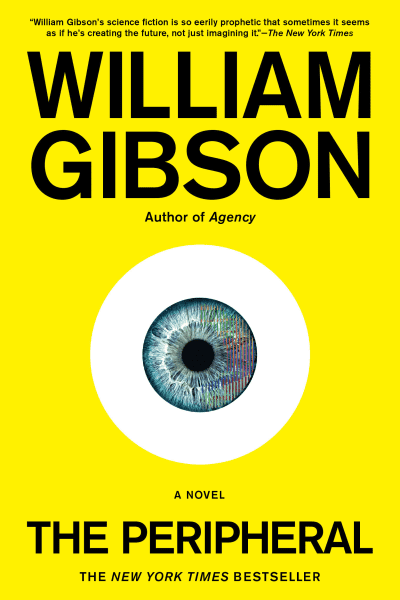
Among the books I got were two I’d already read from the library, but wanted to read again and own, the most recent books by William Gibson: The Peripheral and Agency. And, since I came home to needing to deal with a few stressful things, I have now re-read them both.
(I note that one form of reading that we don’t talk about much is reading to escape responsibilities. I perfected this skill as a kid, and I still fall back on it.)
These books are a tour de force, masterpieces of invention and writing from an author whose skill is legendary. I first read Gibson when Neuromancer came out in the 1980s. He was one of the few male authors I read back then and the only one of the cyberpunk group I really appreciated.
On this re-read, I was in awe at the way he constructed the story
I loved The Peripheral when I first read it — I wrote about it here — and I loved it again this time. I don’t like Agency as much, but I still enjoyed the re-read. Part of that is the characters; I’m more inclined to appreciate people struggling to get by in a southern town in a dystopic near future than I am techbro adjacent folks in a San Francisco of my own timeline.
But this time around the books made me think about some other aspects of both the stories and how those things relate to the reality we’re living in now – a reality that seems to set up all too easily the “Jackpot” that underlies the books.
I can’t talk about this without getting into some spoilers, so I’m going to do a page break here in case you want to read the books first. I know they’ve been out quite awhile – The Peripheral was published in 2014 (and there was even a streaming series), Agency in 2020 – but I want to be polite to anyone who hasn’t read them as well as to recommend that you do so. Continue reading “Re-reading William Gibson”…



 My writers group tries to do a retreat every year, and since we live in six states and three time zones, it’s always a little complicated to figure out where and when. This year we opted for Minneapolis, a place where it’s possible to get a sufficiently large vacation rental at a reasonable price and one that’s not too hard to get to from all our locations.