I am in the middle of writing something up, but it’s not done yet. So here is a reprint from a few years ago.
I watched a lot of cartoons as a young person. Like, a lot. In New York City, where I grew up, we rejoiced in the–at the time–enormous selection of 7 TV channels (including the educational channel), and by 5 o’clock every evening at least two of them were showing cartoons: Warner Bros., primarily, but Woody Woodpecker and the Hanna Barbera slate, and Tom and Jerry… and those frankly kind of awful limited-animation series like Jonny Quest and Clutch Cargo. I imbibed them with a growing critical sense (if you can say such a thing of an 8-year-old), coming to the conclusion that Warner Bros., and later, the work of Jay Ward, were the clear winners.
Both were deeply subversive, and both partook liberally of the attitudes of their time, while mocking those attitudes pretty mercilessly.
I learned a lot about the 1930s and 1940s from Warner Bros. At the time, of course, I didn’t understand how much I was taking on board about, for example, life on the Home Front during WWII (blackout curtains, gas rationing, “Is this trip really necessary?” and the Little Man from the Draft Board), who the Hollywood hot tickets were (all Warners stars, of course). Some of the references were direct: Lauren Bacall wants rabbit pie, ordered by Humphrey Bogart, and Bugs Bunny happily complies, because, well, Lauren Bacall. Others were… well, let’s just say that when I first saw Katharine Hepburn in A Bill of Divorcement, I understood what Bugs Bunny had been going on about with the calla lillies.
Not all Warners cartoons repay rewatching: some of them are flat out appalling: there’s a reason why no one shows “Bugs Bunny Nips the Nips,” or the horrifying “Coal Black and De Sebben Dwarfs” except at “midnight” screenings. And even the more every-day cartoons have moments that bring you up short and make you realize that, in fact, we’ve made someprogress since 1940. On the other hand, the sheer insane genius of “Porky in Wacky Land” or ” The Big Snooze” is hard to beat, and again, will sneak in all sorts of cultural and historical references you won’t find anywhere else.
And then there are Rocket J. Squirrel and his dauntless companion, Bullwinkle J. Moose, the Abbott and Costello of animation. As Beth Daniels says in this lovely article, “Rocky was the more intelligent straight man: a less hostile Abbott to Bullwinkle’s more secure Costello.” I kind of had a crush on Rocky when I was 7: he was so good hearted. And he put up with Bullwinkle’s repeated attempts to pull a rabbit out of a hat. What I didn’t realize when I was 7, because I was soaking in it, was the extent of the Cold War-era mindset the Rocky and Bullwinkle Show lampooned without mercy. Not just Rocky and Bullwinkle and their foils, Boris Badunov and Natasha Fatale (and their boss, Fearless Leader), but in Fractured Fairytales and Dudley Do-Right and especially, Mr. Peabody and his Boy, Sherman. Is there anything that Jay Ward and his team didn’t skewer?
The odd thing is that in considering these seminal influences and how they poked at all that was accepted in American culture, I realized the extent to which they also came from a set of very real values. Poking fun at the pokable is an honorable pastime. Pettiness sets you up for a take-down. Bugs Bunny may have been a self-admitted stinker, but he wasn’t… vicious. Daffy Duck delighted in tormenting Porky Pig, but he wound up hoist on his own petard at least half the time. And over in Rocky and Bullwinkle-land, our Hapless Heroes always seemed to survive, not least because the bad guys were just as hapless.
My husband and I raised our kids on the cartoons of our childhood. I like to think it was less from nostalgia than because we felt they gave the girls a useful toolkit for living in an increasingly nonsensical world. Also: Daffy Duck snarling “Of course you realize, this means WAR!” Priceless.
This week’s post is about my next few days. I’ll skip most of the writing and editing and publishing side, because they’re posts all of their own. One day, you will learn more. Keep reading, because eventually there is coffee.
This weekend I’ll be at Octocon. Online in Ireland. This is the Ireland we don’t see in the news. I feel safe there. In honour of an Irish friend who I (alas) haven’t seen in decades, let me share his cure for hangovers to provide a bridge between the antisemitic country we hear about and the kindness and openness of fandom in Ireland and Northern Ireland: 1 part port to one part brandy. Any quantity. If necessary repeat the dose several hours later.
I’m on two panels and giving a workshop on world building. I do love sharing my worldbuilding research. Each time I teach it a bit differently. This time it’s going to be all about Medieval magic. Not all Medieval magic, but how to incorporate certain aspects of that magic into your perfect novel in a way that makes it feel to the reader that they can find that magic portal and enter your world.
Another thing-of-the-moment is waiting anxiously to see if a kickstarter gets up. I have an essay in the book being kickstarted and I so want it to become published. It’s also related to my research self linking with my writing self. It’s the uni classes I would be giving if I were still in the teaching system in Canberra but, alas, Canberra is still not keen on me teaching and I’ve given up asking and instead written an essay: https://www.kickstarter.com/projects/benyehuda/again-at-a-crossroads
What else am I doing? Eating fruit and nuts, because it’s Sukkot. Being worried a bit because ASIO tells us that Jews here are still under threat. Dealing with hate. Dealing with hate has been an everyday thing for 3 years now (the anniversary in the Jewish calendar of October 7 is at the end of Sukkot) and you’ve heard enough about it, so I won’t explore it here.
I’m revising my own thoughts about the world. I do this regularly. I’m an ethnohistorian, I know that people change and culture changes and I need to know how I change. Every bit of my own bias I understand, I can factor into my other work. When I realised that being hated was a bad path to take for self-analysis, I decided to watch old TV to remind myself of where I have been and give myself context to explain how I deal with this interesting new world. I’m watching two shows right now to give myself this context. One is Heroes, which was first shown in Australia after I’d started looking into how we see heroes in story. I began on that trail 45 years ago, so it’s a handy trail to look back from and check for change. When heroes was first release I was in the middle of formulating a tool, which I never took up academically but which is a lot of fun socially. If our TV was seen by aliens or our literature read by aliens, how would they see humans? I looked at gender, age, cultural background, religious background, amount of violence, amount and nature of sex-related stuff, material goods, use of tropes… No big project because no funding for it, alas. I still play with aspects of the idea, however.
The other show is Doctor Who. I saw the original when I was very small, and it’s been part of my viewing life. Every twenty years I watch as much as I can and it shows me how I have travelled to reach my current point. Last time I rewatched was the year before the new series, because our public broadcaster showed much of the surviving Who. Oddly, I could remember the bits that were not there. Later, as other bits became cartoonified and put to the original audio, I discovered a strange phenomenon: I could remember the original and, in one story in particular, it was as if the original walked alongside the new version and they argued with each other.
Now I’m in the 70s with Tom Baker. I was in high school when it was first shown, and it’s a wonderful tool for bringing back lost memories. When I say “Tom Baker” people instantly tell me about the scarf, but what I find is that Baker himself acts as himself and so the Doctor is real and so… it’s closer to who I was as a teen and how I saw myself.
My family never let me become properly Gothic and was not kind in the way they prevented it (which is another story), so some of the Baker episodes show me a path I wanted to travel but could not. I suspect this will appear in my fiction sooner rather than alter, because I have a character at hand who needs to discover something related.
Everything returns to story in my life. Always. This is not a bad thing.
Another thing that is not bad at all is that a friend gave me some of the spice mix used in Yemeni coffee. It fits with the way coffee was made in the region in the 15th century. When time permits, I’ll see if I can find out the relationship between the current spice mix and the history of coffee. I need to get through the next few weeks first, however. I’ve told you the tip of the iceberg, but I do not want the actual iceberg to turn my life into another Titanic accident. This takes careful navigation.
In the wake of such things as the grifter’s even more erratic than usual behavior and Mitch McConnell’s carefully managed return to the Senate, my social media produced another deluge of demands for putting upper age limits on public office. I just flew home through the San Francisco Airport, noticed they’d named the international terminal after Dianne Feinstein, and couldn’t help thinking how embarrassing and disastrous her last years were.
It is certainly true that some people who should have retired from their jobs much earlier keep hanging on. But I’m still opposed to age limits on most jobs, for one very basic reason: Human beings don’t age uniformly.
Nancy Pelosi was the most effective Speaker of the House the US has seen in decades. She pulled back from leadership posts and is now retiring from Congress, but she was very effective throughout her years in office. I don’t always agree with her, but I cannot deny her ability.
Nancy Pelosi is 86, two years older than Mitch McConnell.
The NY Times had a piece this week about the composer Thea Musgrave, whose opera Orlando, based on the Virginia Woolf novel, will premiere next year. The article starts with her working with a bassoonist on another piece and commenting that she is still learning.
Musgrave is 98.
I’ve just been at a writers retreat where the members ranged in age from 50s to 80s, with most of us in our 70s. All of us are still writing, all of us still smart. With the exception of the youngest of us, all have a few health issues that we pay close attention to, but none of them keep us from writing.
Of course, again with the exception of our youngest member, none of us have day jobs anymore. None of us want day jobs, but all of us want to write and publish our work.
In general, we are now producing the best work of our lives, because we are smart and have a lot of experience and both understand how to write and why we want to do it. What we do now is valuable whether it ever wins a prize or makes the best seller list.
I know people in their 50s who are old and stuck in their ways, people in their 60s with enough health issues to prevent them from doing a full time job. I know people in their 80s and 90s whose judgment is impeccable and who have fresh ideas. We don’t all age at the same pace.
As I wrote a few weeks ago, the biggest problem in politics isn’t that we have lot of old people in Congress; it’s that we have a lot of bad people there. Age limits won’t solve that problem.
As the 2026 midterm elections enter the final stretch, it’s important to know your rights in case your vote is challenged.
The best way to ensure that your vote is counted is to advocate for yourself. I’m a an attorney and lecturer for the University of Southern California’s undergraduate civil rights advocacy initiative, Agents of Change. Here are several straightforward ways to ensure your vote is counted and two practical remedies for you to consider if your vote remains challenged.
A major part of ensuring that you are able to vote is doing the necessary preparation before you even get to the polling place. Read on to find out how and where to register, where and when you can cast your ballot, and what numbers to call for any information you can’t find online.
Are you registered to vote? Check it out
Before you vote, you need to ensure that you’re registered to vote. You can verify your registration status using this tool. If you can’t use an online tool, then call your local election office or a voter help line like the ones listed in the hotline section below.
If you find you’re not registered, you can use this tool from the National Conference of State Legislatures to find your state’s online registration application. If you need to do this in person, then call your local election office for instructions.
At this point, you may have missed your state’s deadline for voter registration. But it may not be too late to register.
Many states allow same-day registration at the polling site. You can find your state’s same-day voter laws detailed here. Ask the poll worker, at the correct polling location, for a same-day registration form; complete the form and then ask for a “conditional ballot.” A conditional ballot allows election officials to count your vote after verifying your voter eligibility. If you can’t research online, you can call your local election office to find out if you can register on Election Day.
Marchellos Scott, right, helps Morehouse College students fill out a voter registration form at a college registration booth on Aug. 19, 2024, in Atlanta. Elijah Nouvelage/AFP via Getty Images
Gather documents to verify your identity
If you live in a state that requires identity verification to vote in person, gather the required documents – which may range from a driver’s license to bank statements with identifying information – before traveling to the correct polling place. You can find your county election office’s contact information here. This webpage includes a table listing each state’s acceptable ID documents and possible exceptions for some people. You may also call your local election office to find out what’s required.
Absentee voters: Locate your state’s identity verification rules here.
Find the correct polling location
You can ensure that you’re headed to the right polling place with this tool. Or call your county election office to find your polling place and its hours of operation; you can look up your county’s election office contact information here.
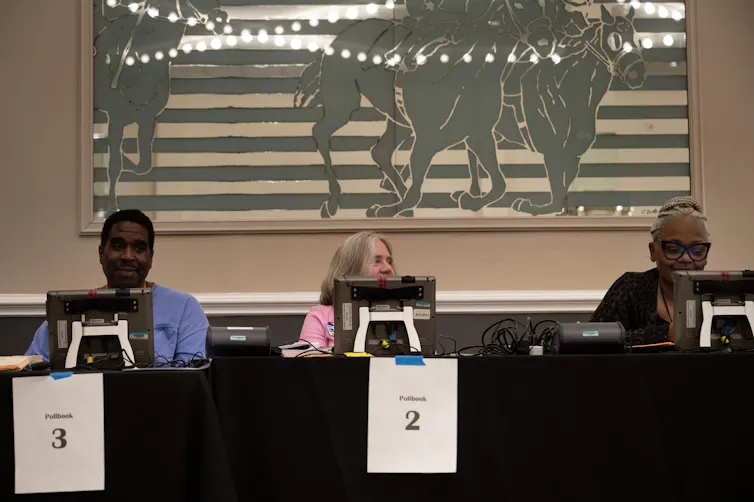
Once you know your polling place and its hours, you can go there and check in. In most cases, you’ll be handed a ballot, shown where to vote and asked to put your ballot in a machine or a box, and then you can go merrily along your way.
But the moment of check-in is where things might go wrong.
Problems at your polling place
Here are potential vote challenges and ways to overcome them.
Possibility No. 1: Out-of-order polling machines.
If you’re asked to leave because of malfunctioning machines, don’t. Instead, ask for a paper ballot.
Possibility No. 2: You’re in line and officials announce the polls have closed.
If you’re in line at the polling location before it closes, don’t let them turn you away at closing time if you haven’t voted. You have the legal right to vote under those circumstances, so stay in line and wait to cast your ballot.
Possibility No. 3: You’re not on the registered voters list.
If you’re told you can’t vote because your name is not on the voter roster, ask the poll site worker to check again and to check what’s called the list of supplemental voters. If they still can’t find your name, ask the poll worker to verify that you’re at the right location.
Possibility No. 4: Someone claims you shouldn’t be allowed to vote.
If your voting eligibility remains challenged after ensuring you’re at the right polling location, ask to cast a provisional ballot, which is available in every state except Idaho and Minnesota. You can find details about your particular state’s provisional ballot rules here.
If you are not given a provisional ballot, call an election hotline for help. Here are four hotlines, run by members of the nonpartisan Election Protection coalition, that can help you:
If someone tries to scare you into voting or not voting for a candidate, stand your ground and demand a ballot from the poll site, call one of the hotlines above to report the intimidation, and file a claim with the FBI later by phone at 800-CALL-FBI – 800-225-5324 – or online at tips.fbi.gov.
File a lawsuit
If you are still blocked from voting, consider legal action – but get advice on your exact situation from one of the hotlines, which have free lawyers on hand. It’s a good idea to write down the names of people who prevented you from voting and to ask people who witnessed the incident for their contact information.
This is a quick note because my week is just a tad busier than usual. First, there’s always catching up on paperwork to do after Yom Kippur, because people always send me things, assuming it’s a normal day. I’ve made a little list of some of the things that must be done by Wednesday afternoon. It’s 14 tasks long and some of them are quite hefty tasks.
The question is, why Wednesday?
I’ve talked about the Royal Commission into Antisemitism and Social Cohesion at great length, but I didn’t mention the other one. I’m giving my testimony as part of a group testimony on Wednesday afternoon. It’s into disability. I tick all the “Who has been left out in our current system” box.
I’m not doing a written submission for this. My right eye is problematic and my vision is even more impaired than usual, so it would be a lot harder than the earlier submissions. But the RC into disabilities is allowing for such things and a group of us is being brought together online to work through the framework and explain the things the Commission needs to know about our lives.
I’ve never done things for two Royal Commissions within six months before. I had a whole submission published and cited in the report for one, many years ago. They’re not an ordinary part of our lives, but they’re one of the places and times when we can interface with government on issues that are beyond the ordinary. They are terrifyingly expensive, but they’re also exceptionally valuable. Even when the government in power pretends to accept the outcomes of a Commission and never does anything, the process shifts Australia and makes us choose our paths more carefully. Initially, the RC into Antisemitism caused a tsunami of hate, but as people saw that tsunami and thought it through, I think the hate is diminishing a little. I won’t know, however, until the studies of it are in.
If I remember and if it’s not classified, next week I’ll let you know what happened on Wednesday. The government methods of other countries always entertain me, so maybe they will also entertain some of you.
If any of you would like a 101 on our parliamentary system and an explanation of how we vote, I’m happy to explain. We are so different from the US and Canada! And all this stuff used to be my meat and drink. Being Jewish excludes me from those circles right now, but I had 20 years of working to help people within the system and I loved it.
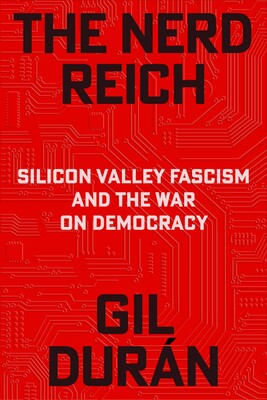
I’ve finally finished reading Gil Durán’s The Nerd Reich, and I recommend it highly. Not that it’s not a tough read in spots – the extreme agendas and immense power and wealth of some of those he’s writing about are hard to take in.
But it’s worth your while, because in addition to the immediate dangers we face from the right-wing extremists now running our government, the risks posed by the broligarch crowd must be dealt with. And defeating them will not be as simple as Democrats winning the next election (not that that’s all that simple), especially when some of those Democrats are all too willing to play footsie with the broligarchs.
Although the book requires you to spend a lot of time with some very unpleasant people (Curtis Yarvin, Peter Thiel, just to name two), Durán does not mince words about the wrongness of their approaches or actions. Having just finished reading Quinn Slobodian’s Hayek’s Bastards for our Strike Debt book club, I found that necessary and comforting.
(While Slobodian’s book is a very detailed recounting of right-wing extremist economists, it is written on the assumption that readers are aware of how awful these people are, so it just recounts what they have done. I would have preferred it if he had interjected something from time to time to show us the damage the people did, even when I was aware of it, just to relieve the unrelenting pressure of their presence.)
Durán is a reporter by training and the book shows just how much effort he’s put into understanding the broligarch crowd and what they want to do. He documents what he says thoroughly and, likely due to his journalism background, he writes very well and very clearly. Continue reading “Reading The Nerd Reich“…
I need to work out. I have a schedule I try to stick with: four days of cardio interspersed with three days of weight training, because my doctor beat me about the head and shoulders about the need for weight training (which I find deeply boring) if I expect to arrive at Old Age in any sort of shape at all. So I have a schedule, which helps keep me honest. To be frank, I’m still sort of getting back into the swing of the routine after spending a week on vacation, but I’ve been pretty good, even when it meant bounding out of bed and starting to exercise.
However.
I have a cold. Coughing, sneezing, scratchy throat, the classic bug. Yesterday I did nothing. Which includes the cardio.
Today I am feeling better. By rights, and by my schedule, today I should do my weights routine. Except that I didn’t do the cardio, which I marginally prefer, yesterday. And I found myself having an actual, very dumb, conversation with myself about the moral imperative to do the weights routine today, on accounta I have a schedule, and if I do not keep the schedule then I am a bad person. Madeleine A opined that if I did not do weights today I would knock the whole schedule out of whack and then chaos would ensue. Madeleine B pointed out that I could do cardio or weights or nothing today, I might as well do whatever I prefer. Madeleine A responded that if I’m going to exercise at all, I should keep with the schedule, because schedule. Madeleine B pointed out that the schedule is entirely arbitrary, I invented it myself to give myself some structure, and that there is no external authority who is going to give me demerits or a spanking if I knock the schedule out of whack. At which point Madeleine A said, huffily, “FINE! You might as well not work out at all today! At least then you’d be back in the rhythm of the schedule.” Madeleine B noted that this might be an over-reaction, but again, there is no external authority who is going to come scold me and tell me that I am a Bad Person for skipping exercise when I’m sick.
At which point Madeleine C, a wholly separate entity, declared she was going to have a cup of tea and revisit the whole question in an hour.
It is a fine thing to create structures. Especially now that I am retired, I love my structures because they keep me from doomscrolling or watching too many reruns of old medical dramas. On the other hand, our structures can be manipulated into shackles, and nobody wants that. Balance in all things.
We in one of those times when it’s not easy being Jewish and not always safe, either. And yet, the new Jewish year began on Friday evening. How do Jews get through times like this? Where it’s possible, food helps. This year I[‘m sharing my family’s most made honey cake recipes, in the hopes that the good and sweet year will spread. These recipes create much goodness and also much sweetness. They’re at their best cut into small pieces and enrobed in really good dark chocolate… but they’re never not good.
The recipes are mostly metric, being Australian.
I use the first recipe as a guide and change it considerably. I use real coffee instead of instant coffee and boiling water, for instance. This year I sued grapeseed oil, other years I might use a but oil. For one cake I used blood orange. And I added my homemade candied dekopon peel. For me, each and every eyar is different and I want the incoming year to be good and sweet and enver boring.
GRANDMABLACK’S JEWISH NEW YEAR HONEY CAKE (GILLIAN’S VERSION)
Ingredients:
500 g honey (or a bit less)
1 cup sugar
1 ½ cups plain flour
1 ½ cups SR flour
juice and rind of one orange (a nice big one – but you can replace some of the juice with brandy or other alcohol)
at least two heaped tbs. good, rich cooking chocolate (not too sweet)
1 dessertspoon instant coffee
approx. 1 cup oil (a salad oil is best, but not olive)
3-4 extra large eggs
½ tsp. vanilla
1 tsp. bicarbonate of soda
1 cup boiling water
about a cup of your favourite dried fruits and nuts (chopped)
1 tsp. of cinnamon, ginger, allspice, nutmeg and a taste of cloves (NOT 1 tsp. of each)
Method:
Beat eggs, sugar, oil and honey. Add orange rind and juice. Add spices. Sift both flours with soda. Add to liquids. Add chocolate, coffee, vanilla, fruit and nuts. Mix well. Add boiling water.
Pre-heat oven to 500°F. When you put the cake in, reduce heat to 350°F. After and hour, reduce heat again, to 300°F until the cake is done (normally another 15-20 minutes).
Cool on greaseproof paper. Store in an airtight tin, preferably in the fridge. The cake will keep for weeks this way – if you can keep greedy fingers away from it.
HONEY CAKE (THE OTHER GRANDMOTHER’S RECIPE)
Ingredients
1 lb honey
1 ¼ cups plain flour
1 small cup sugar
2 eggs
1 small cup oil or melted butter
1 tsp cocoa
1 tsp mixed spice
1 tsp cinnamon
a heaped tsp bicarbonate of soda
Method
Melt the honey and sugar over a low flame. When the are cold, add the eggs (which should be well-beaten first – a form of domestic discipline), the oil and the remaining ingredients. Put the bicarbonate of soda in last.
Pour into a well-greased cake tin and bake in a moderate oven for 1 ½ hours.
So it’s been 25 years since September 11, and we’re awash in retrospectives, some of them even useful.
As someone then living in Washington, DC, with relatives in New York City who lived a few blocks from the World Trade Center, I was stunned and horrified, but I also had what turned out to be legitimate concerns about how our country would respond.
Which was, to put it in one word, badly.
We started unnecessary wars. We underplayed the dangers of the toxic air quality in New York, which has led to more people dying from the effects of the attack than died in the attack (and that’s not including those who died in the unnecessary wars).
And we undermined the civil liberties of the people of the United States. The New York Times has a good op-ed on that this week. I remember that happening in real time, remember feeling very angry about it.
The Department of Homeland Security – an Orwellian name if there ever was one – dates from that time. You have only to read today’s news to see how that turned out.
A month after the attacks I flew to Texas to visit family, traveling through a Baltimore airport that was crawling with armed members of the National Guard and being subjected to an absurdly long line for security. On that trip, I re-read two books: Sinclair Lewis’s It Can’t Happen Here (also very relevant right now, though I find I can’t face it at this point) and Joseph Heller’s Catch-22.
I wrote a major paper on Catch-22 in college. I’ve always thought that the major theme of the book was that Yossarian and his comrades were in more danger from what the powerful in our country were doing to get “value” from the war than from the war itself. That’s what I saw happen after September 11.
What I took from the attacks was that we needed groups on the neighborhood level ready to deal with problems in the community when disaster happens, whether that disaster is a terrorist attack, mass shooting, a “natural” disaster, or something else. I kept looking for government support for organizing such things – a way to get supplies, tools, training – but found nothing.
My desire to do something intensified with the Anthrax attacks that killed postal workers in Washington, but again, there was nothing in the way of support.
A lot of young people enlisted in the military only to get sacrificed in the unnecessary wars instead of defending the country. But there was nothing for civilians to do except “go shopping” (Junior Bush was such a fool). Continue reading “25 Years After September 11”…
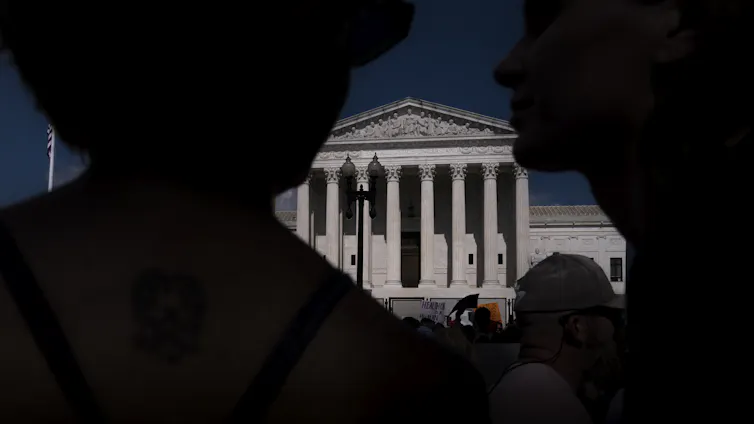
Public opinion on abortion has shifted 4 years after Dobbs decision overturned Roe v. Wade
People gather in front of the Supreme Court building following the Dobbs v. Jackson Women’s Health Organization ruling on June 24, 2022, in Washington, D.C. Nathan Howard/Getty Images
But four years later, one of the most impactful developments has been less visible: a significant, sustained and politically consequential shift in public opinion. In the wake of Dobbs, the debate over abortion rights did not simply return to the states. It fundamentally altered how many Americans think about the issue and how they vote.
In our recently published book, “Not Going Back: Public Opinion on Abortion in Post-Dobbs America,” we examined how and why these changes have occurred, and what they mean for U.S. politics. We believe the shift could have real consequences for the November 2026 midterms.
Post-Roe stability
Drawing on several nationally representative surveys conducted before and after Dobbs, we examined how Americans’ abortion attitudes, political priorities and voting behavior have changed in response to the most significant shift in abortion policy in half a century.
For nearly 50 years after Roe, public opinion on abortion was remarkably stable. In 1975, Gallup found support for legal abortion in certain circumstances at 54% and support for a ban in all circumstances at 22%. In 2021 – the year before the Dobbs decision – these figures were virtually the same: 48% and 19%, respectively.
Despite heated political rhetoric, most Americans held nuanced views. They were neither fully anti-abortion nor fully pro-abortion. Instead, they supported legal abortion in some circumstances and not in others.
That underlying stability shaped both policy and politics for decades. Republicans were able to rally a committed core of supporters around opposition to Roe, while the underlying constitutional right to access abortion remained unchanged.
As states moved quickly after the Dobbs decision to enact abortion bans and strict gestational limits, public opinion moved in the opposite direction.
Today, more Americans identify as pro-choice than they did before Dobbs. And, as we document in our book, more Americans are now taking absolutist positions. They support legal access to abortion in all or most cases and oppose government regulation altogether.
How Dobbs shattered the equilibrium
One of the most striking changes in the post-Dobbs era concerns who cares most about abortion. For decades, abortion was a higher priority for Republicans and those identifying as pro-life.
That dynamic has now flipped. In both 2022 and 2024, Democrats and pro-choice Americans were more likely than Republicans to say abortion was a top political issue shaping their vote. In our book, we document how in both 2022 and 2024, pro-choice Democrats were especially motivated to vote and remained highly loyal to Democratic candidates.
At the same time, the considerable minority of Republicans who support legal abortion found themselves politically cross-pressured, meaning they experienced conflicting political influences.
Drawing on multiple nationally representative data sets, our book reveals that roughly one-third of Republicans hold views on abortion that do not align with the official pro-life position embraced by their party. They either identify as pro-choice or support legal abortion in at least some cases.
It was one thing to identify as a pro-choice Republican when Roe guaranteed a constitutional right to abortion. After Dobbs, however, Republican electoral victories could directly result in abortion bans and other restrictions. That makes partisan choices far more consequential.
We found that cross-pressured Republicans had lower turnout rates and were more willing to cross party lines, reflecting the growing tension between their abortion views and their party’s position. Given the size of this group, that presents a serious challenge for GOP candidates.
A group of abortion-rights supporters gather in front of the Supreme Court on June 28, 2022, in Washington, D.C. Nathan Howard/Getty Images
Reshaping US politics
At the same time, efforts to find a middle ground on abortion have proven difficult. Republican legislators in North Carolina and Virginia, for example, have sought to position policies such as 12- or 15-week bans as a reasonable compromise.
That might have worked in 1990. But public opinion has shifted in ways that make this strategy increasingly untenable. Our research shows that most Americans, including Republicans, do not see these “moderate” policies as meaningfully different from more restrictive bans.
One reason may be that, in the wake of Dobbs, abortion restrictions have become concrete rather than abstract. Extensive media coverage of women denied care during miscarriages, severe pregnancy complications and other medical emergencies has highlighted the consequences of gestational limits. This leads many Americans to judge these policies by their practical effects rather than the specific week at which abortion is prohibited.
In addition, our original survey data reveals that many Americans have only a limited understanding of how pregnancy is dated. That makes distinctions between six-, 12- and 15-week bans less meaningful than policymakers often assume.
Another major change is the emergence of a gender gap in abortion attitudes. For decades, men and women held remarkably similar views on abortion. That is no longer the case.
Since Dobbs, women have become significantly more supportive of abortion rights than men. For example, 56% of women say abortion should be legal in all or most circumstances, compared to 41% of men.
This new gender gap reflects both women’s experiences with pregnancy and abortion and the changed policy environment following Dobbs. After the ruling, the consequences of abortion restrictions became far more immediate and tangible.
Rather than accepting these new restrictions, many women reacted against them. As abortion policy moved sharply to the right in many states, women’s attitudes moved in the opposite direction. This has resulted in substantially greater support for abortion rights.
Our survey research further finds that a better understanding of human reproduction, including how pregnancies are dated, is associated with greater support for legal access to abortion.
Taken together, these changes have reshaped American politics in ways that advantage Democrats. Abortion rights played a key role in the 2022 midterms, contributing to stronger-than-expected Democratic performance nationwide.
And it continues to shape voter motivation and turnout patterns heading into future elections.
‘Not going back’
That said, abortion is not the only issue that matters in modern U.S. politics. In the 2026 midterm elections, the economy and partisanship – especially in an era dominated by President Donald Trump – will remain central to electoral outcomes.
Abortion alone is unlikely to determine any single race. But it has altered the political landscape in ways that will matter this November and beyond.
The phrase that gives our book its title – “Not Going Back” – captures this moment. The changes we document are not temporary reactions to a single Supreme Court decision.
The stability that defined abortion politics for half a century is gone. The new normal is a political landscape in which abortion rights have become both more widely supported and more politically consequential. They are motivating Democratic voters while creating new tensions within the Republican coalition.
Perhaps most importantly, Dobbs transformed abortion from a constitutional question into an electoral one. As abortion laws became substantially more restrictive, public opinion moved toward greater support for abortion access. The 2026 elections will offer another test of how the U.S. responds when public policy and public preferences move in opposite directions.
This story was produced in collaboration with Rewire News Group, an independent nonprofit media outlet that covers reproductive health.
 I watched a lot of cartoons as a young person. Like, a lot. In New York City, where I grew up, we rejoiced in the–at the time–enormous selection of 7 TV channels (including the educational channel), and by 5 o’clock every evening at least two of them were showing cartoons: Warner Bros., primarily, but Woody Woodpecker and the Hanna Barbera slate, and Tom and Jerry… and those frankly kind of awful limited-animation series like Jonny Quest and Clutch Cargo. I imbibed them with a growing critical sense (if you can say such a thing of an 8-year-old), coming to the conclusion that Warner Bros., and later, the work of Jay Ward, were the clear winners.
 I learned a lot about the 1930s and 1940s from Warner Bros. At the time, of course, I didn’t understand how much I was taking on board about, for example, life on the Home Front during WWII (blackout curtains, gas rationing, “Is this trip really necessary?” and the Little Man from the Draft Board), who the Hollywood hot tickets were (all Warners stars, of course). Some of the references were direct: Lauren Bacall wants rabbit pie, ordered by Humphrey Bogart, and Bugs Bunny happily complies, because, well, Lauren Bacall. Others were… well, let’s just say that when I first saw Katharine Hepburn in A Bill of Divorcement, I understood what Bugs Bunny had been going on about with the calla lillies.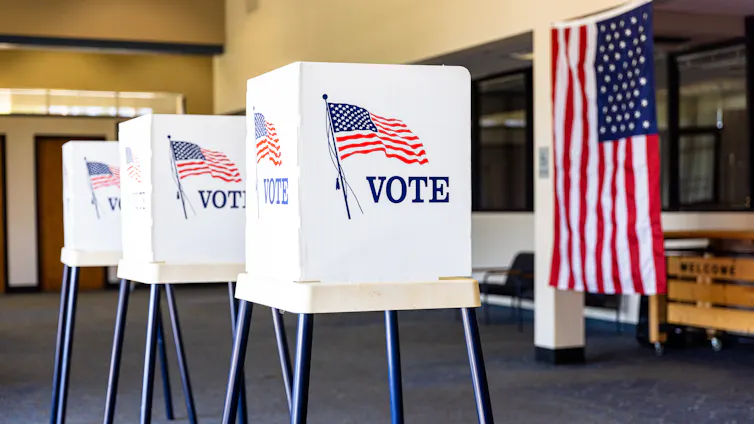


 I’ve finally finished reading Gil Durán’s