
That also meant we got in a visit to DreamHaven Books and Comics – a place worthy of a trip to Minneapolis on its own – and being readers as well as writers, we bought books.
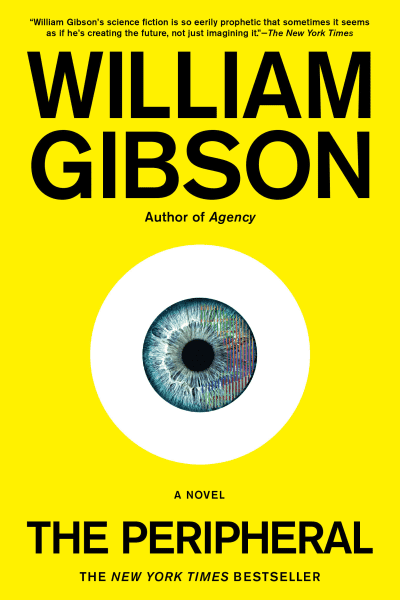
Among the books I got were two I’d already read from the library, but wanted to read again and own, the most recent books by William Gibson: The Peripheral and Agency. And, since I came home to needing to deal with a few stressful things, I have now re-read them both.
(I note that one form of reading that we don’t talk about much is reading to escape responsibilities. I perfected this skill as a kid, and I still fall back on it.)
These books are a tour de force, masterpieces of invention and writing from an author whose skill is legendary. I first read Gibson when Neuromancer came out in the 1980s. He was one of the few male authors I read back then and the only one of the cyberpunk group I really appreciated.
On this re-read, I was in awe at the way he constructed the story
I loved The Peripheral when I first read it — I wrote about it here — and I loved it again this time. I don’t like Agency as much, but I still enjoyed the re-read. Part of that is the characters; I’m more inclined to appreciate people struggling to get by in a southern town in a dystopic near future than I am techbro adjacent folks in a San Francisco of my own timeline.
But this time around the books made me think about some other aspects of both the stories and how those things relate to the reality we’re living in now – a reality that seems to set up all too easily the “Jackpot” that underlies the books.
I can’t talk about this without getting into some spoilers, so I’m going to do a page break here in case you want to read the books first. I know they’ve been out quite awhile – The Peripheral was published in 2014 (and there was even a streaming series), Agency in 2020 – but I want to be polite to anyone who hasn’t read them as well as to recommend that you do so.
These books do what the best science fiction does – throw you into the story and let you figure out what and where and so forth. There are people in London in the 22nd century, after the Jackpot – an experience that Gibson never clearly defines, but that sounds like the upshot of all the time we’ve spent ignoring climate change and dealing with each other in very stupid ways. All that’s clear is that it didn’t happen all at once.
The other characters live in the 21st century in what the people in London call stubs – places where the Jackpot hasn’t happened yet and where worse things are likely to happen. The people of the “county” in The Peripheral live in the mid-21st century and are just getting by, often by playing video games for rich people. Some of them were in the high tech army; others work at whatever they can.
Those in Agency are in a 2017 San Francisco where Hillary Clinton – never named – won the election, but where things are not a lot better than the period we remember. War is brewing and weird things are going on in the tech world.
The implication is that it’s not likely either of these “stubs” survive into the 22nd century, but the people in London become obsessed with trying to help in both cases. Nobody’s sure what will happen, but there is the implication that maybe, just maybe, these two places can avoid the Jackpot.
The ability of the future people to communicate with the past is never explained. There’s the hint of multiverse theory here, but it’s also not explained. This is fiction, after all.
Future London has very advanced tech, including bodies that can be inhabited from afar that are kept for that purpose. The people living there are comfortable, but it is a creepy place, and most of them have their own trauma about it, thus the interest in helping, though others of their time who are aware of stubs use them as nasty playgrounds.
The stories are compelling, with wild adventures and crazy tech and people figuring out ways to visit the other realities using the tech available at their time.
Like I said, I loved them, but at the end I realized I had one problem with both of them: here were two places in crisis, with competent people who could maybe address them, but the solution to the problem came from somewhere else and from power the people on the ground lacked.
In The Peripheral, the key power is Detective Inspector Lowbeer, who is so much more than she seems. She uses people in both realities to get to a decent outcome.
Lowbeer also has a lot to do in Agency, but in addition there is a true AI – not the LLMs that we currently associate with that term – that has been developed by some military research (like the base of almost all of our tech). The AI – Eunice – handles a lot of the crisis.
That is, the people don’t fix their own problems. They do trust those that can help them and they work with them. They are essential to the story – neither Lowbeer nor Eunice can work without the others.
But the fix doesn’t come from the people; it comes from outside. Not quite Deus ex Machina – Gibson does way more with it than that – but it’s clear that without Lowbeer and without Eunice, the crises will keep on coming.
Now I don’t think these stories are an argument for letting the broligarchs go hog-wild with their LLMs that they claim will either save or destroy the world. Gibson’s smarter than that and anyway there are definitely bad techbros out to use Eunice to do harm or at least make themselves rich.
But I find it disturbing to read stories in which the fixes come from powerful entities deciding to be helpful, as if that’s the only way such things will happen. And that’s true despite the fact that Lowbeer, for example, was unable to keep the Jackpot from happening in her own timeline.
Of course, all this is rooted in complexity thinking, where small and seemingly irrelevant shifts could change the future completely, and it is important to recognize that we can’t control where anything is going.
Perhaps all we can do is be like Flynne in The Peripheral and keep our integrity intact and do our best to act morally.
I’m not demanding more certainty than that. I am pretty sure nobody is coming to save us and that all we’ve got is who we are.
But the Jackpot feels very real and I’d really like to read (and write) some stories that give me some idea of how we might pull off the better future that I can also see waving at us (or maybe wavering).
That’s not what Gibson writes, of course. He’s working on a third book. I suspect it’s hard to write. I hope he finishes it.