Interview: Amy Sterling Casil, Ron Collins, Michael Libling Part Two

Welcome back! If you missed the first part of this interview, you can find it here:  https://treehousewriters.com/wp53/2022/11/07/interview-amy-sterling-casil-ron-collins-michel-libling-part-one/

Now, on with the today’s question…

Gillian


Gillian:

Such interesting answers! Thank you.

The different paths you all took to answer the first set of questions fascinates me. You all told stories, in quite different ways. Can you tell me something about the differences between the stories you weave into explanations and the stories you write for books? This is not an academic question – it’s more about your personal approach than your theories about Tolkien’s cauldron of story, for instance. My life is full of theory, and I’d rather it were full of story!


Ron:

I’m struck to ask the question: what qualifies a person to be called an academic?


Amy:

I think it varies from field to field but in literature, it would be “do you teach literature courses” and “do you publish academic writing in journals or texts.”


Ron:

I ask because you were kind of playing around with that idea of who was an academic and who wasn’t, and I’m thinking about my dad – who was a professor of Mechanical Engineering and a researcher. And then I started thinking about Gillian’s question and focusing on what happens when academics start digging into our stuff. I don’t think I have that experience. Commentary on my work has been through social review structures, meaning classic science fiction reviewers, as through direct reader feedback on web stores (Amazon and Kobo and…). I also get the occasional commentary on my own website or email from folks that range from nice to inquisitive.

So, I dunno. I don’t really qualify to answer the question, maybe?

Regardless, all I know to do regarding the commentary my work has gotten – positive or negative – is to try not to pay much attention to it and move forward doing my own thing. That’s easier said than done sometimes.


Amy:

It sure is, Ron – but it’s really important, too. I am doing something with Medium that I think differs from our traditional novel or short story publishing. I get feedback right away and I get metrics (not good ones, but some) directly. I can’t really see and can only guess at comparisons with others. That’s a whole different thing than publishing, having the audience basically be your editor with short fiction, or with even indy publishing – we don’t hear from the majority of readers so ???


Ron:

Yeah, what you’re doing on Medium is definitely a different thing. You’re doing social commentary, which feels almost more like old-school blogging in a lot of ways. It’s very much editorial work rather than fiction.

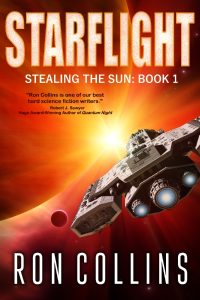
I would expect the commentary to that form of writing to be considerably more personal in a political – though obviously there’s always a political nature to all fiction. When my dad read the first couple books of my SF series, Stealing the Sun, he commented that they were really political. Which they are, but they aren’t. I told him that essentially all SF has political aspects to it simply because we’re almost always playing with what it means to be human. I admit I find the conversation that such social commentary should stay out of fiction to be anywhere from irksome to hilarious, depending on my mood of the day. A difference is that the reader brings themselves into our stories, and will often read their own viewpoint into it (my dad is a right-leaning person…I didn’t ask how he interpreted the politics in those two books, but I could see people deciding they went whatever way they personally thought). When you’re doing social commentary, though, as your work on Medium, for example, you’re directly pointing at people and how they think, and thereby stripping that ability to misinterpret (or purposefully pretend about?) your viewpoint. Raw social commentary can get quite personal real quicklike.

I’m not sure exactly how that applies to the question Gillian asked regarding academic slicing and dicing of work, but I’m sure it does.

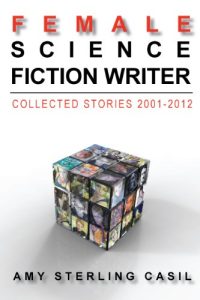
Amy Sterling Casil Femal Science Fiction Writer

Amy:

>>I would expect the commentary to that form of writing to be considerably more personal in a political… [quotation snipped]>>

This is why I’m struggling so much with deciding how to plot or direct or even to do more sci fi, Ron. I work with all of these startups so I see the issues up front. Like I didn’t really write the “political commentary” in this one this a.m. because it’s such a dead deal – but the social media aspect is very much alive. I think *maybe* what I’m doing on Medium is like blogging but I have an audience there. I now put prose (creative) and have put poetry and I will re-circulate that among readers who think I’m just an anti-Clinton person or a pro-women person.

And, I do things with what I do there that are unlike blogging – I include screenshots, the captions I put on images are part of the article, I use the features of it to create different emphases (italics, bold, pullquotes). If we look at different legacy publications, particularly the big newspapers or news magazines, they have various “tools” they can use, like maps, data visualization, etc. I can and do sometimes include that.

Like with the one I just wrote, the software startup CooWe that I’ve been working with for about a year – they are seeking to bring people together in real life in a way that social media and the older programs like Meetup do not. It’s literally dealing with the very basic level of how people decide to get together and interact, and it’s based on NSF-funded research. It’s very easy to use, and less stressful than the traditional efforts. And most of all, it has a not-very-obvious democratization effect that’s super hard for many of us in “our age group” to accept or deal with.

Once I got over that barrier in the classroom (I was the teacher, I *had* to be in charge or I was *supposed to* be in charge) then suddenly, perfect attendance, kids who were supposedly struggling started to excel… it’s people’s attitudes. It’s how they feel about each other, and with each other, and with themselves.

I promised my last group of students, among whom were these just amazing, beautiful, brilliant young women, all unique, all so special – I was like “girls, I love you so much, I want to put you in a story.”

But I see or feel a more corporate future, much like what A.J. wrote about. I don’t want to see that. But I’m not sure I have the capacity to understand or envision the way I should.

YOUR BOOKS ARE GREAT, you are my guy!!

Re: “In our age group,” we’re not quite where Mr. Pettigrew put Bruce. That really was his name – Pettigrew! Stock photo: I so wish I had a shot of him, he was 1000x better/funnier than the fake Kentucky Colonel.


Ron:

There’s a lot to dissect there, but I think I’ll focus on the … um … medium of blogging itself. I mean, really, all the journalistic movements of today (moving to Medium or Substack or Patreon or…) are to my view not a particular big leap from longform blogs which were happening in even the mid-90s. You point out the more modern use of images and pull-quotes and whatnot, but the very first bloggers—who were hardcore html/design wizards—were doing that all over the place. I was learning from them at the time, and the requirement to do it via hand-coding limited the contributor pool. Simpler tools (Word Press and whatnot) opened the field to almost anyone who could type and click.

That was so early in the social media landscape, though. Their audience (and my audience) was considerably limited because most people read newspapers and watched TV. But I followed several of them because I was so intrigued. Their examples led me to build my own presence, which grew into what I do now. I can probably pick out 50 or 100 posts I’ve made that are deep social commentary and that sometimes include various magazine-type aesthetics.

My point is that we’ve used all those techniques in the blogspace for a very long time. And into the 2000s several were growing very large followings. Scalzi’s “Whatever” is one that comes to mind—and much of what he was (and is) doing is social commentary.

So, in reality, blogging has never been anything but self-publishing your own magazine—though the quality of anything, once made available to everyone, will begin to vary widely. Modern platforms like Medium and so forth, paired with everything else, allow one to find, hold, and maybe monetize their audience, though—which was always difficult with a blog.

So, yeah, I love you like a sister, but there’s not a lot new under the sun when it comes to the raw mechanics of content presentation.

The decision to write fiction (vs. non-fiction/commentary/whatever) is a deeply personal one for which there is only your own answer. But I’ll say that, for me, the formats are so different as to be impossible to set side-by-side and compare. I think there are things a narrative story can do that an essay cannot. It goes both ways, though. Story is often indirect in its approach, social commentary cannot generally afford to be anything but fairly direct and to the point.

How story vs. essay get absorbed is perhaps an interesting question—and one at least tangentially related to the idea of external analysis as well as related to your comment that says you’re debating how to or whether to write speculative fiction again (stretching from sci-fi). Is it even worth it, one can read you as saying.

Well.

Maybe it is and maybe it isn’t. It’s hard to call.

I love, for example, all the commentary about how Star Trek (to pick the most obvious example) has suddenly gone “woke.” Star Trek has been “woke” since the day it was envisioned. But when an analyst digs into what the impact of Star Trek has been on the culture of the world, it’s literally impossible to get it right. I mean, has it done anything at all? The existence of the blowback from these anti-woke commentators says there are still a whole boatload of oblivious people who missed the entire point of Star Trek to begin with—but to focus on them is akin to dealing with the survivor bias. The only way you could truly identify the impact of its “wokeness” on the population would be to go back intime and remove it from the timeline.

Replace “Star Trek” with “Science Fiction” (or any story) in that conversation, and you can say the same thing.

Has anyone’s art ever changed the world? I have no idea. But I know it makes my world better.

So, anyway. From a selfish standpoint, I hope you write more speculative fiction simply because I love to read your stuff. But it’s frustrating. Or it can be. To write fiction is to put your heart into this piece of art, and then to be either criticized for it—or perhaps worse, ignored—is sometimes hard to deal with.

Whew…I certainly didn’t think I’d be chatting about these topics when we started!


Mike:

Ah, yes, there are waters into which I will not wade. Several years ago, I allowed myself to become involved in what developed into a flame war with a Canadian listserv/writing group, and I have made a point of never doing so again. While I admire people, like Amy, who boldly put themselves out there, I just don’t have the stomach for the inevitable blowback. And despite being an “old, white male”—the designated, collective source of all evil on this planet of choice and a descriptor I hate as much as I do the generalization of any group, racial, religious or otherwise, my Jewishness has made me a target on more than one occasion. I might feel inclined to write a reply, as I’m doing now, but I have also disciplined myself to delete before posting or sending. Walk away, Michael. Simply turn your back and walk away. You can’t reason here. You can’t employ facts or logic. Just shut your mouth and walk away. You cannot convince, you cannot win. 

I won’t try to define academic, though there is a story that comes to mind, for what it’s worth. I have a friend who taught literature and creative writing for a number of years in some well known American universities. (He was also my first creative writing prof in Montreal.) During one of his tenures, he became friends with another professor—a writer of a many popular thrillers and mysteries, a bunch of which have made their way to film and TV. My friend, whose fiction is dense and literary, decided to try his hand at a genre thriller, in the same vein as his colleague. When done, he gave it to his author pal to read, and the guy could only shake his head and sigh. While the underlying concept had merit as genre, the writing, pacing, and structure remained highly literary despite my friend’s best effort. The verdict was that he simply couldn’t let his hair down, remove himself from the literary trappings. In effect, he wasn’t able to stray too far from his roots. Perhaps, too, there was a basic lack of understanding the target audience outside of academia.


Mike:

Um…uh…ugh…um… here goes nothing!!!???

After reading Ron’s and Amy’s replies, I am beginning to feel like a pale shadow here. While I’ve supported myself with my writing since the late 1970s, I’ve never seen myself as an intellectual or a particularly deep thinker. No one would ever call me the analytical type. Indeed, in my university days, my creative writing teacher, the great Canadian author Mordecai Richler, said something along the lines of, “If anyone in the class is going to make it as a writer, Michael has the best chance because he doesn’t have an academic approach to anything.” Some might have taken this as an insult, but not me. I saw it as a badge of honour. In fact, I still do. So please keep this in mind as I struggle to interpret both the question and construct the jumble that is my response.

I also disagree with you, Gillian. If this isn’t an academic question, it certainly borders on the territory. I’m not trying to be contentious here, but I’m not sure anyone who wasn’t academically inclined would pose such a question.

Anyhow, here’s the short answer: “The stories I weave into explanations” come with a certain amount of pressure. I don’t want to embarrass myself or come off like a doofus, so I tend to pussyfoot, striving to provide an answer that sounds reasonable, but would likely fail to make any real sense should anyone scratch beneath the surface. In other words, I’m a bluffer. As for the stories I write for my fiction, they are mine to approach as I please, and I like to think of them as genuine. I sit. I think. I write. And my brain fills with joy as the story builds and the pieces fall into place. The only pressure is that which I put on myself to get the thing done, without fear of judgement. Here, the keys for me are the opening sentence and voice. When I land both, I land the story.

Now for the long answer: Starting in the late 1970s, I worked full time in advertising as both a copywriter and a creative director, while writing fiction in my spare time. Meanwhile, I also wrote and hosted a Sunday-morning talkshow on Montreal radio, a side gig I maintained for twenty years. The program’s subject matter was trivia. Movies. TV. Golden Age radio. Sports. Science. Geography. Nature. History. You name it!

As a result of the show’s popularity, I was often invited to perform an interactive, non-broadcast version of the program for various groups and charitable organizations in the city. After one of these events, a friend in the audience came up to me and said, “Who are you? That wasn’t the Michael I know up there.” She went on to say that I was like a different person on stage, the transformation occurring from the get-go and right before her eyes. I recalled how my wife had said something similar to me when I first started in radio. Similarly, an art director at the agency had mentioned to me that I was one person when we were brainstorming an ad campaign and a totally different person when pitching to a client. To this I’d have to add that I’m someone else yet again when it comes to questions such as the one you have posed, and yet another personality when I approach my fiction.

My brain and personality adapt to the situation I’m in at any given time. With family and friends, I’m generally quiet and laid-back, prone to quips, though occasionally perceived as angry or glum. For the most part, I think I listen more than I talk. But put me in front of a microphone or before an audience of any size, and it’s as if this other Michael bursts through, entertaining and informing. Truth be told, in such situations, my favourite topics of conversation are ME AND MY WRITING. ME. ME. ME. Strange thing is, I suffer tremendous anxiety in advance of whatever it is I’m going to be doing or presenting. I guess you might say I live with the fear of bombing. For the first nine years of my time on radio, for instance, a queasy gut preceded every show, dissipating only thirty seconds or so after hitting the air. In this same vein, fresh and cleverly constructed interviews such as yours also raise the anxiety level.

And yeah, as mentioned, I’m a different person yet again when I sit to write my stories. Of all the Michaels, I like this one best. First off, the anxiety is absent. And while that outgoing guy from radio and advertising is still present, this personality is expressed in the stories that prevail on the page.  As corny and cliched as it might sound, I truly do experience a natural and joyful high as my characters reveal themselves and the plot, as they say, thickens.

I’m not sure that I’ve come anywhere close to answering the question. Heck, I’m still not sure I understand the question. But there you have it to make of it what you will.


A last word (for now) from Gillian. Signing off for today. These were interesting waters and next week’s section of the interview is even better. Watch this space!


Interview: Amy Sterling Casil, Ron Collins, Michael Libling Part One

Welcome to the first set of interviews. Three writers met with me (via email) and talked about many things. The interview will be posted every Monday for the next few weeks. I (Gillian Polack) am the interviewer, which largely meant throwing in a question and standing well back. The three writers (Amy Sterling Casil, Ron Collins and Michael Libling) are all pretty amazing, but I’ll let them speak for themselves. Let me throw the first of the questions in, to get them started.

Gillian Polack (henceforth, Gillian)

A stranger once asked me to tell them three things about myself. I’ve thought about this often since then, and have discovered that asking writers to tell me three things gives much more interesting replies than asking for a short life history.

1. If you had to explain what you write to that stranger, what would you tell them? (The stranger was French, if it helps.)

2. Imagine a game show (not Squid Game, a poor answer won’t kill you) where you have to describe your writing using five adjectives. The audience buzzes boring words, or predictable words. You don’t want to hear that buzzer. What are your five words?

3. What’s your favourite question about your work, the one you’re always happy for people to ask?


Ron Collins (Ron):

As Mike said in his answer to the first question, “Zut alors! Or, as we say in Quebec, “tabernac!” …Both of which roughly describe my feelings about the answers below…” I keep hearing ‘Tabernac!’ when I read these answers, but, as a response, it doesn’t fit them all. Read on…


1. What do you write?

Amy Sterling Casil (Amy): I’m a female science fiction writer and I now write stories featuring women, girls, and non-human creatures (animals, others, machine life). I also write factual books for children and teens. They’re often about medical, science, or tech topics. And, I write creative nonfiction online via the Medium service. It’s a different type of writing via online. Topics are current and the format is very different from traditional books or short fiction.

Michael Libling (Mike): Most likely, I would pretend I didn’t hear the question and move on to a topic with which I was more at ease. If forced to answer, however, I’d likely blather on like this…

I write stories about everyday life and everyday people, and then drop some freakish element into the mix, which tends to lay waste to the “everyday.” In terms of specifics, I try to avoid the obvious in my pursuit of the “freakish,” thus avoiding vampires, zombies, ghosts, wizards, dragons, and the like. The more unassuming the menace, the more frightening it is to me.

Some editors have told me I write mainstream fiction with a genre sensibility, while others insist my writing is genre fiction with a mainstream sensibility. One long-ago, former agent of mine lamented the fact my work was neither literary nor genre, which made his job too difficult. The way I see it, my fiction tends to cross categories, blending any number of the following at any given time: mainstream, fantasy, horror, mystery, thriller, and science fiction. If there is a unifying factor in my work, it would be the recurrent strains of dark humour.

My upcoming novel (Autumn 2023 from WordFire Press), THE SERIAL KILLER’S SON TAKES A WIFE, was described by one reader as “a breezy spin on horrible things.” Looking back, I think this same description could apply to most of my work.

Ron:

I used to say that I write speculative fiction, and just left it at that.

Unfortunately, or fortunately I suppose, that’s not really true now. I’ve written twenty or so novels, and nearly 200 short stories, and when I look at them, I see the fact is that I write across pretty much every genre. I’ll chuckle at myself here and admit that I was tempted to end that sentence with “except horror,” but then had to chastise myself because I’ve done several things with at least some elements of horror in them. Bad writer!

Here’s the thing, though. I’ve come to the conclusion that I don’t like the default feeling of talking about genre anymore. Yes, I still focus on speculative fiction—science fiction and fantasy and things that go in strange directions—but the reality is that I love story, and that’s what I’m trying to do. Tell stories—hopefully stories that matter to me, filled with characters I can relate to.

I can’t control how people react to those stories, of course. The world is full of opininated people, and I can’t please them all. But these days I figure that if I tell stories that matter to me, I’ll be speaking to an audience that will care about them, too. And if someone doesn’t find them relevant, well, that’s fine. They just aren’t my audience.

So, what matters to me?

That, unfortunately, you’ll need to read some of my work to decide.


2. What are your five words?

Amy:

Emotional, easy-to-read, eclectic, exciting, and electric

Ron: Hmmm. I think I’m going to get buzzed.

Honestly, I don’t know. I sit down, and whatever comes out comes out. Last week, for example, I went to the writing desk totally intent on writing a science fiction story for a publication I often contribute to, but my brain wouldn’t do that. Instead, it wanted to work on a psychological thriller of a short story that bordered on, yes, horror.

That said, I’m a while male of a certain age, so I’m sure that comes out in ways I couldn’t even begin to describe. To generalize, I guess … hmmm … well, let me at least try to answer the question.

·         Hopeful.

·         Honest

·         Wide-ranging

·         Entertaining.

·         Compassionate

See what I mean? I’m totally getting buzzed.


Mike: With apologies to Amy for my failure to emulate her alliterative triumph.

Off-the-wall.

Menacing.

Digressive.

Wistful.

Unpredictable.


3. What’s your favourite question about your work, the one you’re always happy for people to ask?

Amy:
What inspired you to write story ________________ [or essay/article ____________]?

Ron:

“I love your work, can I give you a check?”

(grin)

Seriously, in this world where attention spans can be measured in picoseconds, I’m just happy for any attention my writing gets at all. It’s nice when people have read something of mine and ask about where it came from, and it’s nice when people ask where they can get my work—though I admit that since I am so all over the place (and write that way under my one and only name) I often wonder if I send people the right direction.

Most of my email questions seem to center around when the next book in my SF series is coming out, which is good news/bad news since I’ve done a mini-Martin and had a gap. The good news, though, is that the wait is over and the series is back in production.

That’s a problem with being an independent publisher, though. There’s only just me, so when life happens, if I can’t get my feet to the pedals for a period of time, everything grinds to a halt.


Mike:

Every writer likes to hear, “Where can I buy a copy?” But I also enjoy when a reader asks me, “Did this actually happen? Is that real?” Since much of my writing is grounded in reality and often strays into the autobiographical, I get this a lot. Likewise, I prefer to leave the answer to the question as ambiguous as possible, leading to further speculation.


Gillian:

Three questions is enough for one week! Next week there will be more questions, more answers… and some picture.

The Downhill Path to Understanding

I’m waiting for mail. I blame conversations. I also blame virtual and hybrid science fiction conventions. This last month, I’ve been to a couple, and one of them worked out how people could get that casual chat that’s such a part of face to face conventions. And all this is good… except…. Except… when one is sitting at one’s computer (notice how I distance myself from something I’ve done) it is the work of but an instant to buy that book that the group is talking about.

A group of prize-winning Korean writers talked about influences on their work, for instance, at VICFA (the Virtual meeting for the International Conference on the Fantastic in the Arts) and one of them threw casually into the conversation that the most important writer was finally in translation. Reader, I now own Kim Bo-Young’s I’m Waiting for You.

Most books are still heading my way.

Only one has arrived, and it’s related to me trying to understand why the popular view of Jewish history in central and eastern Europe is so very wrong (mostly) for anything prior to the 1770s. What happened in and around the 1770s, was the partitioning of Poland. A vast country (the whole of the Polish-Lithuanian Commonwealth) went, to describe it a bit simplistically, from being dominant, to being under the rule of others. Most of the sense of Jewish history we have came from places under Russian rule, which is currently very topical. So many lives were changed so profoundly and for such a long period, that we still think of Tevye the Milkman as being a kind of Universal Nice Jew and Anatevka as being the classic stetl and stetls being the only place Jews could live in all those vast regions.

I know more of the history of the region now, and understand both why the change happened, and why a lot of people take the position of Jews in the late Russian Empire as typical and push it back to the seventeenth and sixteenth centuries. I need to know more about how people actually lived. Polish SFF fandom is helping me in this endeavour, but I also have to help myself. I helped myself to much reading. Some I’ve borrowed, some I’ve read online, but very occasionally there is something I must buy because I live in a city with too small a Jewish population to obtain it locally. A book by Yohanan Petrovsky-Shtern is the most recent ‘must-buy.’ It’s called The Golden Age Shtetl. A New History of Jewish Life in East Europe.

My little library of Jewish history is slowly growing, as is my knowledge. This book covers the transition period, when Jewish life changed so dramatically. Before the book begins, there was the Polish-Lithuanian Commonwealth, where Jews could work in almost any trade and lived in cities and towns. At the end of it, we have that dream of a small town or even village Jew, being thrown out of their home by an uncaring Tsar.

The reality is complex, but if I can understand those changes, I’ll know my own heritage but I’ll also be able to write more about it, whether using it as a setting for fiction, or writing critical essays. The immediate reason I bought the book is partly because someone mentioned it and I checked it out, but mostly because I had a conference paper on Jewishness in a couple of works of fiction accepted and I need to know this book to write it. Right now, my subject knowledge is cumbersome. One day, learning about this subject will tip down the artificial mound of rubble made by ill-digested information. As I roll down that hill, everything will suddenly be clear.

And now I must watch for mail. I’m still missing eleven books. They’re all work-related, just as these two are, and every single one of them is likely to upend things I thought I knew and maybe, just maybe, push me off that hillside and start on the real learning.

Comfort and the Lack of It

The Mirro Crack'd book coverMy comfort books of choice are mysteries.

This is in part because a good mystery can engage your mind while being separate from the real troubles of your life. But it’s also because when I was around 10 or 11 I graduated from reading Nancy Drew to diving into my mother’s extensive pile of Agatha Christie books.

That is, I associate those books with the somewhat simpler time of childhood.

As a kid, I vastly preferred the Poirot novels to the ones featuring Miss Marple, and I continued in that preference until after my mother died and I ended up with a bunch of her books. I picked up a Marple and discovered I liked those stories much better than I had as a kid.

It might have been because I had reached the age that Jane Marple is in some of the early books. Christie wisely never quite specifies her age, but at a guess she’s in her late 50s in the early ones and maybe pushing 90 by the end. I was ready for stories about a smart old woman.

And Miss Marple is very smart, a reminder that the misogyny of the 20th century wrote off a large number of intelligent women with a lot to offer society. Christie’s plots are always absurd, but that doesn’t take away from Miss Marple’s powers of observation and detection.

I recently discovered that one of the ebook providers through my library has the Miss Marple books and, in need of some comfort reading, I’ve been going through them. Last week I finally decided to try The Mirror Crack’d From Side to Side, one of the later books, published in 1962 when Christie herself would have been in her 70s.

As a rule, when I re-read a mystery, I’ve forgotten who actually “done it,” though pieces of the story come back to me. (This rule does not apply to books I’ve read multiple times, such as Gaudy Night.) But in this case, I not only remembered who the murderer was, I also remembered that I really hadn’t liked the book when I was young. So I wasn’t sure what I’d think.

I did like it better this time, though I was also much more aware of the ableism, racism, and issues of social class that permeate the story.

On the other hand, it wasn’t ageist. One key subplot involves the companion who now lives with Miss Marple because of her health. This companion is the sort of person who talks to her charges as “we” and ignores their preferences because she doesn’t believe they are mentally competent. Since we see her from Miss Marple’s POV, we understand just how grating that behavior is for an old person, even one who needs some assistance.

But the real reason I’m writing about this book is that it slipped out of the comfort reading category because of a key element of the plot that feels all too relevant in a time of ongoing pandemic.

Discussing that requires a major spoiler for the book, which I might not do except for the fact that it was first published 60 years ago and I suspect that very few people who really want to read it and be surprised have not already read it.

If you fall into that small class, don’t keep reading. Continue reading “Comfort and the Lack of It”

Love and Death: Would You Like a Little Romance with Your Action?

Crossing genres is hot business these days: science fiction mysteries, paranormal romance, romantic thrillers, Jane Austen with horror, steampunk love stories, you name it. A certain amount of this mixing-and-matching is marketing. Publishers are always looking for something that is both new and “just like the last bestseller.” An easy way to do this is to take standard elements from successful genres and combine them.

As a reader, I’ve always enjoyed a little tenderness and a tantalizing hint of erotic attraction in even the most technologically-based space fiction. For me, fantasy cries out for a love story, a meeting of hearts as well as passion. As a writer, however, it behooves me to understand why romance enhances the overall story so that I can use it to its best advantage.

By romance, I mean a plot thread that involves two (or sometimes more) characters coming to understand and care deeply about one another, usually but not necessarily with some degree of sexual attraction. This is in distinction to Romance, which (a) involves a structured formula of plot elements — attraction, misunderstanding and division, reconciliation; (b) must be the central element of the story; (c) has rules about gender, exclusivity, and, depending on the market, the necessity or limitations on sexual interactions. These expectations create a specific, consistent reader experience, which is a good thing in that it is reliable. However, the themes of love and connection, of affection and loyalty, of understanding, acceptance and sacrifice, are far bigger.

In my own reading and writing, I prefer the widest definition of “love story.” After all, people can love one another without sexual attraction and people can love more than one other person, usually in different ways and to different degrees. (For an example of what I’m talking about here, see my Darkover novels, Hastur Lord and The Alton Gift, which involve a three-way love triad in which each character must deal with the others with honesty and compassion.) With the addition of non-human characters — aliens, angels/demons/vampires/werewolves, faeries and other magical creatures, sentient computers, and the like — the possibilities multiply enormously.

I believe that action/adventure, regardless of the genre, is deepened and enhanced by romance, and also that love stories work better when the level of peril is intensified. For one thing, both adventures and falling in love (or growing in love, or discovering that love has always been there) both involve a character taking a risk. Whether the character goes after the evil Empire, battles a dragon, lands on an unexplored planet — or opens her own heart — there is always the possibility that something may go terribly wrong. All too often, safe stories are boring stories. Something must be at stake, and the higher the stakes, the more reasons we have to care about what happens.

I’ve never subscribed to the cliche of the hero and heroine falling into one another’s arms, consumed with lust, in the middle of a frenzied life-or-death conflict. (My libido certainly doesn’t work that way, which might be the explanation.) Such a moment might be the occasion for realizing how much one character cares for the other when at any moment the beloved might be killed/captured/brainwashed/turned into baby-alien fodder. That moment of inner honesty escalates the stakes for the character (and, hopefully, the reader). I like to see that realization played out and savored, not exposed and consummated in wham-bam-thank-you-ma’am style.

Love stories are not just about connecting with another person; they are about connecting with ourselves. In good love stories, the character struggles with internal obstacles — memories, ideologies, character flaws — as well as external ones. In romantic adventure, the two types of conflict mirror one another. Neither is resolvable without the other. The heroine cannot defeat the dragon until she masters herself. (Or, in a tragedy, the hero’s own nature becomes his undoing; for example, Orpheus.)

Both love and crisis can force a character to re-examine her priorities. What’s really important — the way her hair looks or the thousand Bug-Eyed Monsters about to invade her home town? Who does she want to be — the social butterfly or the executioner? Rambo or Mother Teresa? Miss Marple or Indiana Jones? Buffy or Albert Einstein?

Who does she love? What is she willing to do to protect those she loves? What will she do when faced with a choice between her own happiness and the fate of a stranger — or a planet — or a race of magical beings?

Romance allows us to “ratchet up the stakes” in these decisions, pitting personal concerns against altruism, what is right against what is self-serving. Adventure allows us to play out the journeys of the heart in the outer world, exploring more deeply the transformative and healing nature of love itself.

The Pleasant Art of Finding the Right Reading

I’ve vast lists of books to read, because I keep going to science fiction conferences and academic conferences and I always end up with loads of exciting reading. I ought to dissect these lists and ell you all the best reading in them, but I can’t, because I still have to read the books myself. Also, most of them are still in the mail.

That got me thinking abut how we decide what to read when there are too many choices. I’m the sort of person who can’t deal with choices. Give me too many choices and I will walk away in frustration rather than buying the thing I came into the shop for. Except with books. It’s much easier to know which book to read at any given time. This is because, for me, each book is surrounded by information that helps me choose.

When I travel to Sydney, for instance, and go to one of my favourite bookshops there, the folks behind the counter are always knowledgeable. Every time I visit, I buy a book specially for the bus trip home. It has to be something special, I tell them, and something new. It has to be something that’s not being seen quite enough and that I absolutely need to know about. We talk about my favourite writers and they always, always find me something. I’ve only ever given one of those books away, too. Booksellers know books. It’s as simple as that. If I am in a bookshop where the bookseller doesn’t know more than me about the books in their shop, then I walk straight out. This is why I have favourite bookshops: because the people who run them choose with care and thought and understand their work so very wonderfully.

Another route I take is to think carefully about the genre and even sub-genre of the book I want to read. I fit the type of book to my mood, in other words. To do this successfully, I need a vast TBR (to be read) pile. Choice helps me where usually it perplexes me. It’s so much fun finding the perfect book through this method, because I take each book out, one by one, and hold a kind of inner conversation with it.

Other days I need comfort reading. I have maybe 3 dozen authors I turn to for this and which writer I turn to depends so much on what my comfort needs are. When I need much comfort over a few weeks, I’ll haul down a series by a favourite author. By ‘haul down’ I mean that I actually climb onto a chair and take a whole pile of books down. Series of comfort reading are on my high shelf, you see, and reach to the ceiling.

Sometimes I am a butterfly, and stand in my library reading a bit of this book here or that there until I find the one I want. Sometimes I’m a carnivore and eat the content of cookbooks except, these days, all my cookbooks are finally in my kitchen or loungeroom, so I stand by the kitchen counter or sit in a chair near the door. I’ll make a stack of books I want to use recipes from, and read bits and pieces from half a dozen more. It takes several days for the books to all be returned to their place. Sometimes I cook all the recipes. Sometimes I don’t. Sometimes I sit down and read a whole book (or two) but mostly I use the books in my food collection as a trampoline for research and for thinking about what I will be eating.

Speaking about research, finding the right book for researching (whether for scholarly purposes or for a novel) is another method entirely, and even thinking about it makes me tired. I think I might stop this piece right here and go to bed. Time to dream of books.

Books and business and a weekend in Ireland

I’m still in my impossibly-busy time. I wanted to write you a proper post, but I also need to sleep. I’ve spent all my spare money on books this week. Four I have already, and the rest are to come. What I might do until I have the book or can reclaim real time (whichever comes first) is introduce you to some of the new volumes in my library. Two each week, I think, so that you’re not overwhelmed.

I caught up with the authors of this week’s books in my first face-to-face science fiction convention since August 2019. One I saw briefly and she was wearing a t-shirt for the world science fiction in Glasgow in 2024, which made the world feel less big than it has recently. The other dropped in and we had a couple of hours to catch up. By ‘dropped in’ I mean he was willing to take a RAT to see me. We all have different names for the quick COVID tests and Australians call the RATs. This is, of course, because it opens up the potential for very silly jokes. Especially since at least two of my friends have pet rats. I will save you from the jokes and return you to the new books.

Jason Franks’ new volume is X-Dimensional Assassin Zai. Through the Folded Earth. Cross-dimensional assassination…

The other is Thoraiya Dyer’s Tides of the Titans. It’s been a long while since I read a new novel by Thoraiya – they simply have not come my way.

I’m looking forward to both these books so much. I have to wait before I can read them, however. Until the middle of November, my life is on fast forward. The northern hemisphere is in peak conference time and I’m in my silly season and handling health issues. This opens an opportunity. If any of you buy one of the books and wants to read and discuss it with me, you have time. Much time. We could have a discussion here, in the Treehouse. Or not. Maybe you’re as impossibly busy as I am.

If my life were quieter I could read them both next weekend, but next weekend I’m online in Ireland. In fact, I’m staying up late every night this week to get the most Irish day possible during the Australian night. I go to Irish conventions whenever I possibly can (which is about a fifth as often as I’d like to, which is the sad truth for me and most of the conferences and the conventions I love), but this year is special: I’m one of the guests of the Irish National Convention. I’m giving talks, am on panels, and giving a reading. I’m also spending as much time as I can chatting with people – Octocon attracts fascinating folks. It’s a lovely place to meet people and does the virtual side of things with much care and thought, which means even from the other side of the world (while ill – this is like dancing backwards in heels) Dublin is a good place to visit.

If you also join in the virtual side of Octocon, find me and we can chat about books, about writing, about overwork, about the odd shape of our current world…

And the Award-Winning Author Is…

I’m amazed and thrilled to announce that my story “Eight Mile and the City” from When Worlds Collide has won the WSFA small press award for short fiction.

Check it!

This year, the committee got more than 260 stories for initial consideration. They whittled it down to ten finalists, including my story. The finalist list has some heavy-hitters in the SF writing community on it, and there were so many stories anyway, so I wasn’t expecting to win. I had a “It would be great, but no need to get your hopes up” frame of mind. I was in the audience at the award ceremony in Washington DC, and when they announced my story had won, I was floored. I was so surprised, I couldn’t do anything for a moment but stare at the announcer. Joshua Palmatier, one of the editors for the anthology, was sitting next to me, and I could see he was thrilled. In a fit of exuberance, I hugged him, then went up to the podium to get the award. I also gave a short speech. This is what I said:

Thank you, everyone! This is amazing!

This story means a lot to me. Not just because I wrote it, but because of what it means. The main character in “Eight Mile and the City” from When Worlds Collide is gay, but that’s not what the story is about. The story is about a hardboiled detective trying to solve a kidnapping and uncovering his own past as well.

Not that long ago, this story would only have appeared in an anthology of gay fiction and “only”
gotten the attention of the Gaylactic Spectrum Award. This story appears in a fantastic anthology
of wonderful stories that are geared toward all SF readers. It’s not a specialty. It’s not an odd outlier. Instead, it’s one of the family.

We still have further to go, of course, but every step forward gets us one step closer to full inclusion and acceptance. I’m thrilled that my story has become one of those steps.

I do want to thank the committee members for choosing “Eight Mile and the City.” It means so very much! I also need to thank the members of the Untitled Writers Group of Ann Arbor, Michigan–Sarah, MaryBeth, Jonathan, Christian, Diana, Cindy, Ted, Christine P-K, and Christine D–for commentary that improved every line of this story. I want to thank S.C. Butler and Joshua Palmatier for editing When Worlds Collide and buying my story. And I want to thank my husband Darwin McClary for the inspiration I needed to write this piece.

I’m back home now and coasting on euphoria!

The story “Eight Mile and the City” appears in the anthology When Worlds Collide. We have an excerpt below:


We knew she was opportunity because she knocked once and came in. She had a swagger and a set of dagger heels you only see in women south of Eight Mile. A thin line of dark showed at the roots of her carefully golden hair and her lipstick was a strawberry scarlet. She shut the office door behind her and sat in the client chair across from me without asking, her red leather purse perched on her knees like a sleek little lapdog. Seb exchanged a glance with me from his section of the shared Ikea desk we’d salvaged from a burned-out building down on Cass.

“Is this the Eight Mile Detective Agency?” she asked.

Seb leaned back and his chair squeaked. “That’s what it says on the door. You need a detective?”

“Or maybe two.” Her posture hummed with live-wire tension. “I want to hire you to find my son. His name is Samuel Flagg.”

From her purse she removed a paper photograph and passed it over to me. It landed on my desk and I looked down at it without touching. A boy with brown hair, maybe three years old, gazed back up at me with brown eyes. I flipped the photo over to Seb with my fingertips. It was a hell of a flip. My part of the desk looks like the universe a half-second after the Big Bang. But if you stand on it and look down from a distance, you’d see that the chaos makes a wider pattern—these papers sorted by date, those by urgency, others by category.  Seb’s desk, on the other hand, is rigid as a general’s asshole. The few objects on his desk look like they’re nailed there. So it was a feat to flip the photo over my chaos to his order.

While Seb examined the photo, I made myself say, “Your name is?” Talking to strangers is the hardest part of my day. Not because I don’t know what to say. I just have to find a way to say it.

“Candace Flagg.” She reached across the desk. “Pleased to meet you.”

I managed not to grimace when I leaned in to shake. Her hand was cool and thin, and when the sleeve of her blue silk coat pulled back, I noticed the scars.

“Andy Faust,” I said, giving my standard opener. “This is my partner in crime prevention, Sebastian. How long has your son been missing?”

She hesitated. “Next week, it’ll be two years.”

Seb’s eyebrows went up. “Have you called the cops about him?”

“Of course. They told me he isn’t missing.”

Now my eyebrows went up. “You got more to say than that?”

“Look. There’s a reason I’m here.” She leaned in again and lowered her voice. “Word out there—” she made a vague gesture at the door and its pebbled glass window that read Eight Mile Detective Agency: We Push the Boundary “—is that you boys have an in with the NokSinn.”

A silence fell over the little office, but it took me a while to notice. Seb sat stone-faced. I looked away from him and swallowed a throatful of nerves.

Choices in Reading

I am not familiar with the work of  Annie Ernaux, the French author who just won the Nobel Prize for literature. It used to bother me when I hadn’t heard of a writer whose work was well-enough known to be considered for a prestigious award, especially if that writer was a woman.

But I no longer expect to have read everything of note that’s published in the world. It’s not just the obvious fact that writers who don’t work in English are not translated and published in the U.S. as often as they should be, especially since I have read some complex works in French and probably could do it again with the help of a good dictionary.

It’s mostly that there are just a lot of books out there, many of them by writers who should be better known than they are. I find it hard to keep up even with writers whose work I love.

And of course, there’s a great deal of nonfiction to read, not to mention the need to read “comfort” books, most of which will never be nominated for big awards even though they are often better than that label might imply.

It is clearly impossible to read everything and when you know that a great deal of excellent work isn’t even noticed by those who purport to define the literary canon, it’s obvious that one will miss a lot of very good books.

As the French say, “C’est la vie.” Continue reading “Choices in Reading”

Living in William Gibson’s World

The PeripheralI recently read William Gibson’s The Peripheral. In it all kinds of creepy things are going on that ordinary people don’t know anything about.

It harks back in many ways to Neuromancer and its sequels in terms of the level of science fiction in it. Some of the books he wrote in-between felt so close to the near future that they almost seemed mainstream, but The Peripheral incorporates a not-too-distant very different future.

It is, of course, beautifully written. Gibson has always been an excellent writer. I wasn’t a big fan of a lot of the cyberpunks, but back in the 80s, when I was mostly catching up on the great feminist SF of the 70s, I also read him.

And like some other writers who’ve been at this a long time (I’ve commented before about this with respect to Kim Stanley Robinson and Karen Joy Fowler), he’s just gotten better with age. You get the feeling that everything he’s done in the book is deliberate.

He did what he wanted to do.

The thing is that, despite the fact that I’m not inclined to believe in conspiracies — which is to say, I know people conspire, but I don’t believe in big complicated ones that involve things just beyond our ken, as a rule — I’m starting to feel like we’re living in Gibson’s world. Continue reading “Living in William Gibson’s World”