
Don’t Call Me

black rotary dial telephone I hate the telephone.

I used to think this was because my parents hated the telephone. When we moved from Houston to the country outside of the then-tiny town of Friendswood, my parents refused to get a phone.

They explained this by saying that it was because Daddy didn’t want work (The Houston Post) calling him in the middle of the night to go cover some breaking news. I mean, they were fine with phones at work, where they needed them (as reporters and editors).

This lack of a phone was highly inconvenient. I remember running like hell down the road to the nearest neighbor to get someone to call the fire department when the pasture caught fire as we were burning trash. (Note that there were oil and gas pipelines across our property.)

It was also inconvenient if I forgot something for school and needed to call my mother.

They finally got a phone three years later, making it a birthday present for me. They also put it in my name. This made it possible for my father to continue to avoid unwanted calls. There are a lot of Moores in the greater Houston phone book.

It also meant that I started getting obscene calls at an early age. Not to mention calls for other Nancy Moores (something I have gotten all my life).

It was also a party line, which is something that people who always have their private phone in their pocket probably can’t comprehend. I think there might have been six households on that line, each with their own ring.

This wasn’t much of a problem, since we rarely spent a lot of time on the phone. Long distance cost a bundle back then and it was long distance from my house to the town where I went to school. Even talking to your grandmother on your birthday you got off the line quick.

It was only in the last years of her life that my grandmother was willing to chat on the phone for half an hour. I am glad I got those calls in.

But I didn’t set out to write about the history of the telephone. I was talking about why I hate it. It’s not just the culture I grew up in; it’s something more basic. Continue reading “Don’t Call Me”

Ponce Chronicles 2021, Part 10

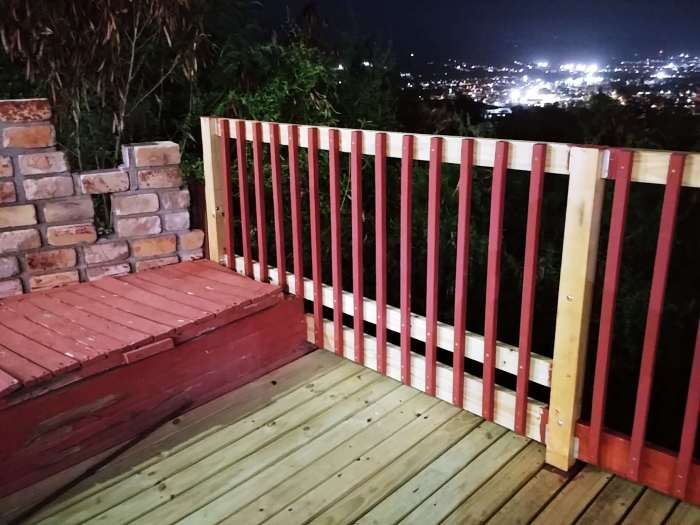
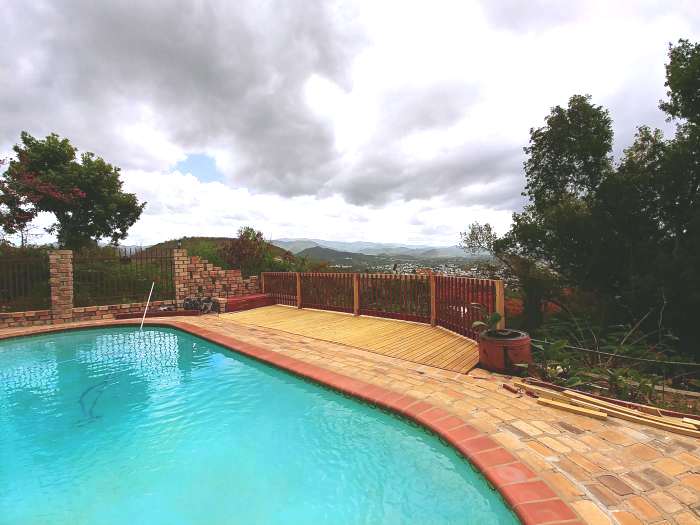
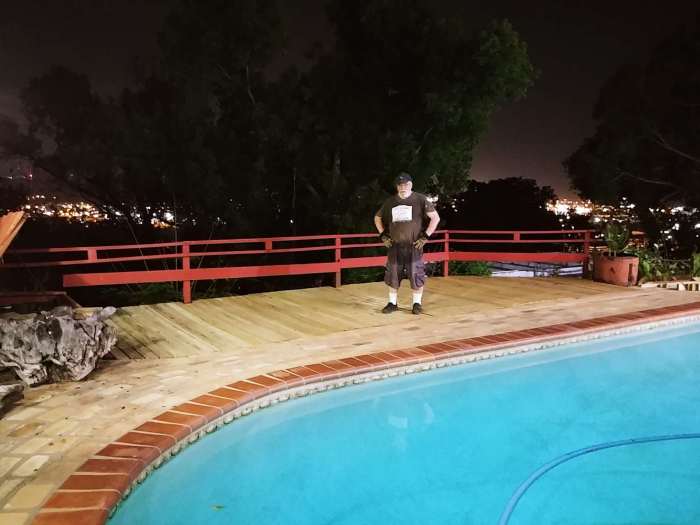
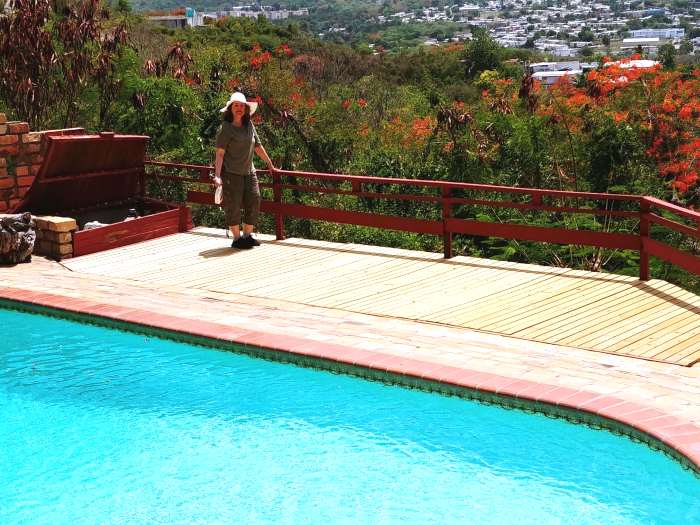
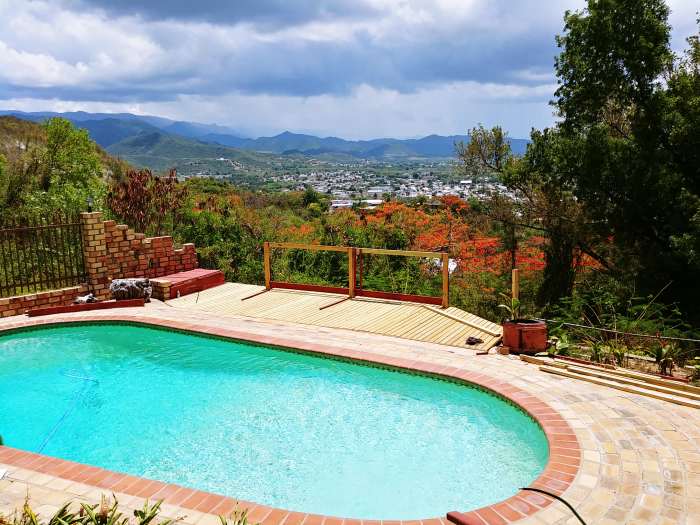
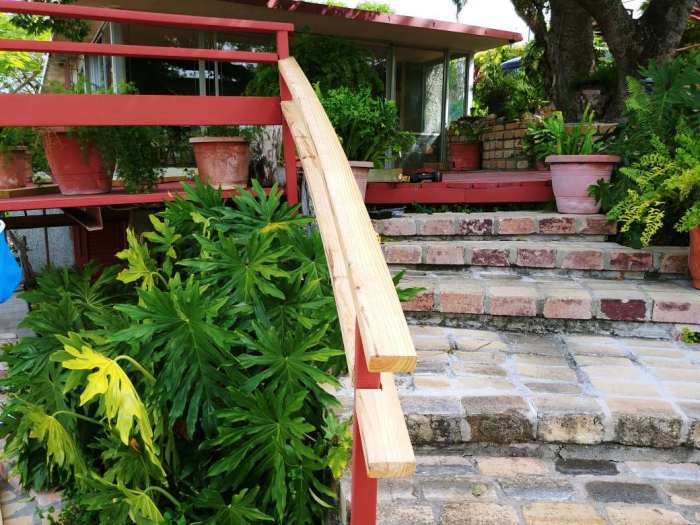
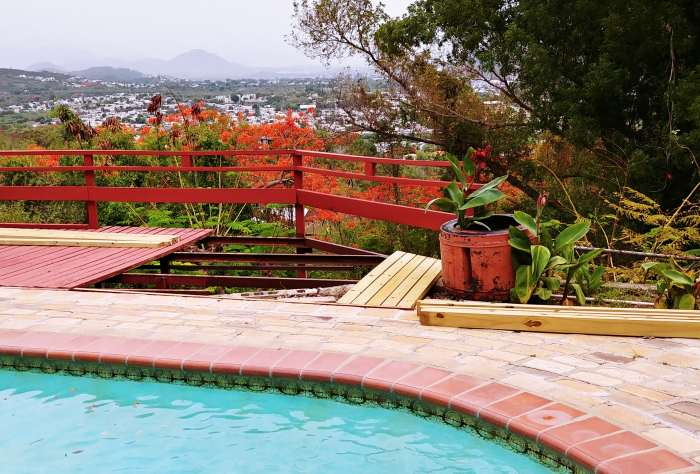
We’re home! Back in Boston. I have never felt so tired in my life. I finished the deck well after dark on the last day and moved on to other essential repairs—such as securing the planks on a little bridge that were flipping up like a cartoon gag when you stepped on them. Here’s the final deck railing section, and the finished project the day we left:

By some miracle, we made it to San Juan in time to catch our JetBlue flight, after a near-all-nighter cleaning up the construction zone (the whole house) and packing. I tried to sleep on the flight, but it was a lost cause. Now, though, I’m all refreshed (hah!) after ten hours of sleep in my own bed. My own bed! I plan to rest for a week. Maybe two.

I thought I’d close this year’s Chronicles with some stray oddities.

Last year I wrote about the Ho Chi Dog Trail we’d discovered running through the property. Stray dogs had found a gap in the fence at one end and periodically came racing through in well-behaved packs, going about their business and disappearing up near the car gate. It was kind of fun, but not the sort of thing weekend renters want to see. I found the gap and plugged it with metal fence rails hastily zip-tied into place. That was a year and a half ago. This year, the gap was back: one rail knocked out and cast aside. Did the dogs do it? Who knows? But mark my words, they won’t do it again. We had the rails welded into place, by the fencing crew who were on the job last week putting up real fence in place of the mangled old cyclone fencing.

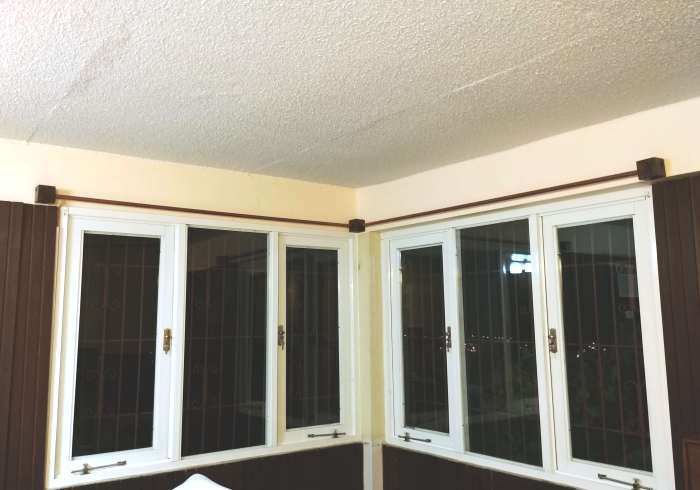
Speaking of putting things up, one small but important task was figuring out an appealing way to hang curtains in a room with concrete walls and awkward corners. Allysen came up with copper pipe as a great curtain rod, and I figured out a way to carve blocks of wood to drop them into, so they’d look good and be easy to take down, and yet not fall down when you wanted them to stay up. Securing them to the walls was the hardest part. Even with a hammer drill, that old concrete was tough!

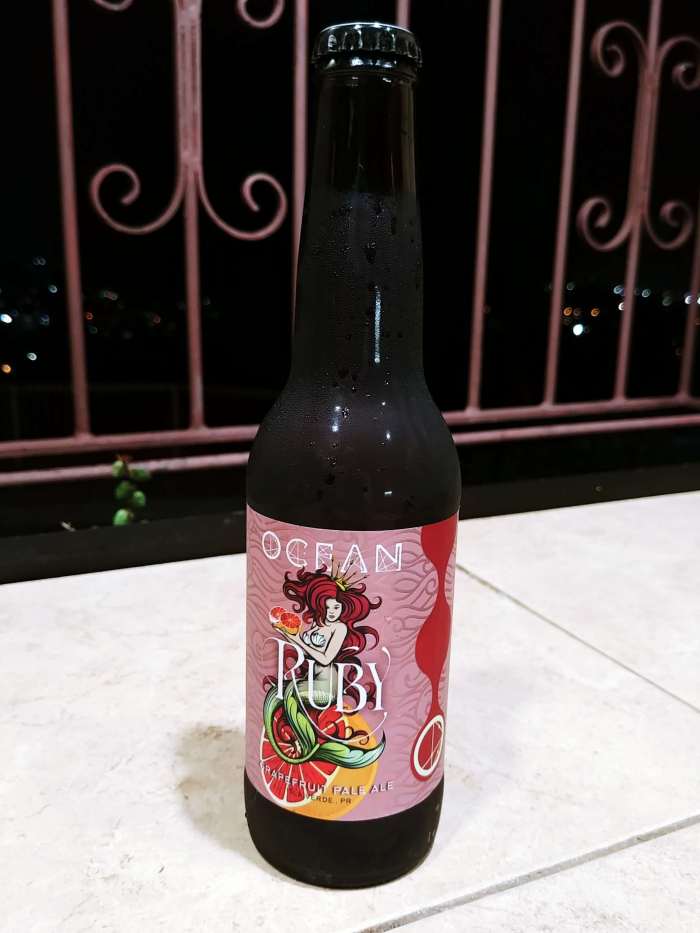
I’ve yet to address a crucial subject: craft beers. They have a number of really good craft beer makers here on the island. You can buy their beers in the grocery stores now, which previously you couldn’t. My favorite is Ocean Lab Brewing Company’s Ocean Ruby Grapefruit Pale Ale. But weirdly, you still can’t get it in restaurants! If you ask for Puerto Rican beer, you get your choice of Medalla or Medalla. (Pronounced “meh-dah-ya.”) Medalla’s a light lager, on a par with Bud Light—decent enough, if you’re hot and tired and want to glug something to quench your thirst. But as a tasty brew with a meal? Not even close. When we asked the restauranteurs why they don’t carry the local craft beers, they said, “Not enough demand. Only the tourists want it.” Well, but… don’t you want to attract tourists?

Still, my preferred drink down here is rum punch, following a recipe created by Allysen’s dad, Phil Palmer. “One of sour, two of sweet, three of strong, and four of weak.” Fresh-squeezed lime juice, dark sugar syrup, amber rum, and water (in the form of crushed ice). Top with Angostura Bitters and fresh-ground nutmeg. Simple, and unbeatable. We’ve cut the sugar some, and are more straightforward about weak. So now we say, “One of sour, one-and-a-half of sweet, three of strong, and forget the weak.” (Okay, we still use the ice, of course.)

(At home, in fact, my recipe for frozen margaritas is based on this formula: “One of sour, one of sweet, three of strong, and three of stronger.” Lime juice, dark sugar, Triple Sec, and tequila. And lots of ice.)

Here’s the final rum punch of the trip, and a fitting close to this year’s Ponce Chronicles:

Ponce Chronicles 2021, Part 9

If you haven’t been following, I’ve been building a deck. Actually, replacing a rotted-out wooden deck beside the swimming pool at Casarboles, my wife’s family’s place in Ponce, Puerto Rico. I’m in a race against the clock (we leave for home in two days, having already extended our stay by two weeks), and it’s been a bear. In the middle of it all, I developed an ear infection, probably from protecting my ears with noise-canceling earbuds, complete with ground-in dirt. Did I let that slow me down? I did not! (Well, maybe a little.)

Here’s a sort of stop-motion record of what I’ve been doing:

Grinding and painting the steel supports…

Last floor plank laid, yours truly ready to keel over…

The new floor, shown to the audience in daylight by a far more attractive model; old, rickety railing system still in place…

Old railing gone, new railing begun… two days to finish…

Okay, back to work!

Ponce Chronicles 2021, Part 8

Progress! With a capital P. Here’s the pool deck yesterday. I filled in that gap and then some, today. Geez, I’m tired. But I have hope of getting it finished before we leave.

And here’s a new bit of railing. It replaces the well-crafted, elegantly curved railing that Allysen’s dad built, and which some boneheaded weekend tenant broke and tried to conceal by hiding the pieces in the bushes. Deep breath.

By the way, in case you’re wondering how I got those curves in the wood to so nicely match their pairs on the other side…

I found two pieces of warped lumber at Home Depot. Their curvature was exactly what I needed.


Blackberry Writing

It’s blackberry season, and as is my custom at this time, I went out this morning to pick from the brambles along our little country road. (We have our own patch, but the berries ripen later because it’s in a shadier place.) I try to do this early, when it’s cool and I’m not having to squint into the sun for the higher branches. As I picked, I thought about the story I’m working on (and currently stalled on 2 scenes-that-need-more), and also writing in general.
Blackberries are tricksy things. They can look ripe from where I stand, but turn out to be all red at the base. Sometimes I can tell the moment I touch the berry — it’s too firm and too tightly attached to the stem. I have to be ready to give up on what looked like a great prospect and move on. When I’m in the flow of picking, it seems I don’t even have to think about this. Isn’t this like a story that seems promising but doesn’t yet have the necessary depth? Occasionally — well, more than occasionally — my mind gets set on “this berry must get picked” and I force the issue. I’ll glare at the red parts and pop the berry into my mouth (“for private reading only”). Berries that are almost-ready go well in oatmeal. I freeze quarts and quarts of them for winter breakfasts. They’re too sour on their own, but they blend well, adding pleasantly tart notes. That’s not unlike taking several different story idea, none of which can stand on their own, and setting them at cross-purposes to make a much more interesting tale.

This whole business of “readiness” in a story is a curious one. It’s a bit like cooking without a recipe, because while there may be guidelines, there are no hard and fast rules of how to tell when a story concept is “ripe.” All too often at the Big NYC Publisher’s Office, after rejecting a work – especially if it was (a) slush and (b) got the standard slush reject letter, which was polite but clear that it wasn’t something they were interested in — the beginning writer would respond. Now, professionals know that, unless you are specifically invited into an exchange, you don’t respond to a rejection.  You take it, you consider what’s worth considering, and you move on.  That exchange is over.

Occasionally the appropriate response is to to ask for more details, keeping in mind that time-crunches didn’t allow the editor to do that in the first place.
More often, though, the editor gets a response along the lines of “My work is utter genius, and you’re too blinded by (fill in the blank) to see it!  But you’ll be sorry!”

I think this kind of reaction isn’t limited to beginning writers, but it is a particular trap. It’s far easier to think that your story got rejected because of the blindness/stupidity/conspiracy/conventionalness of the gatekeepers, rather than that it simply isn’t good enough. It could be a great idea and you weren’t ready to do it any kind of justice. It was a trivial idea that no one could have turned into a decent story. It could have been a nifty idea but it wasn’t developed, it wasn’t “ripe.”

One of the hardest things for a new writer to understand is that there is a threshold of quality — for ideas, for execution — for publication. It’s so hard to hear that the story you are so proud of isn’t good enough. Those thorns hurt as much when I’m pulling out as when I’m pushing in.

And here’s the catch: sometimes the story really is great. Sometimes the market just isn’t ready for the story at this time, but it will be in the future. Somewhere there’s an editor and a readership who will adore it. How can you tell? Continue reading “Blackberry Writing”

Ponce Chronicles 2021, Part 7

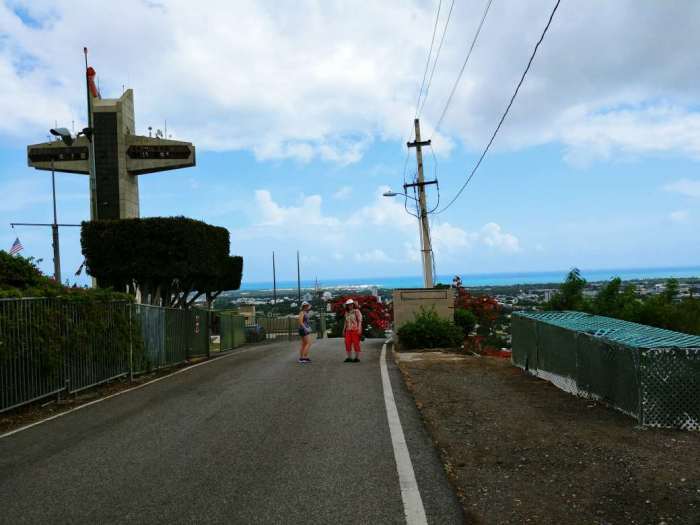
Puerto Rico is called the Isle of Enchantment. There is, in fact, remarkable beauty to be found just a short walk down the hill from Casarboles, the “treehouse” built by my wife’s parents. The first thing you see is the Caribbean, just beyond the view of Ponce. From here, you can turn to your left to enter the grounds of the Japanese Gardens and Cruceta del Vigía.

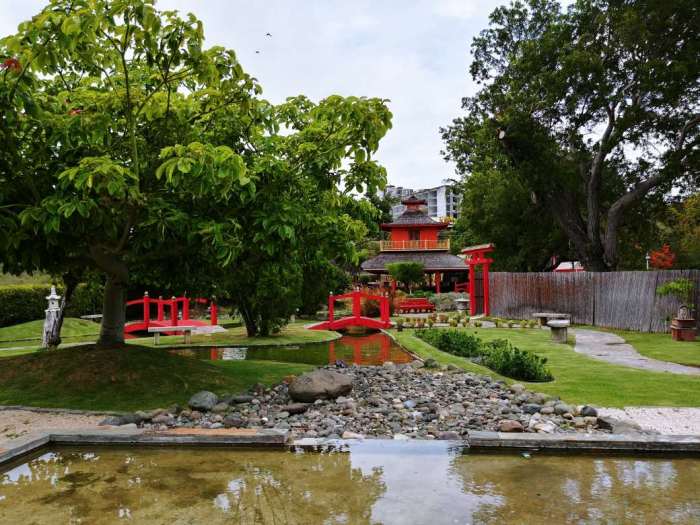
We were treated to a private tour by the lovely activities director Luciris on a day the museums were closed (Allysen’s dad was once very active on the board of directors). We first entered the Japanese Garden, which might seem a little incongruous in this land of Latin culture, but it’s enchanting, just as promised. Here’s a view across the grounds.

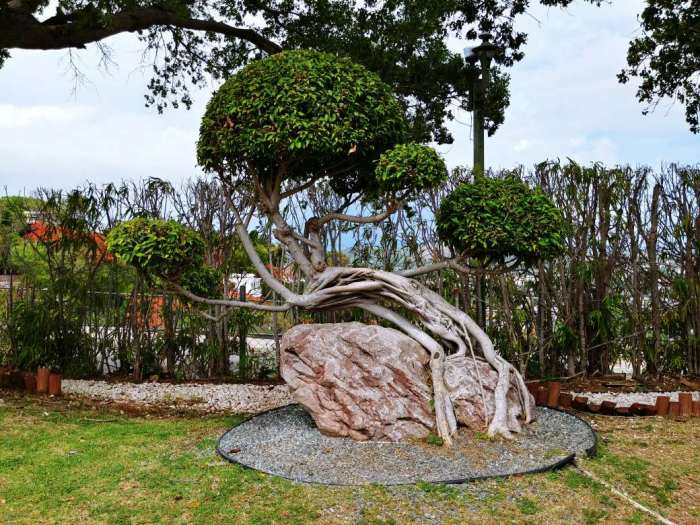
And a strange and beautiful tree. I don’t know what kind.

Continue reading “Ponce Chronicles 2021, Part 7”

All Alone in a Sea of Alone

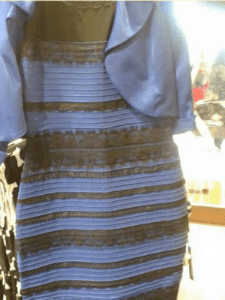
Remember this dress?

I had an existential crisis when I was ten years old.

Okay, perhaps I was an overachiever, anxiety-wise. My class was studying the sense, and the subject of differences in individual perception came up, like it does. It’s very likely, my teacher said, that humans perceive things like color, or certain scents or tastes, differently from one another: that I might experience the color I characterize as yellow differently from you. In terms of light and spectra, the color yellow is the color yellow is the color yellow, but my experience of yellow is based on my hardware and software: that is, my eyes and brain, as well as my experiences in interpreting color.

My class had some fun with this; ten year olds are not notably sophisticated about humor, and for a day or two there was a rash of “Nice red shirt,” comments to people who weren’t wearing red, and so forth. In science class the next day, someone asked, if our experiences are all different, how can we knew that yellow is yellow? My teacher fumphed a bit and got sidetracked talking about light and the visible spectrum, and… my classmate never quite got an an answer, but I remember sitting at my desk feeling deeply unsettled.

If my color  yellow was not the same as someone else’s color yellow, how could I be sure that the word yellow when I spoke it would sound like yellow to a person I was talking to? How could I make sure that anything I said or experienced was the same thing someone else heard or experienced? Short of crawling into someone else’s head, how could I ever know? Which made me feel as alone as I had ever felt in my young life. I felt suddenly like everyone–me and everyone I loved–were all just individual objects blithering through the world, crossing paths but unable to confirm our experiences. It was a kind of lonely I had never suspected existed, and I lost several nights sleep trying to devise different ways that I could confirm with someone that yellow was yellow.

And then, gradually, the anxiety diminished and I stopped trying to invent telepathy or some other way to contact and verify that the reality I live in is, in fact, consensual. I don’t think about it too much any more–although back in the 1990s I wrote a story about a man who establishes a telepathic connection with a pair of genetically engineered lions–and while he’s delighting in the connection with another being, they’re sizing him up for dinner. 

When I think about it, maybe it’s just as well I don’t know what anyone else thinks is yellow.

Ponce Chronicles 2021, Part 6

Back pain and sunburn and plumbing, oh my! And Puerto Rican rain, which comes fast and goes fast. The rain cools things down briefly and washes the Sahara sand out of the air, which is great. And wets all my lumber, which is not great. Here’s where the pool deck work stands:

While working on the deck, I’d had the recurring thought: Don’t hurt yourself. You don’t have time! And so, two days ago, while l/i/f/t/i/n/g/ h/e/a/v/y/ l/u/m/b/e/r/ m/o/v/i/n/g/ c/o/n/c/r/e/t/e/ b/l/o/c/k/s/ bending over to pick up a screw, I did something and my back screamed. I jackknifed to my knees on the brick pool deck and hollered for help. My daughter and wife were both in online meetings with headphones on and couldn’t hear me. Finally Allysen looked out and saw me and yelled, “Are you okay?”

“NOOO!!!”  Continue reading “Ponce Chronicles 2021, Part 6”

Things That Keep Me Up at Night

Our current civilization is built on many dangerous fallacies. Most of them have been debunked, but their impact is still felt. Here’s a few off the top of my head:

  • Some people are better than others.
  • The “better” people are entitled to take things from their “inferiors”.
  • The world is here for human use and it doesn’t matter how we use (or abuse) it.
  • Wealth is more important than ensuring that all have enough.
  • The natural world, both plant and animal, has no importance on its own.

I just read a short piece on how the indigenous people of what is now the Texas Gulf Coast lived for the 2,500 years before the Europeans invaded. They fished to their heart’s content in the bays protected from the Gulf by the barrier islands. They hunted inland for bison, deer, and other creatures, careful not to trespass into the territory of other peoples who lived farther inland. Lots of plant life grew in the area. They used bits of oil that came up in the Gulf to seal things.

Except for mosquitoes — I’m sure they had mosquitoes — it sounds like a pretty good life. The climate there is mostly warm and there must have been good sources of food year round.

I note that they did not build luxury homes and condos on the barrier islands, just temporary shelters where people could gather. I suspect they knew the signs of approaching hurricanes and moved inland ahead of them.

Here in California, the indigenous people used fire effectively in managing the forests and grasslands. They figured out that it was a necessary part of this environment. They, too, had a balanced relationship with a bountiful environment.

And now here we are, with the Gulf on fire from burst pipelines and wildfires already raging through the west ahead of fire season, plus condos on barrier islands collapsing. The people who settled here long before my Anglo ancestors knew how to deal with the environment, but their knowledge was dismissed and ignored.

Look at us now. Continue reading “Things That Keep Me Up at Night”