
Bones communicate with the rest of the body to support overall health – here’s the science behind your skeleton
seksan Mongkhonkhamsao/Moment via Getty Images
Priya Bhardwaj, Washington University in St. Louis
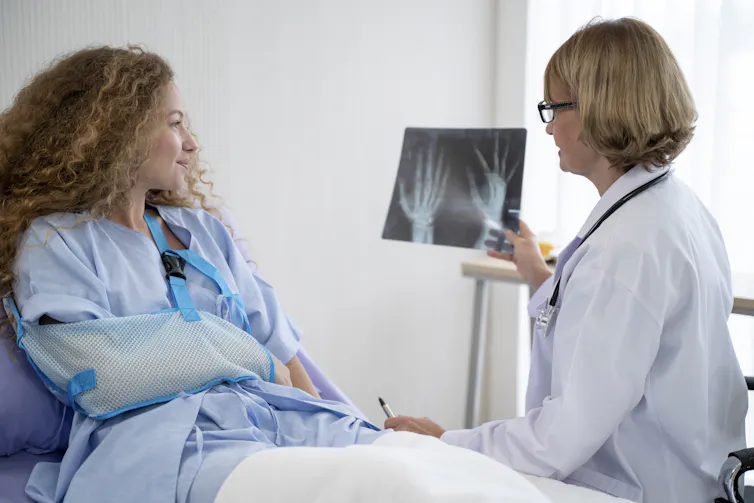
Each year, doctors treat more than 6 million bone fractures in the United States. And while it takes only a few seconds for a bone to break, the processes that keep your bones strong and allow them to heal are taking place continuously throughout your life.
Beneath their hard surface, your bones are alive with activity, continuously being broken down, rebuilt and reshaped. Far from being static structures that simply support the body, bones are dynamic, living tissues that respond to physical activity, hormones and the body’s changing needs.
I am a research scientist who studies bone biology and mineral metabolism. To me, one of the most striking things about bone is how dynamic it is, despite its static appearance. Research over the past 15 to 20 years has demonstrated that this is even more true than scientists had previously realized.
More than just structural support
For decades, scientists have known that bone provides support, stores minerals and continuously remodels itself. This remodeling is the process bone uses to renew itself, maintaining its strength while allowing the skeleton to adapt over time.
Different kinds of bone cells work together to maintain bone structure. Cells called osteoclasts remove old or damaged bone, while osteoblasts build new bone in its place. Osteocytes, which are cells embedded within bone, help sense mechanical strain and coordinate how bone responds. Together, these cells help the skeleton stay strong.
But over the past two decades, new research has emerged that is changing how scientists and physicians think about skeletal health. More than just a structural framework, bone also functions as a highly active tissue that helps regulate the body’s mineral balance, supports blood cell production and communicates with multiple organ systems.
Growing evidence also suggests that in order to perform these functions, bones produce signaling molecules that influence energy metabolism and balance the minerals the body needs.
Lifelong support
The balance between bone formation and bone breakdown changes throughout life.
During childhood and adolescence, the body builds bone faster than it removes it, allowing bones to grow larger and denser. By early adulthood, most people reach their peak bone mass. After that, bone breakdown gradually begins to outpace bone formation, particularly with aging and hormonal changes. Over time, this shift can increase the risk of osteoporosis and fractures.
Bone is also highly responsive to how it is used. The skeleton is constantly “listening” to the demands placed upon it and adjusting accordingly. Everyday activities such as walking, running or lifting weights place stress on the skeleton. In response, bone adapts by becoming stronger. This is why weight-bearing and resistance exercises are so important for maintaining bone health.
On the other hand, prolonged inactivity due to illness, immobilization or a sedentary lifestyle can lead to bone loss. Astronauts also experience bone loss during spaceflight, but for a different reason: In microgravity, bones are lifting far less weight, even when astronauts remain physically active.
Communicating with the rest of the body
Hormones help regulate the process of bone formation and breakdown as well. Calcium and phosphate levels are tightly controlled by the body because they are essential for nerve signaling, muscle contraction and many other biological functions.
Bone serves as a major reservoir for these minerals. During menopause, a woman’s hormones shift and her body produces less estrogen, causing her bone density to decrease.
The kidneys and glands, such as the parathyroid glands, produce hormones such as parathyroid hormone and vitamin D that act as signals to tell bone when to release calcium and phosphate into the bloodstream and when to store them. This helps your body maintain stable mineral levels.
In addition to all of those functions, many bones contain bone marrow, the main site of blood cell production. Bone marrow produces red blood cells, which carry oxygen throughout the body; white blood cells, which help fight infection; and platelets, which are essential for blood clotting.
The marrow also responds to signals such as infection, inflammation and blood loss by adjusting blood cell production, making the skeleton closely connected to both the circulatory and immune systems.
Researchers have also found that bone not only receives signals from other organs, but it sends signals as well. Bone-derived molecules, including the protein osteocalcin, have been linked to energy metabolism and broader physiological signaling.
While scientists are still uncovering the full extent of these connections, growing evidence suggests that the skeleton is integrated with the rest of the body rather than functioning as an isolated structure.

Frazao Studio Latino/E+ via Getty Images
Maintaining bone health
Because bone is living tissue, it can also heal. After a fracture, the body moves through overlapping stages of repair that include inflammation, formation of new tissue and, later, remodeling of the repaired area.
Healing takes time and depends on factors such as blood supply, stability, nutrition and overall health. Poor nutrition, lack of physical activity and health conditions like metabolic bone disease can disrupt bone remodeling, leading to weaker bones over time.
Lifestyle factors like smoking, excessive alcohol use and long-term use of certain medications, including glucocorticoids, can also influence bone health.
Nutrition remains one of the practical foundations of bone health. Calcium is a major building block of bone, and vitamin D helps the body absorb calcium and maintain normal bone mineralization. Without enough of either, the skeleton has a harder time maintaining its structure and strength.
New approaches to bone research
These insights into how bone functions as a living tissue are beginning to reshape how researchers approach bone health.
There is increasing focus not only on bone density, but also on bone quality, remodeling dynamics and how the skeleton interacts with other physiological systems. This broader perspective is influencing how scientists understand and study conditions such as osteoporosis and age-related bone loss.
Maintaining strong bones is not just about preventing fractures later in life. It is about supporting a living system that contributes to movement, mineral balance, blood cell production and communication with other tissues throughout the body every day.
Priya Bhardwaj, Senior Researcher in Orthopedic Surgery, Washington University in St. Louis
This article is republished from The Conversation under a Creative Commons license. Read the original article.