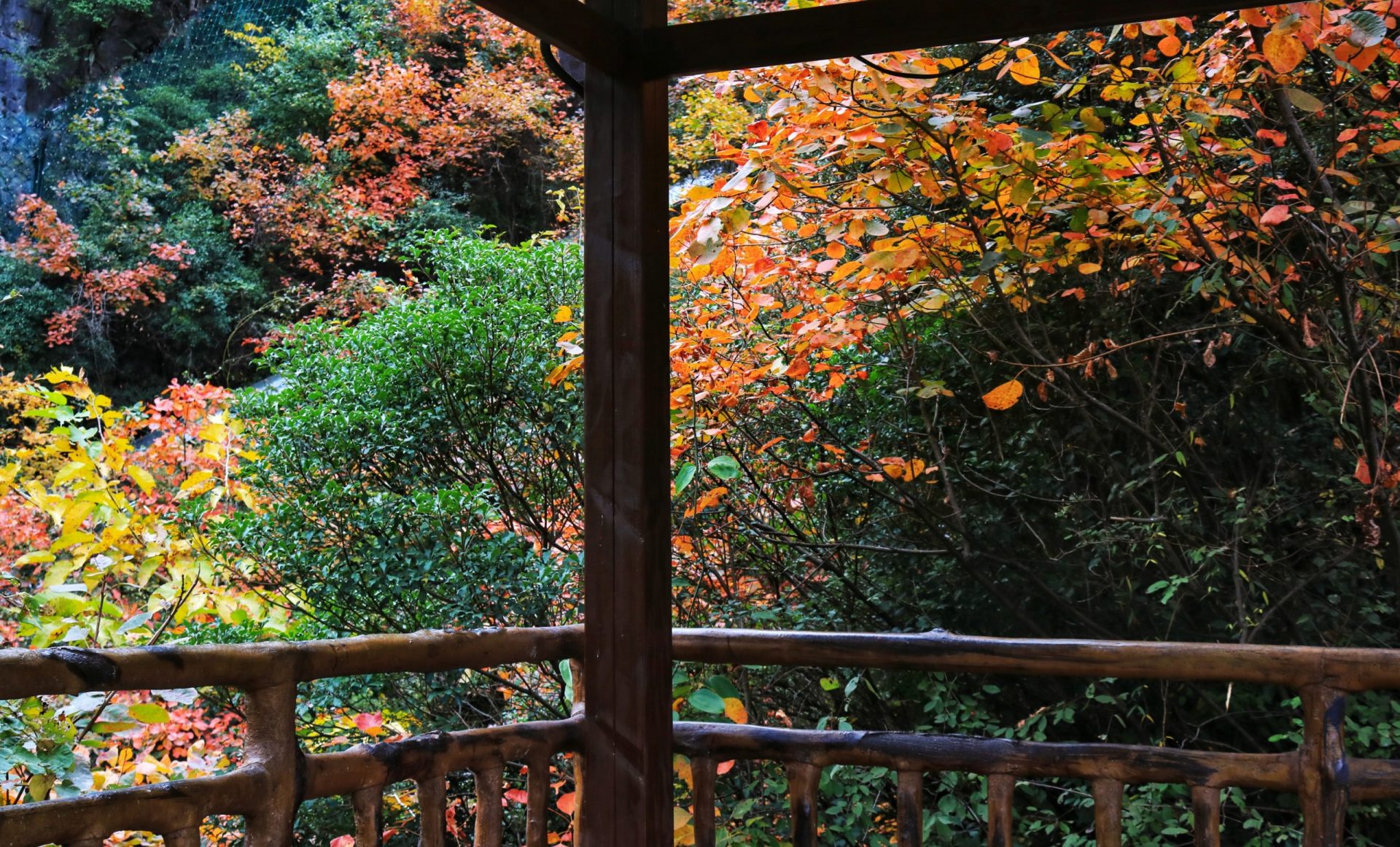
Last week on Facebook, Yaritji Green asked the history of the space I live in. I answered her post directly, and then I realised some of you might be interested, so I’m copying it here.
“I live on Ngunnawal land*, currently owned by the Federal Government and managed by the ACT Government. I don’t own any land, but I lease the space along with many others. I don’t even own the structure of the building – I am part of a body corporate. I own the possessions in my flat, though, and so that flat is my space, even though it’s on the land of others
It was first taken from the Ngunnawal people by farmers and the occasional bushranger. The family that farmed this particular valley is still in the region and one of their ancestors wrote the first Australian Gothic novel. So this valley has consistently been science fictional since White settlement. Then the government took it, when we Federated and the regional was made into the capital.
This space has layers. The most ancient is the geological with a faultline running alongside my flat. Until quite recently, this was part of the Bogong Trail, for corroboree near Yankee hat in the Brindies**, so that was the most stable layer for humans. I don’t know how long the Bogong Trail was used or enough about other uses of this little valley, but we have clear evidence of it being 900+ years, in some paintings near Yankee Hat. My block of flats is the most recent layer. It was built in the 70s, before self-government in Canberra, and my flat was owned by the builder of the whole complex and then by a young couple and then by me. it still had the 70s carpet and kitchen when I moved in.
This has been my place since 1991. Me and my books.”
I am now remembering… the first thing that comes to mind is an Auntie (I won’t use her name because she’s no longer around, but it’s the same first name as the poor child who was murdered last December) who taught my Israeli dance class the dances of this country. Specifically this country: she was a Ngunnawal elder and these were her tradition. She was willing to teach us women’s business, but young Irwin refused to recuse himself.
“You can teach me anything,” he said.
“You’re male,” Auntie said, “And so you deny everyone the learning.” and so we only learned the dances.
Irwin explained his view to me afterwards. In his world, he had the right to learn everything. Mind you, in his world, also, he was a missionary. Totally lovely, and very very Christian.
I remember three steps, but I do them very badly.
One of the things I’d like to do this year is get to one of the bush tucker workshops at the National Museum. Since I cannot do this without a friend who has a car, I’d love to hear from anyone who’d like to do this with me. I can cook using local foodstuffs, but I only know them as adaptations of European foodways and they’re a lot more than that. I need to re-learn from someone with the right knowledge and that is (among others) a guy who does workshops for the national Museum.
For me, living anywhere requires constant (and respectful) learning. I wish the same applies to those who hate. It’s been bad this week.
*Canberra, Australia, just in case a reminder helps.
**Canberra slang for the Brindabellas, a local mountain range. If you know Miles Franklin’s My Brilliant Career, this is where she grew up. Mt Aggie is named after her aunt Agnes.
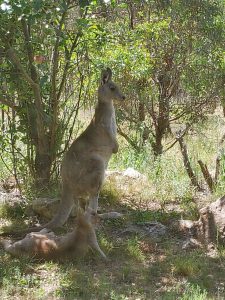
I escaped my flat some days ago, with help from a friend. Of course I thought of a book, and today I took it from my shelf so that it can talk to me while I write. Let me give you a single picture from my trip across the border into rural NSW, and then I shall introduce you to one of my favourite books about this region. There are many books written by local writers. This region has produced writers from the moment anyone who knew the alphabet lived here. This particular volume is by Miles Franklin who, according to her Sydney writer friends, was one of the most generous people imaginable, and had enviable hair.
picture: Gillian Polack Feb 2022
Canberra the city has mountains within it and mountains nearby. We’re so high above sea level – I’m typing from just below 650m above sea level right now, and I live at one of the lowest points – that the mountains look like hills. Before this region was decided upon as the capital of Australia, it was a place where several peoples me (today we call it Ngunawal land because the Ngunnawal are the traditional owners of more of the ACT than the other groups, but the Australian Capital Territory is more complicated than that. Our borders don’t follow the custodial boundaries. A map may help. (My favourite map is a Ngarigo map. It’s an extraordinarily lucid map that makes everything very clear– but I can’t find a copy of it online.) European settlement was mainly farms, with a church, a schoolhouse, and a couple of villages. Most of the people who lived on this land were, in fact, not European until this area became the national capital.
The Franklins were one of the local families in the nineteenth century. I have seen the old rose bushes from the Franklin property (they’re now quite wild) and been stared down by kangaroos in a part of the national park that Franklin would have known as a farm. I’ve been atop Mt Franklin (named after Miles’ family) and climbed (a little) of Mt Aggie (named after her aunt).
Miles Franklin, herself, lived in this region for the first ten years of her life. She was born in 1879, and the 54 years she lived elsewhere was mainly in cities.
Miles Franklin (actually Stella Maria Sarah Miles Franklin) was a fascinating person. My personal favourite of her noms de plume (for she had several) was Brent of Bin Bin. There’s so much in her life that’s not generally talked about: how she supported other writers, what she did with her life outside the most famous books. The edge has gone off the fame of the novels. Most people recognise the name because Franklin’s name is on one of Australia’s most important literary awards (we all dream of this award, but I’m the wrong kind of writer for it, so dreaming will have to suffice).
Neither My Brilliant Career (the famous novel that was turned into a movie) and My Career Goes Bung (its sequel) are on my desk right now, for Franklin used her post-childhood experiences to write them. The book on my desk is tiny, and full of colour. Childhood at Brindabella is my comfort-book and is not an autobiographical novel, but an actual autobiography. Franklin’s childhood at Brindabella Station is at its heart. This book is where I discovered that we are low in lyrebirds in this region because of the US trappers in the nineteenth century, who wanted to feathers for hats. It’s where I learned about how to transport sewing machines to places that still don’t have sealed roads.
I could tell you favourite bits of it until the cows come home. It’s under 160 pages long, however, so it’s better to read it yourself. Then come to me and I will tell you how this region has changed and find you recipes from Miles’ childhood. Despite all the changes, we still have more writers per capita than we ought. Miles Franklin will always be one of the best.