There are, I suppose, as many different stories about why and how a woman gets an abortion as there are women.
Here’s one: In the bad old days before Roe, my mother once drove a friend from New York City to a parking lot in New Jersey, where her friend got into a waiting car. Five hours later the car returned, her friend got out (sheet white and trembling, but okay), got in my mother’s car, and they drove back to the city. She went on with her life, with what residual emotion from the experience I don’t know; I do know my mother was deeply shaken by her small part in it.
And another: I remember several girls in college who got pregnant, before and after Roe. After Roe some things were the same: the secrecy, the collections taken up to help defray the cost, the sympathetic pampering when the girl returned to the dorm. But some things were very different: before Roe there was a well of secret knowledge–all I knew was that someone knew someone who knew a real doctor… and the rest of the process was shrouded in mystery, not as dire or scary as my mother’s friend’s experience, but sufficiently clandestine. After Roe, if memory serves, you had to cross the state line to reach a state where the procedure was legal. But there were official resources on campus which could explain and expedite the process. Still expensive, still secret, but without the gloss of criminality which made a bad situation terrifying.
And one more: mine. Continue reading “Three Stories”…
The Power of Story
Last night (your Sunday night) I was putting together some material for my patrons. It includes an interview I did years ago with Carrie Vaughn, Seanan McGuire and Daniel Abraham. I was looking into what made the suddenly-very-trendy preternatural romance and adventure novels and going straight to three excellent writers on the topic seemed like a good idea.
It still does. I’m considering picking up my old habit of interviewing writers in groups, to find out what they think and who they are. If you think that’s a good idea, please let me know. In the interim, it may be years since the first novels of these three writers came out, but I made such an excellent choice of interview subject: they’re still all perfect for this difficult year. Good writing trumps tough times, I find.
These days using ‘trumps’ like that makes us think of politicians who lead people astray and make the hard, harder, but I want us to return to the pre-Donald use of the word. It comes from playing card games. Card games, like good light fiction, help when the emotions are really not up to heavy lifting. Still, I’d rather read Carrie or Seanan than play cards this month. Cards may be fun, but COVID is still with us and far too many of my friends are down with it. I want to step into a delightfully frothy werewolf tale or dream of sarcasm in fairyland.
My present to you for the Fourth of July then, is a reminder of the power of books to keep us sane when life goes awry.
Rethinking All the Rules
On the first day of our constitutional law class, a hundred or so of us assembled in a large classroom set up something like a theater, with two long rows of steps down to the platform and podium used by the teacher. It was the beginning of the second semester of our first year and we had survived thus far, so we were cocky enough to be talking noisily.
Then the professor came in: Charles Alan Wright, whose name graced various textbooks, who argued regularly before the Supreme Court, and who was particularly noted at the University of Texas law school for coaching the aggressive intramural football team the Legal Eagles. By the time he reached the front of the room, you could have heard a pin drop.
He looked around at us and then said, in a mild voice, “Would someone please give us the case of Marbury v. Madison?”
Now anyone in that room could have explained Marbury v. Madison. Hell, we learned about it in high school. Plus we were law students, legal nerds by definition.
For those who’ve forgotten high school or who aren’t from the US, it’s the case where Chief Justice John Marshall ruled that the Supreme Court can weigh in on the constitutionality of laws and actions by other branches of government. It’s a gimme question. Wikipedia has a good explainer on the case.
Yet everyone else in the room breathed a sigh of relief when Mr. Timmons raised his hand and gave the answer. That’s just how intimidated we were by the professor and by the importance of constitutional law.
Here’s the thing, though. The one thing that didn’t occur to any of us was to question whether Marbury was a good idea. I mean, it would have been like questioning the gospels in a Baptist Sunday school.
Professor Wright certainly didn’t raise the point. I doubt he ever questioned it. But after the last few rulings of the current Supreme Court, it’s pretty clear that allowing a group of unelected lifetime political appointees to be the sole arbiters of what’s constitutional is one of many flaws in our system. Continue reading “Rethinking All the Rules”…
A Potpourri of Short Book Reviews
I’ve been reading a lot of delightful books recently. Here are a few for your consideration.
The Galaxy, and the Ground Within, by Becky Chambers (Harper Voyager)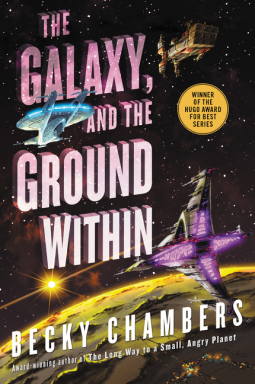
Set on an uninhabitable planet whose only value is as a stopover for other worlds, this story explores what happens when members of very different species and histories are forced into community when they are temporarily cut off from contact with the larger Galactic Commons. Three of these strangers are guests at the overwhelmingly hospitable Five-Hop One-Stop version of a spacer’s truck stop when a freak accident halts all traffic and communications. At first glance, they have little in common: an exiled artist with an urgent, perhaps redemptive appointment to keep, a cargo runner with a military history at a personal crossroads, and a mysterious individual who cannot leave her space suit but is doing her best to help those on the fringes. Add to this odd grouping, their host and her teenager, furred quadrupeds that reminded me repeatedly of space otters. Most of all, though, this book is about how people who are initially not only diverse but at odds with one another can bridge those differences through understanding and shared experiences to form friendships and, ultimately, community.
Crazy in Poughkeepsie, by Daniel Pinkwater; Aaron Renier illustrator (Tachyon)
 It’s difficult to find words to describe a Daniel Pinkwater book because they are a unique breed that defies the usual literary terminology: they’re enchanting (often literally), playful, spontaneous (as in combustion, upon occasion), and hilarious-yet-insightful. In other words, a Daniel Pinkwater book provides the occasion for parents wrestling the copy from their kids, and vice versa, so why not avoid bloodshed, or paper-shred, and read them aloud together?
Mick’s ordinary life comes to a screeching 180 degree turn when his older brother returns home from Tibet with Guru Lumpo Smythe-Finkel and his dog, Lhasa, and Mick finds himself—how, he’s never entirely clear—the guru’s new disciple. Guru, disciple, and magical dog set off on a quest that’s as notable for its vagueness as its unpredictability. They acquire fellow travelers, graffiti-fanatic Verne and Molly, a Dwergish girl (sort of like leprechaun trolls with hidden goals, magical powers, a gift for making friends, and a charmingly madcap sense of humor). Soon they’re cavorting with a ghost whale who is the essence of love, as well as other wacky and memorable characters.
Pinkwater’s in on a great secret: if you want to communicate wisdom to young readers, first make them smile. Or giggle. Or run wild in Poughkeepsie, as the case may be.
The Dispatcher: Murder by Other Means, by John Scalzi (Subterranean)
Part noir detective story, part thriller, part inventive science fiction that examines a world in which death is not permanent (well, certain kinds of death and mostly), this is newest adventure in John Scalzi’s “The Dispatcher” series. I hadn’t read the first one but quickly found that didn’t matter. Scalzi skillfully weaves in all the necessary backstory with nary a plot hiccough.
In Scalzi’s world, a few years ago almost all folks who were murdered don’t die, they reappear in a place they feel safe, like a childhood home. Natural deaths are something else: you die, you stay dead. A new profession has arisen, that of “dispatcher,” a not-murderer for hire. If you’re about to die naturally, you hire them and get another chance at life. Most of the time. But business has been drying up, and Tony Valdez has been taking on cases that blur the shady line of what’s strictly legal. Like killing a Chinese executive so he can re-appear thousands of miles away in time for an important business meeting. At this point, Scalzi propels Valdez firmly into thriller territory, with plenty of dramatic tension, noir mystery, and danger. In Scalzi’s superlatively competent hands, it all comes together seamlessly for a can’t-put-it-down ride.
Paper & Blood (Book Two of the Ink & Sigil series, by Kevin Hearne (Del Rey)
I’m a huge fan of Kevin Hearne to begin with, and his “Ink and Sigil” series is a delight. As a former student of calligraphy, I love the idea that the written word is magical. In this series, set in the world of the Iron Druid, scribes create magical spells using not only words, but painstakingly prepared pens, inks, and paper. The spells include the Sigils of Unchained Destruction, Restorative Care, Agile Grace, Muscular  Brawn, and Quick Compliance and are used to protect the world against malevolent gods and monsters.
Our everyman-hero, Al MacBharrais, is under a couple of nasty spells himself. If he speaks to someone more than a few times, they loathe him (this happened to his own son), and his apprentices die violently after a year of service. This isn’t good news for his hobgoblin apprentice, Buck Foi. While Al is searching for a way to lift his misfortunes, his fellow sigil agents go missing in the wilds of Australia. Al and Buck are off to the rescue, joined by one of the missing agent’s apprentices, his receptionist Gladys Who Has Seen Some Shite, a few sundry allies, and the Iron Druid himself. The search leads them to a forested preserve, where chimeric monsters lie in wait. These critters are sometimes more effective and lethal than others, but always inventive: a turtle-dragon-spider, an eagle bull, a scorpion with a rat’s head (ugh), pygmy goats with fanged snake heads, a gorilla elephant, a yak badger, and my favorite, a zebra possum.
All in all, this is a quick, fun read filled with plot twists and delightful characters but also depth, the best combination.
“Abandoned cheese is a sure sign that something’s gone wrong.”
The Paradox Hotel, by Rob Hart (Ballantine)
If we ever managed to figure out time travel, who would control it? How would we prevent time tourists from messing with the past—and would that warp the present, as in the grandfather paradox? In Rob Hart’s latest novel, The Paradox Hotel, the US government has been policing time tourism and historical research expeditions, only now they’ve run out of funds and the franchise is about to go to auction.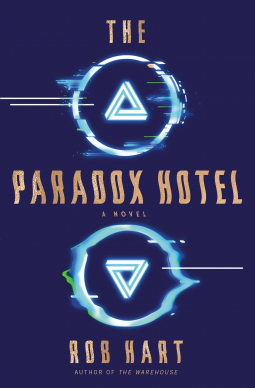
January Cole works security at the Paradox Hotel, which hosts time travelers awaiting their scheduled “flights to the past” at the nearby Einstein Institute. She’s a seasoned time traveler herself, having made many trips as part of the policing agency. As a result of spending too much time in the past, she’s become Unstuck, with the result that she often sees events and people from prior times. The best of these incidents allow her to be with her sweet, loving girlfriend, now dead. But January’s condition is worsening, and she’s not only seeing the past but the future. That future includes a corpse in Room 526.
With trillionaires arriving for the auction, baby velociraptors on the loose, and January’s grip on the present moment growing ever less reliable, it’s inevitable that more things will go wrong…starting with a series of “accidents” befalling the powerful, ultra-wealthy bidders. Clocks run backward, time seems to stutter, the treatment for being Unstuck no longer works, and January’s running out of time to stop the murder.
I loved the convolutions of time, January’s wrestling with grief and guilt, the dips into the past, and of course, the baby velociraptors that grow much too fast, all with the fast pacing of a thriller. In short, Hart’s time-twisting murder mystery satisfies on many counts.
Something Perfect, by Laura Anne Gilman (Faery Cat Press)
Just in time for Valentine’s Day comes a sweet, sexy novella from Laura Anne Gilman. It’s a romance between a long-married couple, Jenny and Nic, who feel more complete with a third person. Luck hasn’t favored them so far, as triads or throuples aren’t for everyone. Polyamory requires excellent communication skills, integrity, and generosity of heart. Frustrated with having their hearts broken from yet another breakup, Jenny asks Nic to use his scrying talent to find their perfect partner.
 “When you see the curve of their face reflected in glass and moonlight,” goes his reading. “The city shining on their skin. When you see that, you’ll know.”
Years go by, until Jenny attends an exclusive party in New York City and spots Amy sitting alone on the moonlit patio. Jenny knows she’s “the one.” Courtship is difficult enough, but between three people it’s a real challenge, especially when one of them is as insecure as Amy, who’s convinced she “isn’t good at sex” and will never find the right partner. Nic’s “Seeing” may have started the ball rolling, but it takes more than magic to forge strong, resilient relationships.
There was so much I loved in this story, and it’s all beautifully rendered: the strength and clarity of Jenny and Nic’s marriage and their ability to communicate in a loving, nonjudgmental fashion; the absence of plot stupidities and misunderstandings that serve no other purpose than to draw out tension, when a simple conversation would resolve them; the positive portrayal of sex and multiple relationships, one that trusts the reader’s intelligence; and most of all, a thread of gold running through the story, the importance of consent. Asking for it, giving it, checking in, taking it back, celebrating it. And the wonderfully juicy erotic bits are great, too.
Within Without (A Nyquist Mystery), by Jeff Noon (Angry Robot)

This is the third “John Nyquist Mystery” I’ve read and it’s by far the weirdest. Nyquist’s latest case involves the theft of a sentient, essence-of-glamor image that has gone missing from its host. To
investigate, Nyquist and his new assistant travel to the city of Delirium, guarded by boundaries that are far more than checkpoints or physical barriers. Their search for the magic practitioner who created and attached the image to begin with leads them into increasingly bizarre cities-within-cities. In Escher, Nyquist discovers his “Inverse,” the character hidden within his psyche, and it turns out to be Gregor Samsa, the narrator of Kafka’s Metamorphosis, who wakens one morning to discover he has turned into a cockroach. So Nyquist must deal not only with Samsa’s personality and voice, but that of the cockroach. As if that weren’t strange enough, his assistant has become infected with a creeping magical substance and, obsessed with taking the image, named Oberon, for his own, disappears. Plot twists abound, building until Nyquist finds himself in an utterly different plane of existence, one in which the images define and distort reality. The book carries forward and intensifies the hallucinatory texture of the previous Nyquist novels.
Sunshine and stories
I was just explaining to a friend on Twitter that my TV watching is related to my reading. It’s all part of my research. I have this driving need to understand story and to explain it. Right now, it looks (on the outside) as if I’m doing a complete rewatch of Doctor Who. There is purpose in my rewatch.
I reached a bit of an intellectual impasse in my research on how worlds are created by writers. The impasse isn’t a big one, but it’s an important one. My analysis was restricted because there was a factor in my own development that I was skipping over. An uncomfortable one.
The love of a TV show means we accept things in it that we possibly should not. As we learn more, we start to question. I’d already questioned the roles women play and gender plays on Doctor Who, but the English centrality means that I wince, for example, when rewatching The Talons of Weng-Chiang. It’s offensive and I’ve known this for years and it’s far easier to wince than to learn what decisions were made that created that offence. The Talons of Weng-Chiang is one of the pivotal sequences for this understanding, because when I first saw it I had close friends who were Malaysian Chinese. My friends were handling the fallout from the representation and I learned about that alongside them… but I still winced and didn’t face what it did to world building in science fiction (or in any story, to be honest). It affected how I build my novels, but there was always a blind spot because I winced rather than pushing myself to understand.
In the late seventies, I was delighted that I had friends who spoke the dialects the Doctor spoke (I remember saying this to one of them) but was at that point where I thought that the theatrical nature of the story justified the cultural outsiderness and errors (“It’s not your culture – it’s a stage thing.” That was my explanation, but it was far more an excuse than an explanation.). I was slow to learn, I think, how far my own life was affected by being an outsider, and this affected my capacity to look into what hurt others.
My work right now is on own voices for cultures that are invisible and in plain sight, both at once. The balance between the shape of specific cultures we put into our stories and the reasons we change them from their origins or ignore origins entirely and use prefabricated culture (the stage version, for example) is that place where invisible meets plain sight. Where were have these blind spots.
I’ll talk about that in my research write-up, when I’m further along. In order to do the research, however, I need to shine the light of day on things that I didn’t like to question. I need to ask myself why it was fine for me to watch this and enjoy it with only mild wincing and talk to my friends about it, even as they faced everyday bigotry based on the same notions and we talked about that, too.
There are several sequences in the late 1970s Doctor Who that are critical to this, for me. The rest of the watching is because taking them out of context doesn’t actually help me understand which aspects of the built world are invisible and which are in plain sight. This is not a one-off analysis, either. We don’t get a simple insight and become perfect people thereafter. We need to learn, continually. The robot sequence just before The Talons of Weng-Chiang reminded me, for example, me see how status and class and relative humanity are important in all of Doctor Who.
The presentation of different aspects of humanity changes over time, just as all our narratives do. Within the world of the Doctor, culture changes and what is safe to talk about and how people are introduced changes, too. A TV series that has been shown on and off for decades is a rather good tool for checking my own blindspots. It’s doubly useful because it’s not local to me. I will have to revisit Australian stories from the same times, soon. I need to bring more of the invisible into my clear day.
Some of it I watch with awareness. Other bits I focus on very, very closely. One of the bits I’ll focus on especially closely is what I like to think of as vampires in space. It was written by Douglas Adams. Enclosing a mind as vagrant as Adams’ then comparing this to one of his novels then checking how the radio play and the television versions are different again, illustrates rather well how narrative rules push us into this bias or that.
‘Bias’ is too simple a word, really. What I’m working on now is about what world we see as a suitable environment for stories and what stories can be safely told in them.
It’s Monday and I should give you a book to read and all I can talk about is TV and my research. There are other writers who do and have done research and the novel I’m going to give you to for your “Why does Gillian give me so much reading!” list is by one of them. Suzette Haden Elgin was the writer who taught me (without ever knowing who I was) that it’s possibly to ask the big questions and to do serious research and to translate that research into totally captivating fiction. I haven’t read much of her work, because every time I read something I want to think for a while before reading more. Native Tongue is a very fine place to start. My warning is, however, that most languages in fiction read as half-baked once you are in the Suzette Haden Elgin rabbit hole. Most writers invent language without considering what it does in society and culture. It’s very hard to unsee the gaping holes once you understand what languages are and how they can work.
It’s that clear sunshine on the hidden…
DogBlog: Today I am Two
In the chaos of deadlines and New Book Planning, I’ve forgotten many things. But this, I did not forget. Today is Max’s second birthday.
While her “present” will be a long hike this weekend, tonight a small gathering will be raising a glass (and handing out a new Hedgie) to celebrate. Over on Twitter, I asked if I should get her a pupcake, or if that was gilding the already-spoiled puppy.
The overwhelming response was “yes, get her a pupcake!”
For those of you unfamiliar with this trend, a pupcake is…exactly what it sounds like. A dog-tummy-safe cupcake, made with things like bananas, pumpkin, and peanut butter flour. You can make them at home (there are mixes!) or you can go to a hoity-toity pet shop or specialty baker. Yes, there are actual dog-treat bakeries.
Dog people, we need a reality check. Dogs eat dirt. They eat raw carcasses they find by the side of the trail. They will eat shit, some of them. They are not impressed by a fancy pupcakes with dog-safe frosting and a candle. Admit it, you’re doing it for the insta.
(Not that there’s anything wrong with that.)
But this is a milestone birthday. We did it, we got through her puppyhood and her adolescence mostly intact, if a lot poorer (most recent expense: $80 for meds to get her through another bout of Giardia, ouch). She’s reached her adult size and weight, and her personality is, if not set, then firmly established. 85% sugar, 10% vinegar, and 5% hellion. I love her to bits, and I wouldn’t trade her for anything. Although I might downsize her just a bit.
Are there things I’d do differently over the past two years, given the chance? Absolutely. “No dogs on the bed” would have been a hard rule from the start, for one. Getting her better-socialized with under-ten humans. Figured out her particular quirks and needs faster than I did. It’s probably impossible to raise any living creature and not have regrets along the way.
There are some things I just have to accept were always going to be, raising a pandemic puppy. But I think we did okay.
People tell me she will start to settle down, energy-wise, around three. Or four. Or maybe five.
Please god, by five. Momma’s tired, and the cat needs a break.
And this brings us to the end of my regular dogblogging. I hope you enjoyed growing up with us.
Then,

and now.
…and did I get her a pupcake? You’ll have to check my instagram to find out.
What’s in a Title?
 I was raised informally; the teachers at my (progressive) grade school were addressed by there first names; I called my parents’ friends by the first names as well–no Aunt or Uncle unless they insisted (only one person–my father’s accountant’s wife–insisted). This doesn’t mean I didn’t treat them respectfully, but it does mean that I grew up expecting a certain amount of reciprocal respect. When we moved and I went to a more traditional school, I called the teachers Miss/Mrs/Mr. I did ask once why we didn’t call all the female teachers Ms, and was told without irony it was because they didn’t have that many young unmarried women on staff. Okay then.
I believe people should be called what they want to be called (within reason: if you want to be styled Grand Panjandrum, okay, but don’t expect me to do it without an eyeroll). And until invited to do otherwise I still call doctors “Doctor,” regardless of whether they are MDs, DDS, PhDs, or any of the other long list of doctorate degrees. My father-in-law had a doctorate in Education, and while he didn’t do it often, he occasionally would insist on being “Doctor Caccavo.” Because he By God worked for that degree, and the prerequisite degrees, all while supporting a family.
For what it’s worth, in the UK, up until very recently, some medical doctors were Dr. and some were Miss or Mrs. or Mr. Allow me to put my Medical History Geek Glasses on: in the Middle Ages there were three classes of medical practitioners: doctors, surgeons, and apothecaries. Doctors were the ones who had studied medicine; they’d gone to school and learned all the theories. They did not lay hands upon the patient except in the most basic way–that was for assistants, or for surgeons. Surgeons were tradesmen: they used their hands, they apprenticed, learned the skills required, and practiced (some cut hair and pulled teeth as well; Sweeney Todd may have been a Demon barber, but he was also expected to be a dentist as well). Even up to the beginning of the 21st century, aspiring surgeons were plain Mister or Ms. until they finished medical school–then were briefly Doctors, until they finished surgical training and passed their exams, at which point they returned to Mister/Ms. again.
Don’t get your knickers in a twist about doctor. Continue reading “What’s in a Title?”…
The Importance of Folklore
Tonight I’m reading Simon J Bronner’s The Practice of Folklore. Essays toward a Theory of Tradition. I want to rant about the importance of folklore and folkways to our lives. They help us reach out to people and share. They are also magically important in novels, which is why I’m researching the theory right now.
In a chat somewhere online a few days ago, someone stated very firmly that they had invented a fantasy world and that what we knew of this world didn’t apply. In theory, this is true. In practice, however, we (human beings) have things that connect us to the world., In novels, storylines that kinda reflect what we think we know are easier to read. If we think that very green grass means much rain and wonderful grazing (I’ve been dreaming of Ireland) then if we have a wet climate with much grass and a character walks out onto it and it’s hard and dry and fractured, like the Australian outback during a drought, it will be really hard to envisage the world. If we talk about living in houses and how deep the foundations are and then show those houses floating, foundationless, in mid air, we will be fretted and want to find easier reading. One way that some of the bets writers hold worlds together while still challenging what we think we know is to use folklore, popular culture, and folkways. Michael Chabon’s The Yiddish Policeman’s Union does this rather wonderfully from one direction and his The Amazing Adventures of Kavalier and Clay does it just as wonderfully from another.
And yet… most folklore studies are descriptions of folklore. I have a pile of photocopied jokes from my father and I used it when someone asked me for a piece on folklore, twentysomething years ago. I described the collection and gave some examples of the jokes. That was my father’s folk collection. My own is food and foodways. I have a rather nice little collection of community cookbooks.
These descriptions and studies are tremendous for writers. They are such vast resources. Nevertheless, it’s studies such as Bonner’s that teach us how to use folklore most effectively. I’m reading Bronner’s book now in order to better analyse fiction, but I own the book as much for my own writing as for my analysis of others.
The more we understand the role folklore, folkways and all their related subjects play in our lives, the more fuel there is for writing and the more joy there is in reading. And now you know what I’m working on for the next three months. Folklore and folkways in just one writer’s work. It’s part of my big project, the sequel to my Story Matrices work. And it’s so much fun. If I can understand theories of tradition, just think of what it does for my own novels, how enriched my worldbuilding will be.
There’s one single extra big and very important component. Nancy Jane Moore reminded me that I promised a post today and told me that it was Juneteenth. Juneteenth is very alien to me, culturally, because I’m Jewish Australian. Australia’s colonial heritage is very different from that of the US. When the US was enmeshed in civil war, we were still a bunch of British colonies. We have our own history and our own days that are equally difficult, but none of them are Juneteenth.
When I find something that foreign and that interesting and that holds that much historical importance, one very good way to explore it is by understanding the folkways and folklore associated with it. It’s a part of cultural respect.
I can’t tell you what to do or think about Juneteenth, but I can tell you that if you want to understand it, you look at the words and the traditions of those whose day it is. That’s step one in learning to tell stories about people from different backgrounds to ourselves. It’s not a matter of learning a date and noting that it’s important, it’s a matter of finding out why it’s important, how it’s important and what cultural fabric surrounds it. Bronner’s book doesn’t talk about Juneteenth at all, but his chapters on other subjects help give me a path to follow as I respectfully start learning.
City Hiking
I took a class last month through East Bay Regional Parks and learned how to use hiking poles effectively. The class impressed me so much that I put my old hiking poles (which weren’t very good) out on the curb, where they were quickly snatched up. My sweetheart got me some much better ones for my birthday.
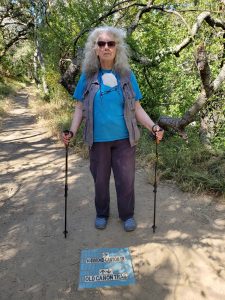
That gave us an excuse to go hiking, but since we had lots of other things to do, we didn’t want to go far. So we went hiking in the city of Oakland. Our first outing was to Dimond Park (which is pronounced as if it was spelled “diamond”) to hike along Sausal Creek.
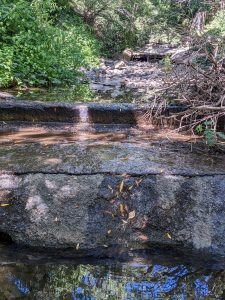
The trail has not been as well-maintained as it should have been and it was difficult in spots. The poles made a huge difference. Continue reading “City Hiking”…
Shall-Be-Nameless Magazine Review
Every once in a while, I post a review of a magazine. Usually, it’s done something to tick me off and I want to vent. Unreadable print ranks high on my list of no-nos.
For many years, I was a fan of a healthy cooking magazine. It provided me with wonderful recipes and articles about the chemistry of cooking. It changed its name, and I faithfully followed it into new territory. If there were fewer recipes that appealed to me, there were more articles on how food is grown, as well as other aspects of health. A few months ago, that incarnation went belly-up. I received a notification that the remainder of my subscription – all 3 months of it – was being transferred to a general “good living” magazine. I was assured of many healthful, delicious recipes.
The first issue had one, exactly one, article I was interested in (the varieties of lavender bushes).
The current issue is as follows:
The cover features a grinning man wearing huge beads, nail polish, and a tattoo of a cross. He is grinning widely, showing unnaturally white teeth. I’ve never heard of him.
Article 1: A list of “summer fun” events sure to be Covid super-spreaders.
Article 2: “For the dad who has it all”: a collection of gender-stereotyped merchandise I’d never buy for anyone.
Article 3: “Pool party” features blow-up pools large enough to accommodate several adults. In my area, water restrictions forbid filling ordinary, below-ground pools. Don’t the magazine folks realize that some of us are living in drought zones?
A bunch of articles on makeup, with or without SPF. Yawn.
Article 4. A remodeled porch, with many pages of interior decoration porn.
Articles too-many, more interior decoration that would be way beyond my budget even if I could stand to look at it. Chairs designed to give you crippling back pain. Fabric upholstery my cats would love as scratching posts. Wall paint so dark as to create instant depression. Kids’ rooms no self-respecting child would enter.
Article 5. Ah, gardening. Planters with trellises. Nope, nope, nope. Well, maybe, if I wanted to grow only 2 bean plants. Nope, nope, nope.
Articles more-too-many. You’ve-got-to-be-kidding-me style decor, complete with a plaque that says, “You’re a mess.” Yep, you are.
More sure-to-drive-kids-insane decor. More gloom-inspiring wall paint.
Article 6: “Egg bites”???
Article 7: Ah, some actual recipes, beginning with hearty salads. I think maybe I can work with this…until I look at the nutrition information and see sodium levels that start at 500 mg/serving and go upwards of 1,500 mg/serving. In what universe is this healthy??? (The American Heart Association recommends no more than 2,300 mg a day and moving toward an ideal limit of no more than 1,500 mg.) You could get your entire day’s allowance of sodium in just one salad!
Article 8: Cover guy in “Finding Home.” Wearing pajamas, then wearing 1890s-style onesies. Wearing…what is that thing? I’m so uninterested in this person I don’t recognize and who seems bent on warping his spine that I’m anti-interested.
Article 9: Drinks, all of them containing alcohol. Many pages’ worth.
Article 10: Summer gatherings in this family’s garden. Same back-pain-inducing furniture, but the garden looks nice. They have a cute dog. Maybe an outdoor meal might be safe…oh no, now they’re indoors. Still, they look like a nice family.
Article 11: More decor, described as “exuberant patterns and joyful color.” Too busy, too impersonal, too aggressive on the eyeballs. Does anyone actually spend time in these rooms?
Article 12: More salads, these arranged on large platters that look pretty but are designed to make sure (a) ingredients are distributed unequally; (b) there will be unusable leftovers. But I’ll take a look. I like salads. I see 654 mg sodium…1.064 mg sodium…wow, here’s one with only 470 mg. sodium but 42 grams of fat...at least most of it’s unsaturated, but depending on your caloric intake, that could be an entire day’s fat allowance. (See the above-recommended limits on sodium.)
I’ll pass.
After I toss the issue in recycle bin.
There, I feel much better.