‘We Are Stardust.”

I mentioned last week that I had signed up for an 18-day virtual meditation retreat that started on Election Day.

It was the smartest thing I’ve done all year.

I was a little stressed as I watched returns on Election Day itself; I remember 2016 all too well. But on Wednesday, when it started to become obvious that the Biden-Harris team was going to win, I got calm.

And I’ve stayed that way.

It’s not that I’m sanguine about all the challenges ahead. I already sent money to Fair Fight Action for the Georgia Senate runoffs.

I’m worried about a lot of things. The Republicans seem to have become a cult. The moderate Democrats seem to be under the illusion that we can just go back to “normal” even though it’s obvious that ship has sailed.

And while our local races here in Oakland went well — we’re going to have a more progressive city council this time around — that just means that we’ve got a better chance of getting our voices heard. It doesn’t mean we don’t have to work to get something meaningful done.

I’m concerned about a lot of things, but I’m not freaking out. And that is truly wonderful. Continue reading “‘We Are Stardust.””

Culture and science fiction conventions

I wrote out many thoughts on last weekend’s World Fantasy Convention, but something rather important has come up and I need to talk about it. It’s related to World Fantasy, true, but it’s also related to many other online conventions this year.

People from all over the world dropping in to take tea and chat can be delightful… but can also cause problems. No convention has been entirely without problems and no convention has been entirely without moments when cultures have come together and produced fascinating and useful conversations.

I could cause more problems if I listed the issues each and every convention has had or say nice things about the terrific conversations, but I shan’t do either. Instead, I shall give a small list of quite specific ideas to consider. These are the kinds of discussions that program people have or should have. (I’ve had them when programming. And yes, I made mistakes. The world is a big place and full of exceptional complexities.)

1. How do countries see their own various cultures? We can’t just take our own views and use them as a framework for the description of others. My favourite example of this is that people of Korean ancestry are from the dominant culture in Korea and the opposite in the US: a Korean and a Korean American have completely different experience in terms of prejudice and who society favours.

2. How do minorities see themselves, explain themselves, and why? The example I give on panels is often me, myself and I, for I am not the same Jewish as US Jewish and have some very interesting life experiences to prove it. Ask me about them, and ask me what elements of Australian history pushed me towards my self-description as off-white.

3. In any community, who are the experts on matters of culture? I’ve spent a large chunk of my life working on these things and some con-runners know this and ask me to be on panels or for advice. Others… don’t. The variations on ‘don’t’ can be entertaining but often make me feel like an outsider. I have other things to do than spend more of my life as an outsider (I am one anyway, so I don’t need to accept the gift of more outsider status) and move on to other things. We are all different people. Ask around and find out who knows what. (Ask me what my new PhD topic is, I dare you. It includes the words ‘culture’ and ‘genre fiction’. Ask anyone researching what their research is about.)

4. There are procedures and guidelines for working with so many minority cultures in so many countries. My favourites look a bit like this: https://www.australiacouncil.gov.au/workspace/uploads/files/writing-protocols-for-indigeno-5b4bfc67dd037.pdf This and a set of writing guidelines have been produced by the owners of the culture in order to make it possible for the rest of us to write without appropriation. While not all cultures have documents of this sort, they often have people who can be asked. It would be very useful if possible panellists know about policies and protocols and politics. It would also be useful if they could explain how one works with people of this culture or that. However, none of us know everything. Panellists should all know their limitations. That’s the bottom line. We need to know who we can speak for and who we should defer to on a given subject.

This is not a list of ten. It could be, but those four subjects are immense and enough to be getting on with.

Transforming Conflict (and Myself)

I just finished up an online class in conflict transformation. I stumbled on it by accident scrolling through the Coursera class catalogue and decided to sign up on the spur of the moment.

Conflict transformation is part of the growing movement in conflict resolution and other kinds of peacemaking efforts that work to address conflicts ranging from neighborhood disputes to all out war.

The transformation aspect emphasizes two major points. First of all, conflict is not inherently bad; it points out where deep-seated problems are and can lead to a path to do something about them.

And secondly, many conflicts involve people in very unequal situations. By approaching the problems with an eye toward transformation, rather than simply resolution, those trying to find a peaceful answer must consider that inequality in helping the parties find a solution.

To quote a phrase often heard at demonstrations: “No justice, no peace.” An ordinary mediation session at which both parties give something up is not going to resolve a conflict when major injustice is on the line. Continue reading “Transforming Conflict (and Myself)”

Comfort reading

The other day, we were chatting, in the usual Treeehouse way, about one of our favourite topics. The question we asked each other was not “Which books do you like?” but “Why do you like this book in particular?” We were talking about elements of a book where the author had put the finger on something so precisely that that author and that trait give us pleasure, even years after we first read it. We decided that when one of us remembers something about a favourite book, we might write about it here. We all need comfort right now, after all, and comfort reading is right up there with chocolate as something worth sharing. I’ve eaten some excellent chocolate today and I have a cup of tea at my right hand.

The book I want to share is one that’s really not very well known these days. I’m not sure it was even published outside Australia. It’s by Ray Harris The Adventures of Turkey. Boy of the Australian Plains. I have the 1960 edition, but didn’t read it until some years later. My school library had an earlier edition. I learned about space travel in that library and dreamed of becoming a science fiction writer. I learned about history in that library and dreamed of having history as part of my life. I watched the moon landing in that library, in 1969, when I was eight, and I read The Adventures of Turkey in that library.

Turkey was a schoolboy who lived outback, in an Australia I thought I visited on holidays. When I was a teenager, I was on a school exchange programme and discovered that almost everything in the novel either never existed or was in the past. Mostly in the past. I spent a lot of my early history quests trying to find out about Turkey and his life.

What is it in this book that still grips me? It’s a perfectly created world. It’s what most fantasy novels dream of being, but it chronicles the apparent everyday of school children from way out Woop Woop or from back of Burke. This is an Australian fantasy place, where the climate is tough and the people tougher, and where snakes are dealt with calmly and the real hero is a lanky boy who looks like a bush turkey.

The conversation us Treehousers (I’m now stuck in Australian English, sorry) had, was about writing techniques.

What writing techniques did Harris use that makes me dream about this non-existent Australia every time I read the book? (Do not ask how often I’ve read the book: I’ve owned this copy for about 45 years. We are talking about ultimate comfort reading.) This is not about what the book gets wrong. It’s about what it gets right.

One of my favourite openings of novels is in Susan Cooper’s The Dark is Rising. In the first paragraph we learn so much about a family that everything that happens to Will Stanton happens in that family context. The events are more startling because we know his family, intimately, from Will’s reaction to them in that first paragraph.

Ray Harris uses a similar technique.

“Turkey, me toe’s sore!”

Without speaking, the lanky fourteen year-old slid his school bag in front of him and took his small stepsister pick-a-back. He carried her easily enough. She put her perspiring cheek against his not neck, pushing his hat on one side. He made no protest.


It’s at once very Australian and very simple.

Everything in the novel is Australian and simple. We were just getting used to the idea that we could use our own dialect for protagonists in the 1950s and 1960s, so Harris used a voice even in that opening paragraph and that voice is what comforts me.

It’s my father’s voice.

Dad was brought up in country towns. I’m very much a big city person and I’ve never spoken the way Turkey does. I use a bit of dialect (‘Strine’ is its official name) now and again, to tease people, but I actually had to learn it from others as a child. The Adventures of Turkey was one of those others. It helped me to understand my father’s jokes. It helped me to see that there was an Australia outside my suburb and that I wanted to find out more about that Australia. It did all this by presenting the often-humorous life of Turkey, one day at a time.

While as a school story Turkey was new to me, the humour wasn’t. My father’s jokes are in it, and the entire novel lovingly embraces the narrative style of CJ Dennis (The Sentimental Bloke is another story I visit and revisit when I need comfort – it’s an Australian retelling of Romeo and Juliet) with hints (mere hints) of the adventures of Bunyip Bluegum (Norman Lindsay’s The Magic Pudding) and the short stories of Steele Rudd about Dad and Dave.

If you find the common elements in all of these, you will see what gives me comfort in The Adventures of Turkey. Whimsy walks alongside stern practicality. There’s an acceptance that even simple prose can be used to share the reality that ordinary life is tough but still worthwhile.

All of this was communicated through a writing style that supported resigned humour. The comfort comes from Strine itself, in a way. When I first discovered it, I was reading British school stories and dance books and horse books and I was reading about Anne Shirley and Laura Ingalls Wilder. I was reading science fiction and fantasy and anything that contained history. None of them gave the firm foundation that Turkey did.

It’s the sense that the everyday can be story, I think. Even if it’s an everyday that is so unlike my own that it felt ultra-real.

That opening says it all. Susan Cooper’s opening said that the everyday can be turned upside down and inside out. Harris said that the everyday didn’t have to be turned upside down and inside out to make good story. This is the comfort.

How Not to Win an Award

Each month, I ask my patrons what they’d like for their new essay. They vote. This month the vote was split, and I chose the one I wanted to write about, because no-one was asking me and I had stories to tell. You’ve seen the announcement here – that I won a prize for one of my novels. A not-unimportant prize. It struck me as odd that only my patrons want to know why I wrote this novel. Or maybe the oddness is that people are curious, but have not asked. Either way, I wrote that essay and it will go out tomorrow or Thursday.

The story of the novel may be cool, but I thought you’d like the story of what happened on the night of the award ceremony. It was the beginning of what promises to be a very interesting year.

The Ditmars are the Australian equivalent of the Hugos – awards for writing and art and criticism and more voted by SF fans. My novel was one of the finalists for best novel. I assumed I wasn’t going to win because I could see no reason why I should. I was fully expecting Eugen Bacon to win, in fact, so I didn’t worry too much about the award itself. My brain pushed all deep thought and lists of debts owed to the side, although I did wonder when the announcement would be made.

I only heard about the award ceremony three hours before, and that was a form invitation that all the finalists received. It was already Rosh Hashanah. My New Year.

If it hadn’t been for the pandemic, I wouldn’t even have kept the computer on. Work was out of the question and for me, that award ceremony was work. It took me a while to puzzle this out. I did it on Facebook with many contributions from friends. I discovered then that a lot of people go to award ceremonies for fun. I don’t. I love it when people I care for get recognition, but I find the ceremonies themselves hard work. Speaking to a big audience about a topic I love, however, that’s fun.

I finally puzzled my way through the whole problem, sent an email to my publisher, and sent an apology to the organisers. The only reason it took me that long was that I was dealing with medical issues all that week. I had to decide through a haze and it was not comfortable physically or emotionally. My mother was happy with my decision, which was the big thing. I couldn’t tell her about it until afterwards, however. Three hours is not a long time.

When the three hours were nearly up, I was spending my new year with two of my close friends. Yaritji Green, in the middle of our chat, asked me if I knew someone and I told her they were on the Ditmar committee. I asked her if that meant she was at the online ceremony. Not only was Yaritji at the online ceremony, but she was willing to stand in for me if needed. 

She asked me for some dot points, in case. I didn’t take the need seriously, for that whole day had turned improbable three hours before. I told her “This was an impossible work and the award is in an impossible year and it’s impossible for Gillian to be here cos it’s Rosh Hashanah.” I tried to think about it more but, “I have heaps of things I would say, but I can’t think of them tonight. My brain is outside work zone.”

She asked me about the nomination and I explained, “I had my heart stuff then wrote that novel the following October/November, BTW, so it’s very appropriate that you’re (as a doctor) my sub.” (I’ve cleaned up the impossible typing – everything looked impossible at that moment.) “I cogitated on the conditions for the novel for 20 days in hospital, then while I was recovering, then when I found myself with no paid work because the uni was leading up to sacking me and then splurged and I wrote it very quickly. You don’t need to say any of this – I’m just remembering that this was the first time I sorted out HOW to turn garbage into fertiliser. Fruitcake was the first flower in my new garden.”

My mind didn’t have much time to dwell on the irony in what I’d explained to Yaritji. In fact, the moment I finished typing it, I sent it and two words arrived from Yaritji.

You won,” she typed.

She had been speaking on my behalf while I was trying to get my mind around why it was impossible to think lucidly about this novel. My immediate reaction to “You won” was “Wait…what!!!” Yaritji knows me very well and sent me a picture of her computer, with the announcement writ large on the screen.

That’s the end.That’s how it happened. I suspect I won’t believe I actually won until I see a trophy.


Head to the Spaceport and Book Passage!

Forget Covid. Forget politics. Go outside tonight if you have any kind of clear sky and a view to the southeast and southwest—even if it’s between the trees and buildings. To the southeast, Mars and the Moon are about to fall into a dangerous, non-distancing embrace. They are spectacular together, with or without city light pollution. And to the southwest, Jupiter and Saturn continue to dance brightly (well, Jupiter is bright, Saturn is less so) at arm’s length.

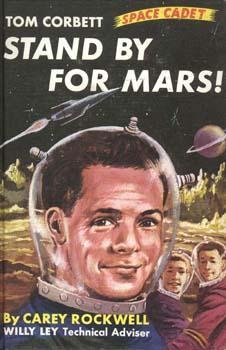
I saw them all while walking the dogs (I couldn’t even see any stars), and was thrown right back to the 1950s and early 1960s, when the solar system was a simpler place, and we just knew that in another fifty years, we’d be able to head down to the Atom City Spaceport and hop on a luxury space-liner to any of those places. Those were the days! The Golden Era of Space Travel (as it should have been)!

Stand by for Mars cover


Car, parked.

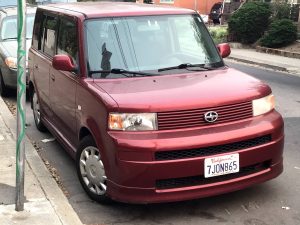
carOn March 13, I filled the car with gas because we were planning a trip to visit my sweetheart’s mother for her 90th birthday. But the next day we both woke up feeling a little under the weather, so we decided we shouldn’t go.

Four days later, the Bay Area set up a shelter-in-place to slow down the pandemic.

I haven’t put gas in the car since. According to the gauge, there’s about three-quarters of a tank available.

At a rough guess, I’ve driven the car about a hundred miles in the last six and a half months. To put that in perspective, I’ve walked about 850 miles in that same period.

Now it’s not unusual for me to walk more than I drive when I’m not traveling. I live in a very walkable neighborhood. And I’m even driving to run some errands right now; when you buy two weeks worth of groceries at once or are picking up a farm box instead of browsing the booths at the farmer’s market, a car is useful. Continue reading “Car, parked.”

Wildfire Journey, Part I

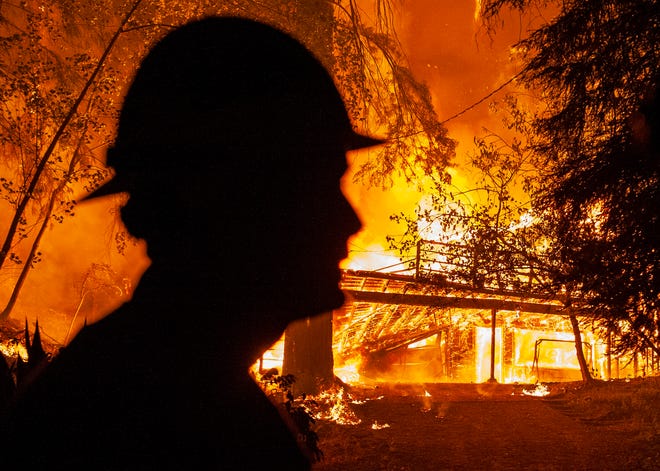
First came thunder and dry lightning. Such storms are rare in my area, due to the configuration of the mountains, but this one was extraordinary by any standards. The first storms hit early on August 16, with not dozens but thousands of lightning strikes (estimated 12,000 over 72-96 hours). 

We had watched the lightning for a few hours, flash after blinding flash, and commented that in his last years, our old German Shepherd Dog had become fearful of loud sounds like thunder and fireworks (we dealt with this by immediately getting out his all-time favorite toy and playing with him). Even though we knew of the danger of fires, somehow it didn’t connect. It should have. Over 500 wildfires sprang up in the next few hours, fanned by hot, dry winds. Soon we saw news stories of multiple fires in our county, Santa Cruz, and neighboring San Mateo, that were to merge into the #CZUAugustLightningComplex fire. 

The next day, the air was noticeably smokey, but we’d had smokey air before, from the Camp fire a couple of years ago, and others in Northern California. We kept an eye on the news but otherwise went about our business, mostly staying indoors. But as August 18 went on, the smoke thickened and the extent of the fire at Butano Park, northwest of us, expanded with terrifying rapidity, our mood went from watchful to alarmed. About dinner time, the smoke was as thick as San Francisco fog. 

“We should prepare to get out of here,” I told my family. “Just in case.” For months now, I’d been gathering materials on disaster preparedness, and had checklists and evacuation route maps in a folder on the kitchen counter. Now I got out those lists.

We each went about packing up suitcases, getting cat carriers ready, piling up our binder of important documents and insurance policies, getting out boxes of family photos. CPAPs, check. Jewelry, check. Prescription meds, check. And so forth.

The smoke got worse. The fire got closer. Big Basin State Park, that jewel of old growth coastal redwoods, was in flames. 

“We’re leaving,” I said, and called my dear friend and fellow writer in the East Bay. 

“Of course you can stay with us,” she said.

“But first,” I told my family, “we will have a good dinner.” As I’d planned, fajitas with squash from our garden. The hot, flavorful food strengthened us for what was to come.

We finished dinner, I loaded the dishwasher and set it to run, and then we loaded up the cars, locked the house, and drove off. As it was, our grown daughter and the cats had an offer of refuge south of Santa Cruz, so after some discussion, we decided to split the family. We stepped out of the house into a sea of billowing smoke.

The road into our little town was already filling up with outbound traffic. At the one and only stop sign in town, in front of the volunteer fire department, sheriffs were directing traffic south toward Santa Cruz. “Go, go, go!” the officer in the middle of the intersection shouted, waving cars through. I’d planned on going left, then along a twisty mountain road I knew well to the nearest highway, but followed the course of least trouble for everyone. It meant a somewhat longer drive for me to detour south, then east, then back north, but in the interest of keeping outgoing traffic flowing smoothly and not making more work for the folks who were trying to get us all out safely, I took it.

Shortly thereafter, while I was on the road, we all received reverse-911 texts of the mandatory evacuation orders. Continue reading “Wildfire Journey, Part I”
Rip van Winkle versus the Spaceship

I’m dreaming of spaceships today. I want to write a story set in one.

I need to write a story. It’s only Tuesday here and my New Year is on Friday and I’m writing your post nearly a week early because of that festival. I was going to tell you all about Medieval Jewish foodways in western Europe and about modem Jewish foodways in Australia and I was going to make you cravingly hungry for honeycake. I’m derailing the whole conversation (one I haven’t yet begun) because of my dream of spaceships.

I won’t tell you the dream itself, for it’s going into a short story, later today. One short story set in a spaceship and I ought to be caught up on all my new fiction for Jewish New Year. What I want to talk about is the alternate path the dream did not take.

Before 2020, I assumed that if someone were inside for months on end, when they went outside, finally, I would have a Rip van Winkle experience. I would emerge to a strange place I did not recognise: the rest of the world would have moved on.

This is not at all what happened when I went to medical appointments last week. Sure, the streets look at bit different. I emerged to a financial recession, after all, where the strict COVID limits on who can do what. Overcrowding is rare and people are more scattered. There are crosses and lines to mark safety.

I knew about these changes, however, before I encountered them. Rip van Winkle emerged to a place he did not know and that he did not understand. While he was asleep, he was out of sync with the outside world.

It would take an active choice to be out of sync right now. Or a second terrible moment, like the wildfires in the US or riots or… a great deal of what’s happening in the world right now. Multiply the peril and one’s focus turns to keeping going. I suspect the US has many Rips right now.

Given my last twelve months, I assumed that this is what would happen to me. That I would emerge into a changed world and I would not belong to it at all. When I found that this wasn’t at all true, I needed another metaphor. Washington Irving failed me. It’s tragic that he did not fail the US.

I explained my situation a bit more clearly to a neighbour’s friend when I put my rubbish out (this was such a big accomplishment! Once this statement would have been sarcastic – right now it requires the exclamation mark.). My neighbour’s friend failed me in a different way when I emerged.

When we told each other what we did for a living and I said I was a writer, he took my earlier admission of disability to mean that I filled in my time writing. He was nice about me turning my disabled state to good use.

This was when I fell out of sync with the world. Had working for a living changed since I last spoke to a stranger? He moved off the ‘occupation for a person with disabilities’ and onto the ‘does this out of passion’ thing. If we meet a few more times, maybe he’ll see the professional side of writing, and understand that being disabled doesn’t actually mean having a lesser life. It’s a life with restrictions and much medical stuff, but it’s capable of being amazingly rich. Mine is that life. I commented to him that I was bored for a whole hour earlier this year and I looked at the boredom and examined it closely and exclaimed in wonder at it and that is when I discovered that I was no longer bored.

This is why I had the spaceship dream.

I was never Rip van Winkle. I’m in a small spaceship. I can talk to other people and am in touch with the whole world of I want to be, but I’m in a spaceship. No dinner parties. No long chats with friends around a pot of tea. No long walks in the spring sunshine. But I know what’s happening and can be a part of it. It’s only my physical presence in a place other than my spaceship that’s not a given.

In the Creativity War, Sometimes You Need to Retreat

Even before the pandemic hit, I was having trouble getting traction on my new book. Lots of notes, lots of false starts. Feeling like a blind badger trying to find its way through unfamiliar territory. Since we entered Covid-world, it’s only gotten worse. I’m sure you all have your own reasons why it’s hard to get things done these days. Add to that a degree of discouragement over how hard it’s been to get my two-volume last novel (The Reefs of Time / Crucible of Time) noticed within the SF readership, and the result has been a creative malaise that I’ve found very difficult to shake.

Wife to the rescue. The moment certain outside stressors let up enough to allow it to happen, she seized the proverbial bull by the you-know-whats and made the call to get me a retreat-spot on Cape Cod. Sending me kicking and screaming, that sort of thing.

And now I’m here in Sandwich, MA, near the sea, land of great bicycling and even greater seafood. I’m loving it. Her instructions were explicit: “If you can write, that’s great. But you are not going there to get writing done. You are going there to shed all the dog walking and the house repair and the taking care of people who need help and the worrying about the state of the world and find yourself again. You are going to rediscover what it means to you to write a book, and why you want to do it.”

So, here I am. Too soon to be certain, but from preliminary signs, I think it could be working. (And I did write a bit last night.)

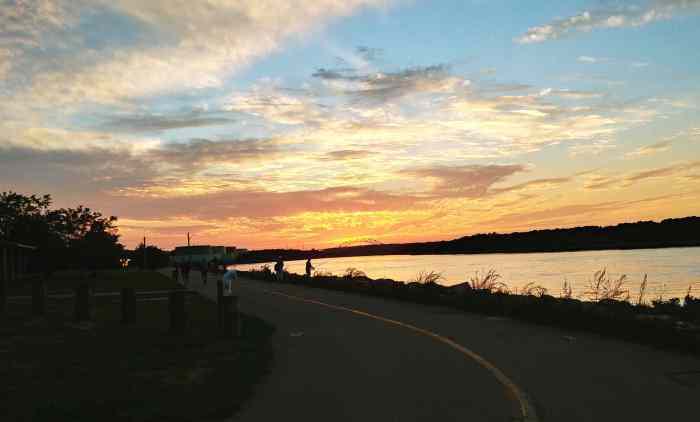
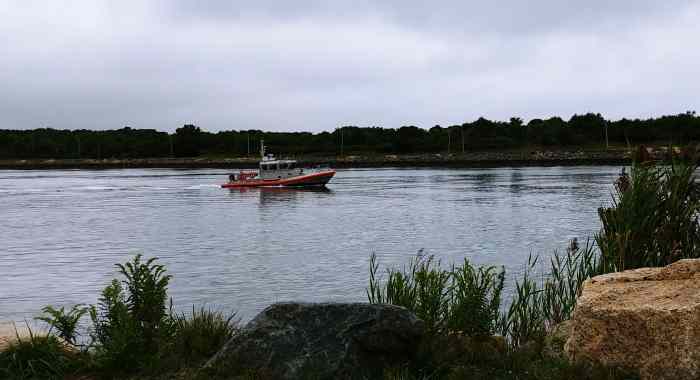
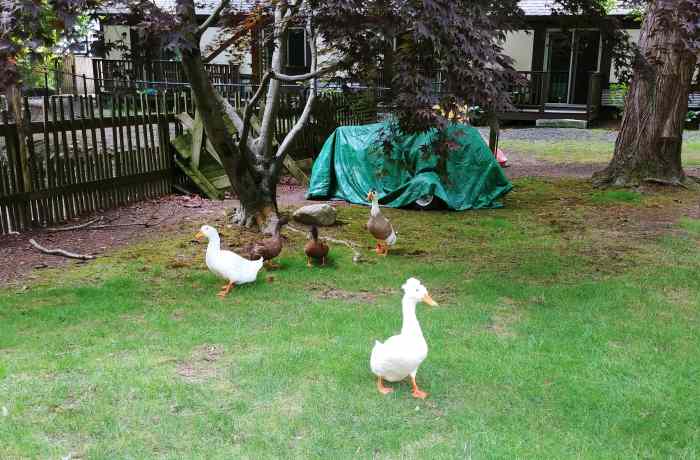
Here are some pix from the motel and the Cape Cod Canal bike trail.

CapeCodCanalside bike trail sundown
Sunset over the Cape Cod Canal bike trail.


Coast Guard, heading out toward Cape Cod Bay. I’d like to have one of those boats, tough and seaworthy. I wouldn’t paint it gray, though. Something bright.


Duck-mascots at the motel.