Today I’m dreaming of Jewish monsters. This is the reason: https://www.kickstarter.com/projects/ranthalix/jewish-monsters-and-magic-trading-cards
I heard about the project because the publisher of The Green Children Help Out is involved in it. There is an increasing number of people who, despite everything that’s going on in the world and all the antisemitism, are enjoying the wild and amazing stories that are part of all the Jewish cultures.
I saw that this weekend at the Virtual International Conference on the Fantastic in the Arts. R Andrea Lobel was a guest of honour (who has published a story of mine in Other Covenants – sometimes I think the world is a tiny place) and delivered her plenary on Jewish fantasy.
First, she explained something that had me nodding in sad recognition: right now, a lot of Jewish writers are being avoided by publishers, by booksellers, by many people. Jewish writers from all over the world, and Israeli writers regardless of religion or political views. My own income from writing has suffered from this. I’m visible in some places, and in others, it’s as if I never existed… and I’m one of those who have experienced less hate. No book sales, but also no death threats.
Seeing the Jewish monster cards made me smile. Something cool and fun is entering this world despite all the hate. Of course I’ve backed them. I told my friends that they are a combined Chanukah and New Year present for me, myself and I, but the reality is that they are a tool with which I can combat ignorance and hate. I can learn more about Jewish monsters… and also use them to teach writing. I miss teaching, and cards like this would make it enormously fun.
Rabbi Lobel talked about the history of Jewish fantasy (English-language history, for she did not have two hours! The Jewish Fantastic goes back a long, long way.) then she gave examples of some modern writers of Jewish fantasy for the attendees. I think you might be interested in her list. I’ll give it to you as a screenshot.
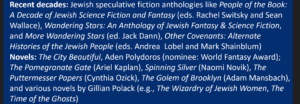
The thing is – and this is not a small thing – there are hundreds of works. Not so many in Australia, which is another story, and I am still a bit overwhelmed that I’m on the list along with Jack Dann. This means that 50% of the current Jewish Australian fantasy writers who have published novels and short stories containing Jewish stuff is on this list. I doubt anyone in Australia will even notice. Jewish fantasy writers are not included in Jewish Writers’ festivals in Australia and Jewish writers are currently not very welcome in the literary scene. I notice, however, and it means a great deal. Mostly, it means that I shall not give up on my fiction despite the current problems.
This week’s post is not deep. It’s a small moment of joy in a difficult time.

 ale or whatever passed for it). I grew up in the era of folk music, where almost everyone I knew had a guitar, banjo, recorder, or equivalent instrument. Maybe a dulcimer, castanets, or lap harp. Sure, we went to concerts, but we made our own music, too. For the last couple of centuries, folks who could afford it had a harpsichord, clavichord, pianoforte, as well as a harp (ref. any Jane Austen novel or film). Composers wrote for their patrons (or their patrons’ families), music simple enough for an amateur to enjoy playing. Even with the shift through recorded media to professional concert music (everything from symphonies to metallica), folks continue to enjoy playing music. Perhaps it’s a bug they catch in high school band or orchestra. Perhaps their moms forced them into piano or clarinet lessons and they found themselves wanting to play long after lessons went by the wayside.