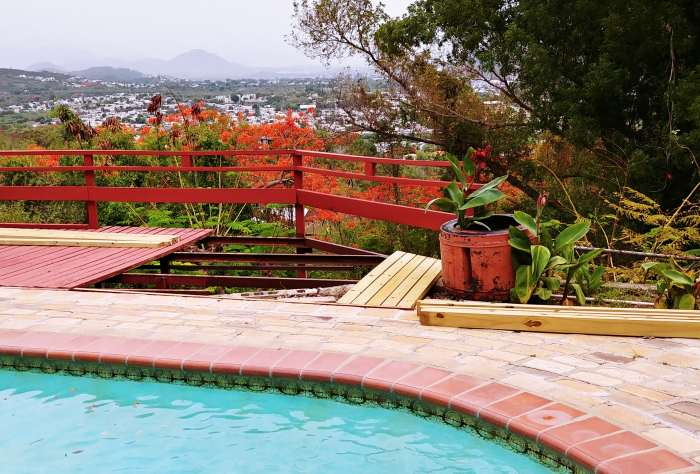
If you haven’t been following, I’ve been building a deck. Actually, replacing a rotted-out wooden deck beside the swimming pool at Casarboles, my wife’s family’s place in Ponce, Puerto Rico. I’m in a race against the clock (we leave for home in two days, having already extended our stay by two weeks), and it’s been a bear. In the middle of it all, I developed an ear infection, probably from protecting my ears with noise-canceling earbuds, complete with ground-in dirt. Did I let that slow me down? I did not! (Well, maybe a little.)
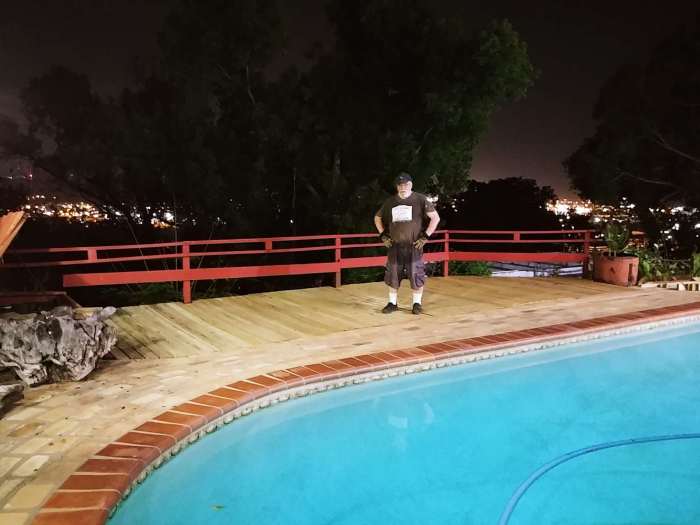
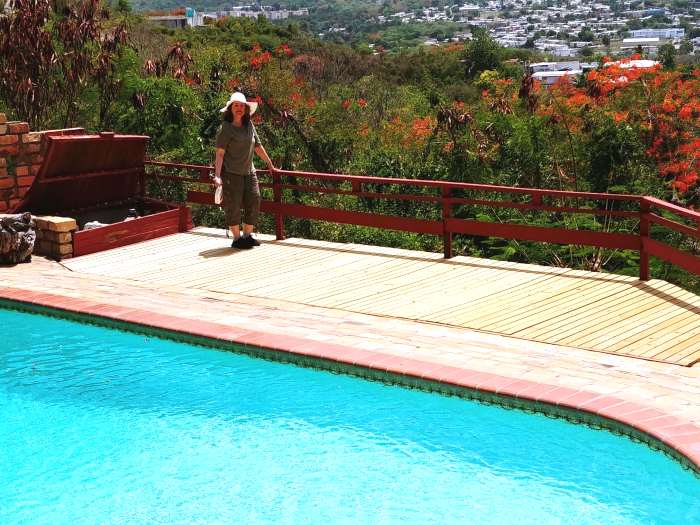
Here’s a sort of stop-motion record of what I’ve been doing:
Grinding and painting the steel supports…
Last floor plank laid, yours truly ready to keel over…
The new floor, shown to the audience in daylight by a far more attractive model; old, rickety railing system still in place…
Old railing gone, new railing begun… two days to finish…
Wait, what, you may be thinking – Laura Anne saying “too many dogs?” Is she all right? Has she been replaced by a canid-hating alien?
No, it’s still me. But my fellow humans have once again tipped the scale and made me rant.
I admit it: I am in many ways the quintessential, stereotypical PNW dog owner: I see no reason why my dog should not accompany me pretty much anywhere and everywhere.Within reason, okay, and not to get up in the face of people who don’t like dogs.I get it.I mean, I don’t GET it, but I respect their dislike, whatever the reason for it.
Now, I’ve got some reason for my feelings: Max is (for the most part) a well-trained dog who understands how to behave in public spaces.And there’s little pleases me more than seeing other well-trained dogs sharing public spaces.People, mostly, are happier when dogs are around. Lord knows, this world needs more happiness.
Last week, however, I had to reevaluate my position on, “dogs, yay!”
Because of a change in my schedule, I went to a different farmers market than I usually attend. This one was slightly smaller, and it was all packed into one street. Which was a complication, but they’d laid out the pedestrian traffic lanes pretty well.
But because of the location, and perhaps because of the neighborhood it was situated in, they were a number of people with small children, and dogs — and occasionally small children and dogs. They were also, because of the location, a great number of people sitting at café tables outside of restaurants and stores, watching the crowds go by.
This was a little problematic for me, for reasons of Covid and crowd trauma.But it was outdoors, people were mostly-masked, it was fine.
But.
There were too damn many dogs.
These were good dogs, as far as I could tell.They seemed to be well-behaved, and completely under their owner’s control. Normally I would consider it an excellent example of why dogs and humans should be allowed to interact.
But.
There were just too damn many of them for one already-crowded street.Every step, another dog, every turn, another dog.Dogs under a barrage of noises and smells, including the doubtless distracting smells from the food booths.
And people being careless about where their dog was poking their nose.Yeah, your dog may be the friendliest thing that ever wagged.But you still need to pay attention to what’s going on.
So there I am, being hyper alert, and I could feel Max starting to stress, partially because she could sense I was worried, but also partially because she wanted to play with a lot of the dogs, and they wanted to play with her, but she knows that market time is not playtime. Probably a lot of other dogs had the same tug-of-war going on behind their big brown eyes.
There’s only so much you can ask a dog’s brain, and its desire to please you, before something’s gotta give. And when something gives in a dog, you get stress, and when you get stress you get barking, and occasionally you get biting.
So we did our shopping and got the hell out of there.And I won’t be going back.Because hell yes, I’m leery of crowds these days.But sometimes it’s not trauma.Sometimes it’s just knowing the odds.
So fellow dog owners, real talk: our dogs don’t have to go everywhere with us. Honest. And if you just gotta take them with you to the weekend market, deputize someone to wait with them outside the market while you wander in and out of the booths.
The disaster you avert may be your own.
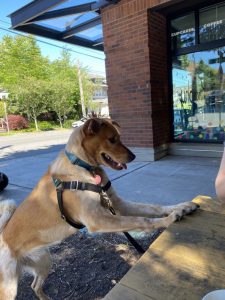
Max, getting a little too excited….
A slightly saltier version of this post originally appeared at my Patreon.
Progress! With a capital P. Here’s the pool deck yesterday. I filled in that gap and then some, today. Geez, I’m tired. But I have hope of getting it finished before we leave.
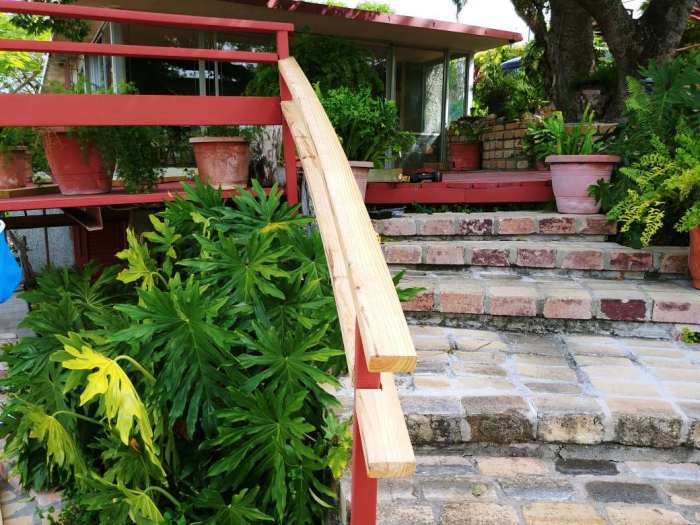
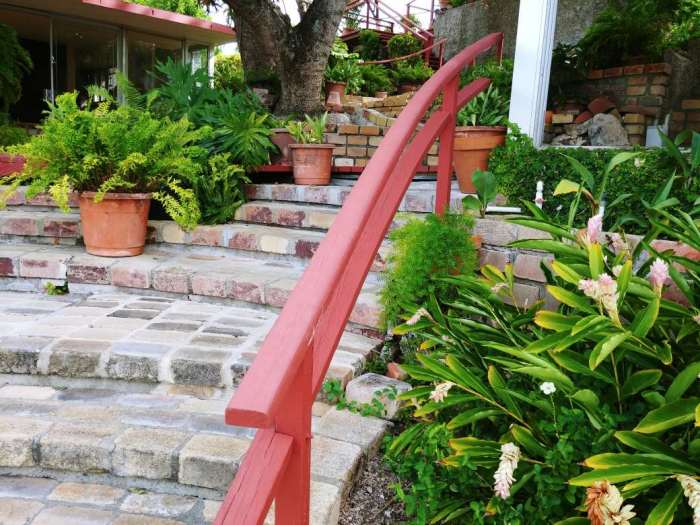
And here’s a new bit of railing. It replaces the well-crafted, elegantly curved railing that Allysen’s dad built, and which some boneheaded weekend tenant broke and tried to conceal by hiding the pieces in the bushes. Deep breath.
By the way, in case you’re wondering how I got those curves in the wood to so nicely match their pairs on the other side…
I found two pieces of warped lumber at Home Depot. Their curvature was exactly what I needed.
It’s blackberry season, and as is my custom at this time, I went out this morning to pick from the brambles along our little country road. (We have our own patch, but the berries ripen later because it’s in a shadier place.) I try to do this early, when it’s cool and I’m not having to squint into the sun for the higher branches. As I picked, I thought about the story I’m working on (and currently stalled on 2 scenes-that-need-more), and also writing in general.
Blackberries are tricksy things. They can look ripe from where I stand, but turn out to be all red at the base. Sometimes I can tell the moment I touch the berry — it’s too firm and too tightly attached to the stem. I have to be ready to give up on what looked like a great prospect and move on. When I’m in the flow of picking, it seems I don’t even have to think about this. Isn’t this like a story that seems promising but doesn’t yet have the necessary depth? Occasionally — well, more than occasionally — my mind gets set on “this berry must get picked” and I force the issue. I’ll glare at the red parts and pop the berry into my mouth (“for private reading only”). Berries that are almost-ready go well in oatmeal. I freeze quarts and quarts of them for winter breakfasts. They’re too sour on their own, but they blend well, adding pleasantly tart notes. That’s not unlike taking several different story idea, none of which can stand on their own, and setting them at cross-purposes to make a much more interesting tale.
This whole business of “readiness” in a story is a curious one. It’s a bit like cooking without a recipe, because while there may be guidelines, there are no hard and fast rules of how to tell when a story concept is “ripe.” All too often at the Big NYC Publisher’s Office, after rejecting a work – especially if it was (a) slush and (b) got the standard slush reject letter, which was polite but clear that it wasn’t something they were interested in — the beginning writer would respond. Now, professionals know that, unless you are specifically invited into an exchange, you don’t respond to a rejection. You take it, you consider what’s worth considering, and you move on. That exchange is over.
Occasionally the appropriate response is to to ask for more details, keeping in mind that time-crunches didn’t allow the editor to do that in the first place.
More often, though, the editor gets a response along the lines of “My work is utter genius, and you’re too blinded by (fill in the blank) to see it! But you’ll be sorry!”
I think this kind of reaction isn’t limited to beginning writers, but it is a particular trap. It’s far easier to think that your story got rejected because of the blindness/stupidity/conspiracy/conventionalness of the gatekeepers, rather than that it simply isn’t good enough. It could be a great idea and you weren’t ready to do it any kind of justice. It was a trivial idea that no one could have turned into a decent story. It could have been a nifty idea but it wasn’t developed, it wasn’t “ripe.”
One of the hardest things for a new writer to understand is that there is a threshold of quality — for ideas, for execution — for publication. It’s so hard to hear that the story you are so proud of isn’t good enough. Those thorns hurt as much when I’m pulling out as when I’m pushing in.
And here’s the catch: sometimes the story really is great. Sometimes the market just isn’t ready for the story at this time, but it will be in the future. Somewhere there’s an editor and a readership who will adore it. How can you tell? Continue reading “Blackberry Writing”…
I don’t like billionaires taking joy rides in space.
This is not an objection to space exploration. I’m all in favor of space exploration. I grew up with the U.S. space program. I went to church with the people who put Neil Armstrong on the Moon.
Also, I write science fiction. I believe in the human desire to figure out what’s going on in the universe.
Further, I’ve never believed that our choices are between exploring the universe and taking care of people here on Earth. We can and should do both.
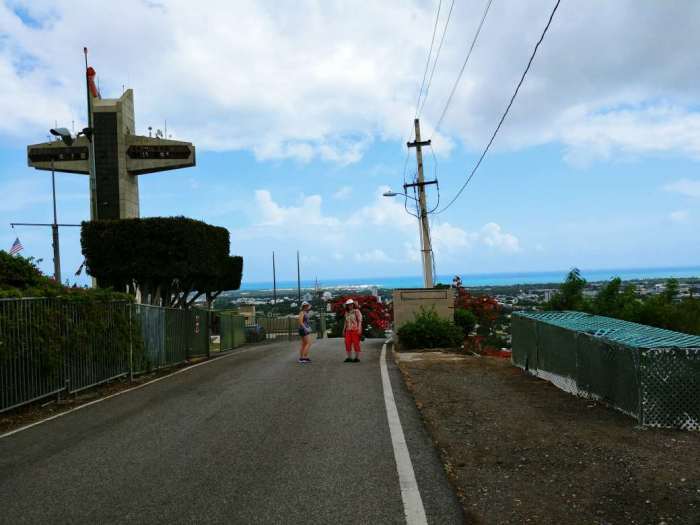
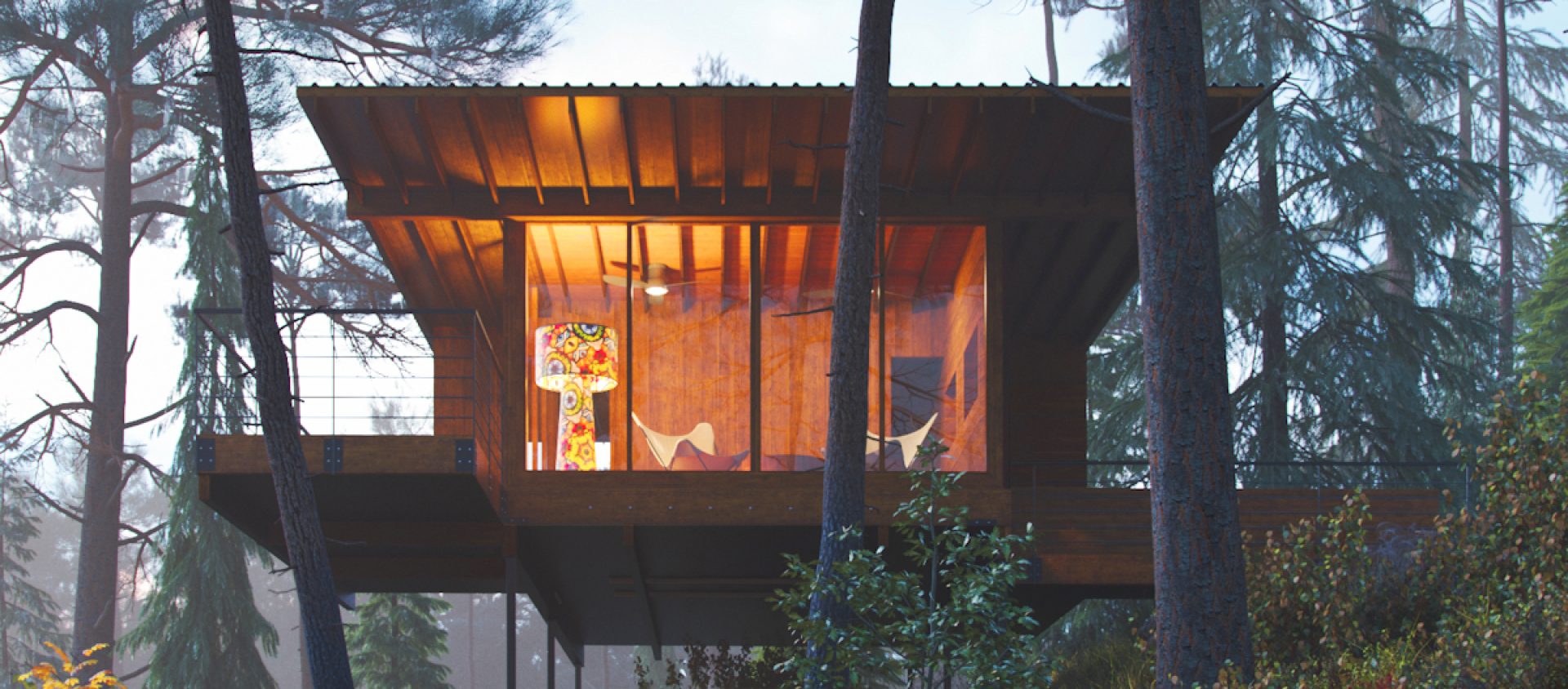
Puerto Rico is called the Isle of Enchantment. There is, in fact, remarkable beauty to be found just a short walk down the hill from Casarboles, the “treehouse” built by my wife’s parents. The first thing you see is the Caribbean, just beyond the view of Ponce. From here, you can turn to your left to enter the grounds of the Japanese Gardens and Cruceta del Vigía.
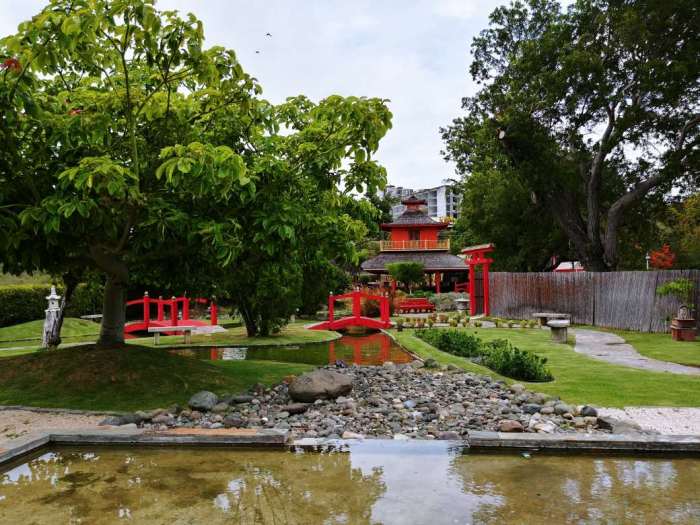
We were treated to a private tour by the lovely activities director Luciris on a day the museums were closed (Allysen’s dad was once very active on the board of directors). We first entered the Japanese Garden, which might seem a little incongruous in this land of Latin culture, but it’s enchanting, just as promised. Here’s a view across the grounds.
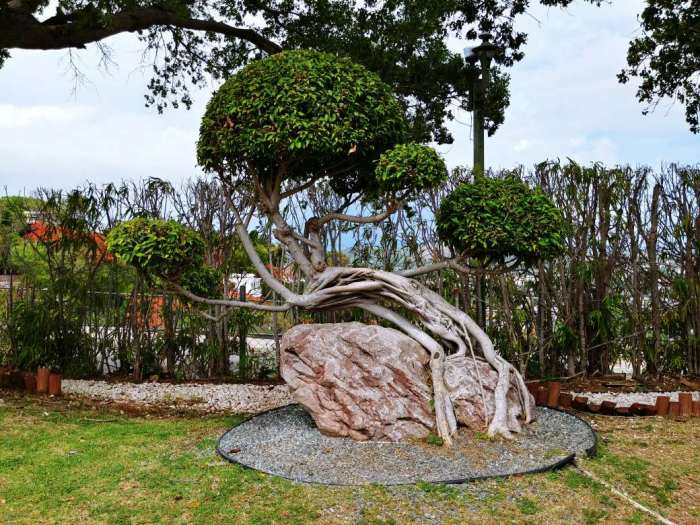
And a strange and beautiful tree. I don’t know what kind.
I had an existential crisis when I was ten years old.
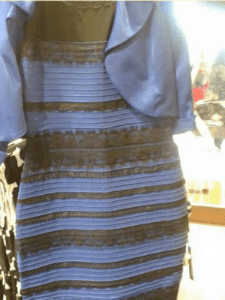
Okay, perhaps I was an overachiever, anxiety-wise. My class was studying the sense, and the subject of differences in individual perception came up, like it does. It’s very likely, my teacher said, that humans perceive things like color, or certain scents or tastes, differently from one another: that I might experience the color I characterize as yellow differently from you. In terms of light and spectra, the color yellow is the color yellow is the color yellow, but my experience of yellow is based on my hardware and software: that is, my eyes and brain, as well as my experiences in interpreting color.
My class had some fun with this; ten year olds are not notably sophisticated about humor, and for a day or two there was a rash of “Nice red shirt,” comments to people who weren’t wearing red, and so forth. In science class the next day, someone asked, if our experiences are all different, how can we knew that yellow is yellow? My teacher fumphed a bit and got sidetracked talking about light and the visible spectrum, and… my classmate never quite got an an answer, but I remember sitting at my desk feeling deeply unsettled.
If my color yellow was not the same as someone else’s color yellow, how could I be sure that the word yellow when I spoke it would sound like yellow to a person I was talking to? How could I make sure that anything I said or experienced was the same thing someone else heard or experienced? Short of crawling into someone else’s head, how could I ever know? Which made me feel as alone as I had ever felt in my young life. I felt suddenly like everyone–me and everyone I loved–were all just individual objects blithering through the world, crossing paths but unable to confirm our experiences. It was a kind of lonely I had never suspected existed, and I lost several nights sleep trying to devise different ways that I could confirm with someone that yellow was yellow.
And then, gradually, the anxiety diminished and I stopped trying to invent telepathy or some other way to contact and verify that the reality I live in is, in fact, consensual. I don’t think about it too much any more–although back in the 1990s I wrote a story about a man who establishes a telepathic connection with a pair of genetically engineered lions–and while he’s delighting in the connection with another being, they’re sizing him up for dinner.
When I think about it, maybe it’s just as well I don’t know what anyone else thinks is yellow.
Treehouse residents Nancy Jane Moore, Madeleine E. Robins, and Gillian Polack are all reading on Sunday, July 25, beginning at 5 pm PDT as part of FOGcon’s Authors Read.
Nancy is a featured reader along with San Francisco author Claire Light, and Madeleine and Gillian are part of the rapid-fire readers participating in FOGcon’s ongoing virtual event program.
The current schedule is three rapid readers, followed by Claire, then a break before three more rapid readers. Nancy will close the readings. There will be time for questions and the event will close with breakout rooms with each of the featured readers.
All of this takes place on Zoom. Register here to get the Zoom link.
Back pain and sunburn and plumbing, oh my! And Puerto Rican rain, which comes fast and goes fast. The rain cools things down briefly and washes the Sahara sand out of the air, which is great. And wets all my lumber, which is not great. Here’s where the pool deck work stands:
While working on the deck, I’d had the recurring thought: Don’t hurt yourself. You don’t have time! And so, two days ago, while l/i/f/t/i/n/g/ h/e/a/v/y/ l/u/m/b/e/r/ m/o/v/i/n/g/ c/o/n/c/r/e/t/e/ b/l/o/c/k/s/ bending over to pick up a screw, I did something and my back screamed. I jackknifed to my knees on the brick pool deck and hollered for help. My daughter and wife were both in online meetings with headphones on and couldn’t hear me. Finally Allysen looked out and saw me and yelled, “Are you okay?”



 It’s blackberry season, and as is my custom at this time, I went out this morning to pick from the brambles along our little country road. (We have our own patch, but the berries ripen later because it’s in a shadier place.) I try to do this early, when it’s cool and I’m not having to squint into the sun for the higher branches. As I picked, I thought about the story I’m working on (and currently stalled on 2 scenes-that-need-more), and also writing in general.