I’m in the middle of summer and, no matter how much work I do, some escapes me. This is not such a bad thing as long as I don’t miss my deadlines. Summer is a time for meandering, however, so I’m guilty of detours.
Deadlines can be horrid things, but this week they all include cool stuff. One set of deadlines includes its own intrinsic meander. The book I need to finish re-reading today, for example, is Robert Darnton’s The Great Cat Massacre. It’s an early (1984) foray into French cultural history. Darnton is one of my favourite cultural historians and French history is very much part of my historical background. He talks about sermon literature as sources and how there was a wildly huge collection of French peasant fairy tales for about 50 years in the 18th to 19th centuries.
I’m reading Darnton’s study because I need to be more grounded in the way I interpret fairy tales and also because my life needs more safe places. The re-reading began, however, as a reminder to myself that even the best scholars are capable of filling into stuff they can’t find out about with explanations that are fun but not reliable.
Right now I’m making a mental list of sources Darnton refers to and one of those he doesn’t even think of adding in. He includes collected stories by peasants and traces the relationship between French literary fairy tales and those later popular ones. He doesn’t talk enough about chapbooks and broadsides and forbidden books as sources for popular literature here, however (he does elsewhere). He also leaves the Maase Book and the whole realm of Jewish women’s literature and other equivalent narratives by Jews out of his overview.
It’s as if a society only contains one religion. I need to remember that I only really understand Jewish and Christian Europe and that I myself have to explore beyond my boundaries. Other scholars skip Jewish culture, but they also skip gendered culture. Jack Zipes is my go-to author for gender in fairy tales, however, not Darnton.
I am a person who looks at their own intellectual path and questions it. That’s why I need to finish the Darnton book. Darnton and Greg Dening and Emmanuel le Roy Ladurie and Claude Levi-Strauss started me on this journey, decades ago. Right now I’m discovering that every single scholar who questions stuff still accepts a truckload of cultural values and assumptions.
We all privilege culture. Even those of us who are working hard to break down that privilege and to understand what comes from where and why. I need to understand how I’ve been influenced.
This is not for my fiction. Or maybe not only for my fiction. It’s my research side. It’s going to affect my fiction. I can already see changes in how I think about my own writing.
I was thinking, the other day, that I need to write a novel that looks at how a person create safe spaces for themselves and uses those safe spaces to get through impossible times.
What I’m doing right now is saying, “We all create safe spaces. Even intellectually, we are more contented in safe spaces.” I can’t write this novel until I understand how my favourite scholars create the safe spaces for their ground-breaking work. Why is it safe to talk about this subject or that? Why can one talk about the Middle Ages in popular culture and skip straight to the 18th century?
All this sounds theoretical. When I write something on the academic side, it is. It has some extraordinary practical applications, however. I’m applying the theory to fairy stories and folk tales right now, for that’s what my research is in, but last time I did this same type of questioning, I applied it to my cooking. I worked out that I only use a small part of my kitchen for actual cooking. The rest of it helps reassure me I can cook, or it gives me the stories of my past cooking. Anything that doesn’t fit my kitchen is hidden or not there at all. You could understand a lot about my cultural background and my financial position and even my friendships by exploring my pantry and refrigerator and freezer. Sweet foods are rare, pork and its equivalents are non-existent. Since the bushfires were followed by the pandemic, I’m set up so that if I can’t shop for a month I will still eat healthily. All of this and more is there for anyone who cares to look.
In short, the way my kitchen is set up makes it comfortable for me to cook, now, when life is a bit difficult. The way any book is set up tells me what the writer finds comfortable and helps me understand what the limits of their research are. Understanding those limits means I can push my own scholarship in ways I never will do with my cooking. It also means I understand the choices I myself make.
My New Year’s resolution is to create more safe spaces for myself, so that I can grow despite the dangers the external world shoves in my face. This style of reading is step one in that resolution. I’m not the kind of person who walks out boldly. I’m the kind of person who lays a path and walks it with others. I begin with reading books by experts and dissecting those books.
This particular path is a very fine one to walk. If anyone wants to walk it with me, you’re welcome.

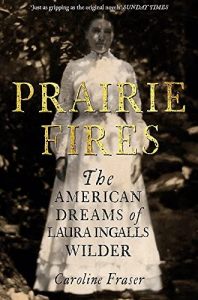 I just finished reading Prairie Fires, a biography of Laura Ingalls Wilder, which I recommend highly. The author of the eight Little House books, she wrote about her childhood during the push west by homesteaders and farmers. “I told the truth,” she said. “But not the whole truth.” The books are a “good parts” version of her life, but some important “truths” were omitted, because Wilder (and her daughter Rose Wilder Lane, who was her secret beta reader, line editor, and editorial advisor) took out things that didn’t underscore her narrative. The narrative? That her family (in particular her adored father, Charles Ingalls) survived and flourished through hard work, love, and self-reliance, and that self-reliance, a core virtue of westward expansion, is a uniquely American virtue.
 Back in 2016, I wrote a series of essays following the presidential election, entitled “In Troubled Times.” Some of these strike me as valid now, “In Tumultuous Times” as then. This one is on “Emotional Sobriety.”
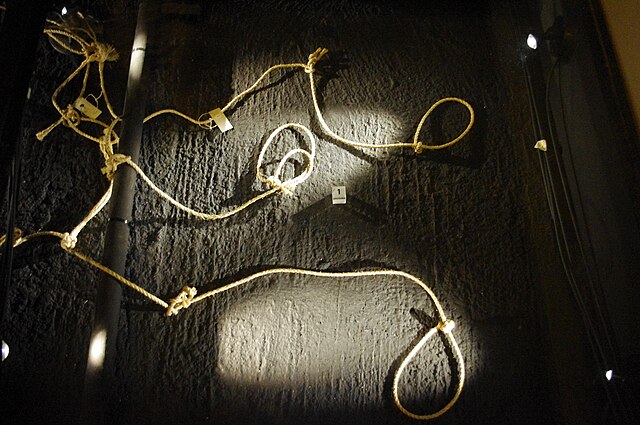 I don’t consider myself naïve about scams. I know to never give out any my bank or credit card numbers, Social Security number, or date of birth to anyone who phones me out of the blue. In fact, when I am in a cranky mood, I might lecture the caller about how what they’re doing is fraud. I read articles about romance, grandkid-in-jail, phony arrest warrants, and other scams. As 2021 drew to a close I realized that I had fallen into a scam I hadn’t heard of: befriending a person on social media and then inducing them to set up a GoFundMe for a medical emergency. Fortunately, I came to my senses before I sent any money from that campaign. Until then, it had never occurred to me that I had been manipulated over a year and a half. As embarrassing as the experience was for me, I’m going public in the interests of educating others.
 When I was